Rethinking Your Casino CMS: Architectural Choices for Modern iGaming Sites
Introduction
Operating a large-scale information portal in the gaming sector involves unique data complexities that standard publishing setups struggle to handle. While typical corporate blogs or news sites thrive on chronological articles and basic categorization, digital properties covering gaming reviews, software providers, and regulatory updates deal with heavy relational data. When teams try to force generic tools to manage intricate bonus structures, payment method matrices, and software specifications, they often run into technical debt and messy database states. Addressing this challenge requires a hard look at how backend software is structured. Moving toward a purpose-built casino CMS shifts the paradigm from manual page editing to intelligent, data-driven content modeling, allowing technical and editorial teams to scale operations cleanly.
What Is a Casino CMS?
A casino CMS is a specialized content management architecture engineered from the ground up to handle the relational, high-volume data demands of modern digital publishing in the gaming sector.
Unlike conventional platforms designed around flat text pages and linear blog posts, a dedicated casino content management system treats every core entity—such as a software provider, a payment gateway, or a compliance requirement—as a structured data object. Instead of copying and pasting the same bonus terms across dozens of independent articles, editors update a single record, and the system propagates that change across every connected review, comparison grid, and category listing dynamically.
How Does It Work?
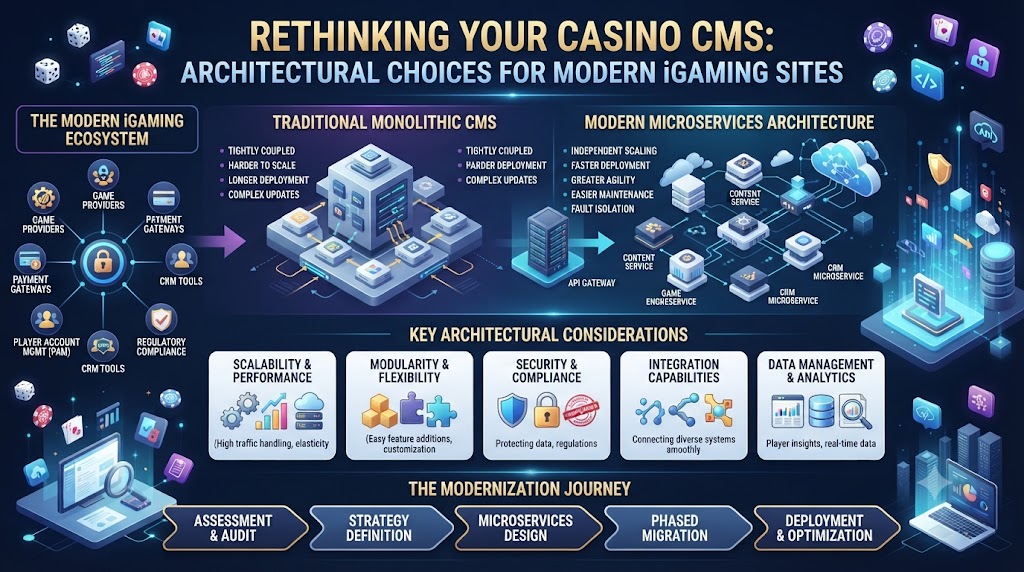
Building an efficient publishing environment requires decoupling the backend data layer from the frontend presentation. This modular approach changes how content moves from an editor’s desk to the live site.
Relational Taxonomies
Rather than relying on basic tags and folders, the system uses deep relational mapping. Game categories link directly to their respective software developers, while payment options connect to processing time metrics and geographic availability flags.
Modular Content Blocks
Content creators build pages out of reusable components—such as pros-and-cons elements, rating breakdowns, and regulatory warning boxes—ensuring visual and structural consistency across thousands of distinct landing pages.
Controlled Publishing Pipelines
Enterprise publishing demands structured workflows. Drafts move through multi-stage validations, requiring technical accuracy checks and compliance sign-offs before the system schedules them for deployment.
Why Does It Matter?
As digital properties expand to thousands of pages, manual content updates become an operational bottleneck. Without a structured software layer, updating a single widespread variable—like a shifting regulatory restriction or a processing fee—demands tedious manual edits across countless individual files.
Investing in a specialized publishing foundation protects brand accuracy, ensures uniform editorial output, and provides search engine crawlers with clean, logical site hierarchies. Furthermore, it frees technical teams from constant maintenance requests, empowering content managers to handle complex updates through intuitive administrative interfaces.
Key Features of a Modern Casino CMS
Evaluating platform options requires looking past standard text editors to focus on features that support heavy data management and large-scale publishing.
1. Advanced Custom Field Architectures
The system must allow administrators to define custom data schemas for ratings, bonus terms, wagering requirements, and restriction flags without altering core codebases.
2. Dynamic Comparison Grids
Building accurate comparison matrices manually is prone to human error. A robust platform automatically generates comparison tables by pulling real-time data from centralized review components.
3. Multi-Region Localization Workflows
Scaling internationally requires software that supports region-specific content toggles, localized currency fields, and jurisdiction-based compliance messaging.
4. Granular Metadata and Schema Controls
The platform should offer native support for custom URL paths, automated Open Graph tags, canonical rules, and clean XML sitemap generation tailored to deep category trees.
5. Role-Based Permission Hierarchies
Security and content governance depend on strict access controls, cleanly separating the capabilities of junior contributors, senior editors, compliance officers, and system administrators.
Main Components of the Technology Stack
A high-performance casino content portal rarely operates on a single piece of software. It functions as part of an integrated digital ecosystem connecting data storage, delivery networks, and analytics.
+-------------------------------------------------------+
|                 Casino Content CMS                    |
|       (Manages relational data and schemas)           |
+-------------------------------------------------------+
                           |
                           v
+-------------------------------------------------------+
|               API & Middleware Layer                  |
|     (Handles caching, CDN routing, and data feeds)    |
+-------------------------------------------------------+
                           |
                           v
+-------------------------------------------------------+
|               Frontend Delivery Layer                 |
|     (Renders responsive, high-speed UI for users)     |
+-------------------------------------------------------+
The CMS Engine
Manages editorial inputs, relational database logic, version control systems, and template rendering pipelines.
Content Delivery Network (CDN)
Caches static assets, globalized templates, and media files at edge locations worldwide to guarantee minimal latency for end users.
Analytics and Event Tracking
Connects visitor interaction data, click-through performance, and traffic metrics directly to backend dashboards for ongoing optimization.
Common Use Cases
Managing Large-Scale Review Portals
Publishers maintaining thousands of distinct operator and game profiles rely on relational database structures to keep specifications, ratings, and disclaimers uniform.
Multi-Jurisdiction Publishing Operations
Teams publishing across various regional markets use localized content modules to serve region-specific guides, currency symbols, and regulatory notices automatically.
Automated Resource and Directory Hubs
Websites aggregating software developers, payment options, or guide taxonomies use relational database structures to instantly populate directory and category pages.
Benefits of Specialized Software Architecture
Adopting a tailored publishing platform delivers clear operational improvements:
- Drastic Reduction in Manual Overhead: Centralized data storage eliminates the need for repetitive manual updates across hundreds of individual files.
- Guaranteed Data Consistency: Standardized fields prevent contradictory information from fragmenting across different sections of the portal.
- Accelerated Content Deployment: Modular layout components enable editorial teams to build and publish comprehensive guides in a fraction of the usual time.
- Optimized Search Engine Crawlability: Clean URL paths, automated schema injection, and robust metadata management support organic search visibility.
- Clear Separation of Concerns: Content teams work within intuitive publishing interfaces while developers maintain a secure, scalable backend architecture.
Limitations to Consider
While specialized software offers distinct advantages, organizations must carefully evaluate potential hurdles:
- Higher Initial Setup Investment: Configuring custom database schemas and data migration pipelines demands more upfront engineering effort than deploying a generic blog platform.
- Steeper Editorial Learning Curve: Content teams accustomed to standard text editors may require initial training to master structured data fields and modular components.
- Complex Migration Pathways: Moving thousands of unstructured legacy pages into a newly normalized database schema requires meticulous data mapping and scripting.
Software Comparison
| Software Type | Primary Purpose | Best Suited For | Key Consideration |
| Casino CMS | Content publishing & data structuring | Casino content websites, publishers, & review portals | Content flexibility & taxonomy design |
| Casino Management Software | Operational management & player tracking | Casino businesses & gaming operators | System integrations & backend security |
| iGaming Platform | Broader digital ecosystem & game hosting | Larger gaming operations & operators | Architecture, scalability, & licensing |
| Casino Website Software | General website development & presentation | Digital publishers & affiliate sites | UX, SEO, & long-term maintainability |
Practical Examples
Example 1: Streamlining Review Updates
A digital publishing team managing over five hundred game reviews notices that a specific software provider updates its return-to-player specifications. In a standard website setup, an editor must open five hundred separate pages to find and update the text. With a structured database architecture managed through a dedicated platform, the editor updates the single provider entry, instantly refreshing the metric across all five hundred pages.
Example 2: Managing Multi-Jurisdiction Disclaimers
An international gaming information portal must display different regulatory notices based on where the visitor is located. By implementing conditional content components within their publishing workflow, the editorial team ensures that appropriate regional compliance text renders automatically without requiring separate page builds for every market.
Decision-Making Framework: Generic vs. Specialized CMS
Deciding whether to build upon a generic publishing platform or invest in a specialized system depends on several operational factors:
- Content Volume and Complexity: If your site publishes simple articles, a generic tool suffices. If you manage complex relational data like game specs, payment guides, and ratings, specialized software is necessary.
- Technical Resources: Evaluate whether your team has the development capacity to maintain custom database schemas and specialized API integrations.
- Growth Projections: Consider where your publishing operation will be in three to five years. Selecting scalable architecture early prevents costly data migrations later.
Common Software Mistakes to Avoid
- Choosing Solely on Feature Count: Selecting a platform loaded with complex features your team will never use only introduces unnecessary bloat and slows down publishing workflows.
- Neglecting Content Migration Planning: Underestimating the effort required to clean, map, and import legacy content into a new database structure often leads to broken links and lost metadata.
- Ignoring API Documentation and Flexibility: Failing to review integration capabilities early can trap your technical team when trying to connect analytics, search tools, or external data feeds.
- Weak Access Control Configuration: Failing to establish proper role-based permissions risks unauthorized edits and compromises site security.
Cost Considerations
Budgeting for a publishing technology stack extends far beyond initial software licensing fees. Organizations must evaluate total cost of ownership by accounting for:
- Initial system architecture and custom schema development
- Content migration and data cleanup services
- Ongoing infrastructure hosting and CDN expenses
- Technical support and maintenance resources
- Staff training for editors and content managers
Practical Tips / Key Takeaways
- Define clear content requirements and data schemas before evaluating software vendors.
- Map all required third-party integrations, including analytics, search indexing, and caching layers.
- Review role-based access controls to safeguard editorial integrity and security.
- Plan content migration early to prevent broken links and metadata loss during platform transitions.
- Evaluate the long-term total cost of ownership, including hosting, maintenance, and future scalability.
Frequently Asked Questions
What is a casino CMS?
A casino CMS is a specialized content management system built to handle the complex, data-heavy publishing requirements of gaming and review websites. It uses structured databases and modular components to manage reviews, bonuses, and payment methods efficiently across large sites.
How does an iGaming CMS differ from a generic CMS?
Unlike generic platforms built for basic blogs, an iGaming CMS provides native data types and relational taxonomies. This allows publishers to manage structured attributes—such as provider specs and licensing details—as distinct variables rather than raw, unformatted text.
Why is structured content important for review websites?
Structured content ensures data consistency across hundreds of pages. When a core detail changes, updating a single database entry reflects the change everywhere, saving time and preventing contradictory information across the site.
Can a generic website platform handle gaming content?
A generic platform can handle basic text publishing, but it often struggles as content scales. Without custom fields and relational databases, maintaining complex review directories becomes a manual, error-prone burden for editorial teams.
What features should technical teams look for in publishing software?
Key features include advanced custom field management, dynamic comparison tables, robust multi-language localization, granular SEO field controls, and strict role-based access permissions.
How do database schemas impact content management?
Database schemas define how different pieces of information relate to one another. A well-designed schema allows publishers to group games, software providers, and payment options logically, improving both backend organization and frontend user experience.
What role do APIs play in a modern publishing stack?
APIs allow the content management system to communicate seamlessly with external tools, such as performance analytics, search indexing engines, caching layers, and external data feeds.
How does software architecture affect SEO performance?
Clean software architecture supports fast page load speeds, proper schema markup implementation, clean URL structures, and automated sitemap generation, all of which help search engines crawl and index content effectively.
What should organizations consider before migrating content?
Teams must carefully plan data mapping, clean legacy formatting, preserve existing URL structures with proper redirects, and verify that all metadata transfers accurately to the new system.
Where can publishers learn more about gaming technology options?
Resources such as CasinoBullseye provide in-depth guides, technology comparisons, and operational insights to help publishers and operators evaluate software solutions effectively.
Conclusion
Selecting the right publishing technology is a foundational decision that impacts everything from daily editorial workflows to long-term digital growth. By moving away from rigid, generic platforms and embracing structured systems tailored to complex information, digital teams can drastically reduce manual overhead and improve data consistency. Whether you are managing a growing review portal or scaling an international publishing operation, understanding your specific technical requirements ensures your technology stack supports your business objectives. Platforms like CasinoBullseye offer valuable resources and guidance for teams researching modern publishing solutions and digital infrastructure strategies.
Leave a Reply