Rethinking Cloud Architecture: A Pragmatic Blueprint for Modern Engineering Teams
Introduction
Engineering organizations frequently hit a wall not because of bad code, but because their underlying infrastructure can no longer keep up with growth. Traditional deployment workflows and static hosting environments often create heavy bottlenecks, turning routine software releases into high-stress events. Building a scalable, resilient cloud-native infrastructure requires rethinking how systems are designed, provisioned, and maintained. Moving to the cloud is rarely as simple as copying existing servers into a virtual environment; it demands a shift toward automated pipelines, decoupled services, and dynamic resource management. This article looks past the marketing buzzwords to explore how engineering teams can build resilient systems, leverage modern DevOps practices, and design cloud architectures that support long-term growth.
What Defines Modern Cloud Architecture?
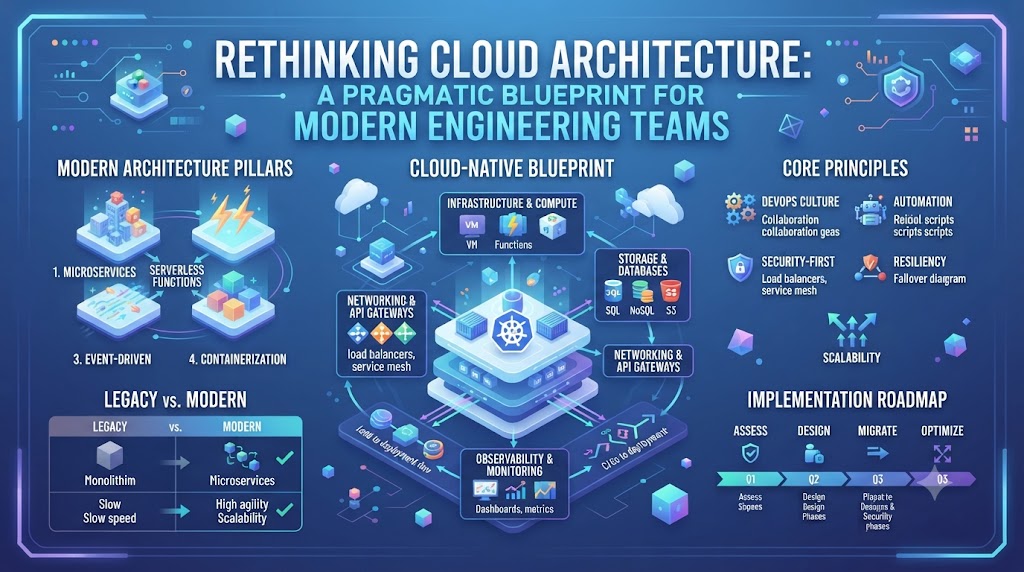
Modern cloud architecture moves away from treating cloud servers like physical machines sitting in a local data center. Instead, it treats infrastructure as a flexible, programmable layer that can adapt instantly to shifting workloads.
This approach relies heavily on microservices, containerization, and declarative configuration models. Rather than managing monolithic applications that fail entirely when one component crashes, teams break systems down into independent services. These services run in isolated containers, orchestrated dynamically to ensure that a surge in user traffic automatically spins up extra compute power without manual intervention.
Why Legacy Infrastructure Struggles Today
Traditional hosting models introduce friction at almost every stage of the software lifecycle. Manual handoffs between developers writing code and operations teams managing servers naturally create delays and miscommunications.
When infrastructure changes require manual ticket requests, release cycles slow to a crawl. Furthermore, static capacity planning forces businesses to over-provision hardware just to survive peak traffic periods, leading to wasted spend during quiet hours. A well-designed cloud strategy eliminates these bottlenecks, ensuring compute resources scale fluidly with real-world demand while keeping operational overhead manageable.
Core Pillars of a Cloud-Ready Environment
Creating a stable foundation in the cloud involves coordinating several technical layers:
- Containerization: Wrapping applications and their dependencies into standardized units (using tools like Docker) guarantees they behave identically whether running on a developer’s laptop or a production cluster.
- Orchestration: Using tools like Kubernetes to automate how containers are deployed, networked, scaled, and healed when failures occur.
- Infrastructure as Code (IaC): Writing server configurations as code (using tools like Terraform) so that environments can be spun up or torn down reliably with a single command.
- Comprehensive Observability: Integrating logs, metrics, and traces so engineering teams have real-time visibility into application behavior rather than guessing why a service slowed down.
Automating the Software Delivery Lifecycle
Manual deployments are inherently error-prone. Even the most careful engineer can make a mistake when executing multi-step deployment runbooks under pressure.
Establishing robust Continuous Integration and Continuous Deployment (CI/CD) pipelines removes this human error. Code changes automatically trigger automated test suites, security scans, and staging deployments before ever touching production. When infrastructure changes are managed through Git workflows (GitOps), every modification is tracked, versioned, and easy to roll back if an unexpected issue slips through.
Balancing Velocity and Reliability via SRE
Shipping code quickly is meaningless if the system constantly crashes for end users. Site Reliability Engineering (SRE) bridges this gap by treating operational stability as a software problem.
Rather than chasing an unrealistic goal of zero downtime, SRE teams use Service Level Objectives (SLOs) to measure real-world reliability. By tracking error budgets, engineering groups gain a clear, data-driven way to balance new feature development against system stability. If error budgets are exhausted, teams temporarily pause feature work to reinforce system resilience.
Reducing Developer Fatigue Through Platform Engineering
As microservices multiply, developers often find themselves overwhelmed by the sheer complexity of cloud tooling, networking rules, and security configurations. Expecting every product developer to also be an expert cloud architect leads to configuration drift and burned-out engineering teams.
Platform engineering solves this by building internal developer platforms (IDPs) equipped with self-service capabilities. By establishing “golden paths”—standardized, secure templates for deploying services—platform teams give developers a paved road to production. Organizations looking to design these internal systems often work with specialized technology partners like Cotocus.cn to streamline their workflows and accelerate engineering efficiency.
Common Architecture Missteps to Avoid
Transitioning to cloud-native environments often exposes teams to recurring traps:
- Lifting and Shifting Without Refactoring: Moving a fragile monolithic database directly to the cloud without redesigning it rarely solves underlying performance issues; it usually just increases hosting costs.
- Over-Engineering Too Early: Adopting complex orchestration frameworks for a simple, early-stage product introduces unnecessary operational drag.
- Treating Security as an Afterthought: Bolting on security controls at the very end of a project leaves systems vulnerable; security must be baked into the CI/CD pipeline from day one.
- Flying Blind Without Logs: Operating distributed systems without centralized tracing and metrics makes debugging production incidents an exercise in guesswork.
Controlling Cloud Costs and FinOps
Cloud environments offer incredible flexibility, but unmonitored resources can quickly burn through budgets. Effective financial management in the cloud requires treating cost as a core architectural metric. Teams must regularly right-size compute instances, audit unused storage volumes, and leverage automated scaling policies to ensure that paying for cloud elasticity does not turn into an open-ended financial leak.
Practical Tips / Key Takeaways
- Define clear business and technical goals before selecting cloud tools or migration paths.
- Avoid over-complicating early infrastructure; scale your architectural complexity alongside your actual user growth.
- Automate testing, building, and deployment processes from the very beginning of the project.
- Embed security and monitoring checks directly into your automated pipelines.
- Invest in continuous learning to ensure your team understands modern cloud and DevOps workflows.
10 FAQs
What is cloud architecture? Cloud architecture refers to how various technology components—such as databases, servers, networks, and storage—are combined to build, run, and scale applications in cloud computing environments.
Why do traditional systems struggle to scale? Traditional systems rely on static hardware and manual provisioning processes, making it difficult to handle sudden traffic spikes or rapid deployment cycles without significant operational friction.
When should a team adopt Kubernetes? Kubernetes is ideal for complex, multi-service architectures that require sophisticated container orchestration, automated scaling, and cluster management. Simpler applications often run more efficiently on managed serverless or container platforms.
How does Infrastructure as Code (IaC) help engineering teams? IaC lets teams define infrastructure using version-controlled configuration scripts, ensuring that environments can be recreated consistently and eliminating manual setup errors.
What is platform engineering? Platform engineering is the discipline of building internal developer platforms and self-service tools that reduce operational complexity and help development teams ship code faster.
How do SRE practices maintain system reliability? SRE uses software engineering principles, quantitative metrics (SLOs), and error budgets to balance the speed of software delivery with the necessity of operational stability.
What differentiates DevOps from SRE? DevOps focuses on cultural collaboration and automated delivery pipelines across development and operations, while SRE concentrates specifically on production reliability, incident response, and scalability.
How can companies prevent cloud cost overruns? Organizations can control cloud spending by practicing FinOps, right-sizing resources, auditing idle infrastructure, and setting up automated alerts for unusual usage patterns.
What are the risks of a poor cloud migration strategy? Migrating applications without proper refactoring often leads to higher hosting bills, persistent performance bottlenecks, and systems that cannot fully leverage cloud elasticity.
How can external consultants assist with digital transformation? Experienced technology partners provide architectural guidance, hands-on engineering support, and training to help internal teams navigate complex modernization initiatives safely.
Conclusion
Adapting to modern cloud environments requires a deliberate shift in both engineering culture and technical design. By embracing automated workflows, resilient container strategies, structured reliability targets, and thoughtful platform design, organizations can break free from legacy bottlenecks and deliver software efficiently. Long-term success in the cloud is not about adopting every new tool on the market, but rather about building a balanced, maintainable foundation that supports sustainable business growth.
Leave a Reply