NoOps Career Development: Essential Automation Skills, Training Paths, and Cloud Technology
Introduction
Modern IT environments need regular updates and careful management. Teams often spend hours checking systems and fixing routine tasks. Manual processes can also slow application delivery. Automation gives technical teams another way to manage this work. NoOps certification introduces learners to modern operational automation. A structured NoOps training course can also help build useful technical knowledge.
NoOpsSchool is a specialized IT education, certification, and consulting platform. It focuses on NoOps, cloud infrastructure automation, and modern software delivery. The platform serves an international English-speaking technical audience. Its advertised learning and professional services cover engineers, architects, managers, and other IT professionals.
What Is NoOps?
The keyword what is NoOps refers to an approach that reduces routine operations work. It uses automation and cloud services to manage suitable technical activities. This allows teams to spend less time on repeated manual tasks.
NoOps does not mean removing operations teams or human responsibility. People still create system designs and review automated changes. They also manage security, monitor performance, and investigate serious problems.
For example, a cloud platform can create resources through approved code. A delivery pipeline can run software tests automatically. Monitoring systems can send alerts when services behave unusually.
What is NoOps also involves planning and control. Automated actions need clear rules and regular checks. Human decisions remain necessary for complex situations.
Main ideas behind NoOps
- Automate suitable repeated activities.
- Use cloud services for infrastructure management.
- Maintain clear security controls.
- Monitor applications and infrastructure.
- Review automated changes before important deployment steps.
- Keep skilled people responsible for system health.
A good understanding of what is NoOps helps professionals choose suitable learning areas. It also helps organizations plan realistic automation projects.
Why This Matters for IT Teams and Careers
IT teams work with many connected services. They manage application releases, cloud resources, and system performance. Manual processes can make these duties more difficult.
Automation helps teams create repeatable workflows. It can also support better coordination between development and operations. However, every automated process needs testing and maintenance.
How IT teams can benefit
Consistent processes: Automated workflows follow planned instructions. This can reduce differences between environments.
Release management: CI/CD pipelines help organize software testing and delivery. Teams can review changes before release.
System visibility: Monitoring tools provide information about application health. Alerts help people notice unusual activity.
Infrastructure management: Code-based configurations support repeatable resource creation. Teams can review changes before applying them.
Operational planning: Automation can reduce some repeated duties. Teams can focus more attention on system improvements.
Skills for career development
NoOps creates learning opportunities across several technical roles. Engineers can develop infrastructure automation skills. Architects can study cloud system design. Managers can learn about operational planning.
A NoOps certification may help learners follow a structured syllabus. A practical NoOps training course can introduce tools and workflows. Neither replaces experience with real technical systems.
NoOps vs DevOps: How Both Approaches Work
The exact keyword NoOps vs DevOps describes two connected approaches to software operations. Both support collaboration and reliable software delivery. Their main difference is the level of operational automation.
DevOps encourages developers and operations professionals to work together. Teams share responsibility for building, testing, and releasing applications. Automation supports these activities.
NoOps focuses on reducing routine operational tasks. Cloud services and automated workflows handle suitable activities. Developers can use approved platforms for common infrastructure needs.
| Area | DevOps | NoOps |
|---|---|---|
| Purpose | Improve development and operations collaboration | Reduce routine manual operations |
| Work approach | Shared technical processes | Greater use of automation |
| Infrastructure | Managed through team workflows | Provisioned through automated methods |
| Software delivery | Automated build and testing | Automated delivery and operational tasks |
| Human role | Shared responsibility | Design, review, and oversight remain |
NoOps vs DevOps does not mean one approach must replace the other. DevOps practices remain useful for modern software teams. Testing, collaboration, and feedback still support reliable systems.
Organizations can combine both approaches. They should select automation based on their technical needs. People must remain responsible for security and complex decisions.
NoOps Automation Tools
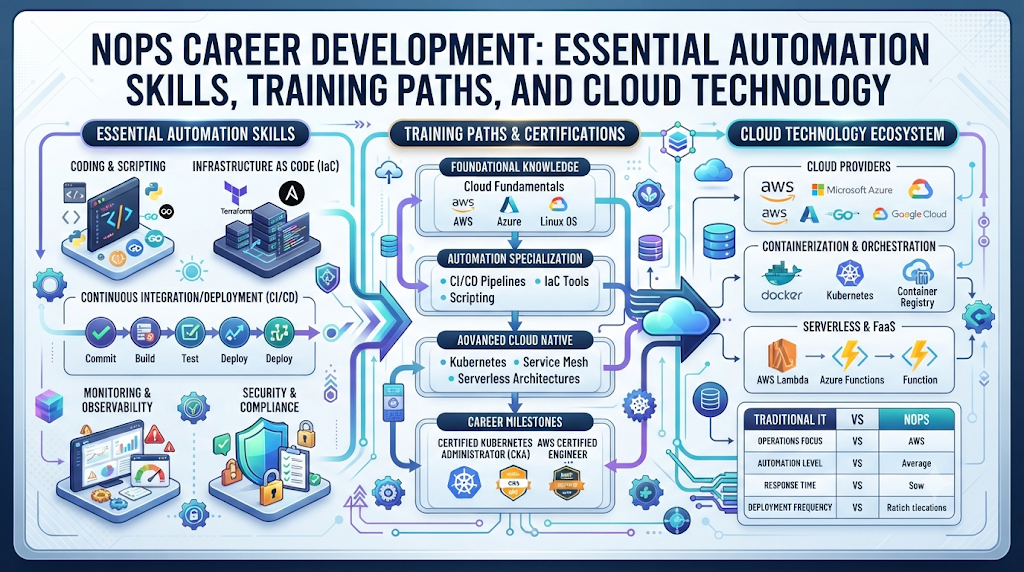
NoOps automation tools support different parts of cloud operations. They help teams manage infrastructure, applications, and delivery processes. Understanding each category helps professionals select suitable learning topics.
1. Infrastructure as code
Infrastructure as code means describing infrastructure through configuration files. Teams can use these files to manage cloud resources. Terraform is one example of an infrastructure automation tool.
This approach supports repeatable configurations. Engineers can also review changes through version control.
2. Container technology
Containers package applications with the components they need. Docker is an example of container technology. It helps teams run applications in consistent environments.
Containers can support development and deployment workflows. They still require proper security and resource management.
3. Container orchestration
Container orchestration manages containers across computing environments. Kubernetes is a widely used example. It helps manage application workloads and related resources.
Teams must understand configuration and monitoring. Incorrect settings can affect application availability.
4. CI/CD platforms
CI/CD means Continuous Integration and Continuous Delivery. These processes connect code changes with automated testing and release activities.
A pipeline can run checks after developers submit code. It can also prepare approved changes for deployment.
5. GitOps systems
GitOps uses Git repositories as a source for approved configurations. Automated systems can apply those configurations to environments.
This method supports change tracking. Teams can review configuration history when investigating problems.
6. Observability platforms
Observability means understanding system behavior through available data. It uses logs, metrics, and traces.
These details help engineers investigate application performance. Monitoring alerts can also identify possible service problems.
7. AIOps systems
AIOps means Artificial Intelligence for IT Operations. It uses AI and operational data to support analysis.
It may help identify unusual patterns or group related alerts. People must still review important findings.
These categories make up many NoOps automation tools. The right selection depends on system requirements and team knowledge. Automation should always include security and human review.
NoOps Certification: Important Points Before Enrolling
A NoOps certification is a structured learning option for people interested in automation. It may introduce important concepts and technical practices. The learning content should match the learner’s goals.
Before choosing a program, examine its syllabus. Check the topics and practical activities. Also review the provider’s current information.
How to evaluate a certification
- Relevant syllabus: Check whether the topics match your role.
- Practical exercises: Look for activities beyond theory.
- Technical coverage: Review the included cloud and automation subjects.
- Learning support: Understand what guidance is available.
- Assessment information: Check the stated evaluation process.
A useful NoOps certification should improve technical understanding. It should not be viewed as proof of every practical skill. Personal projects and real work experience remain valuable.
NoOpsSchool.com advertises certification tracks for different NoOps roles. These include Engineers, Architects, Managers, and Professionals. Learners should check the current details before selecting a track.
NoOps Engineer Certification
A NoOps engineer certification relates to building and managing automated cloud environments. Engineers work with infrastructure, application delivery, and monitoring systems. Their responsibilities depend on the organization.
Technical knowledge for engineers
Cloud infrastructure: Understand computing, storage, and networking resources. Learn how applications use cloud services.
Terraform: Study how configuration files define infrastructure. Practise reviewing and managing resource changes.
CI/CD: Understand automated testing and deployment. Learn how pipelines support software delivery.
Docker: Study how applications run inside containers. Understand images and container environments.
Kubernetes: Learn how container workloads are managed. Study basic cluster operations.
Observability: Understand logs, metrics, and traces. Use this information to investigate system behavior.
A NoOps engineer certification can organize these topics into a learning path. Learners should also build and test small projects.
Engineers need troubleshooting skills as well. Automation may handle known failures, but unusual problems need human investigation.
NoOps Architect Training
NoOps architect training focuses on planning automated infrastructure and cloud environments. Architects decide how different systems connect. They also consider long-term technical requirements.
Important architect responsibilities
- Plan cloud infrastructure and application environments.
- Select suitable automation methods.
- Design reusable infrastructure configurations.
- Consider security and access controls.
- Plan monitoring and recovery processes.
- Review system performance and resource requirements.
Architects must understand how technical decisions affect teams. They should create designs that people can maintain. They must also plan for failures and unexpected changes.
NoOps architect training should include system design exercises. These activities help learners understand infrastructure relationships. NoOpsSchool.com advertises learning and certification tracks for NoOps Architects.
NoOps Manager Certification
A NoOps manager certification focuses on managing automation-related work. Managers coordinate people, technical processes, and project priorities. They also review operational risks.
Management areas to understand
Workforce planning: Identify the skills needed for automation projects.
Process review: Find repeated tasks that may suit automation.
Risk planning: Maintain controls for sensitive operations.
Resource management: Review infrastructure requirements and cloud usage.
Team coordination: Make sure technical responsibilities are clear.
Performance review: Study delivery quality and system reliability.
A NoOps manager certification may introduce these management areas. Managers should also understand the technology used by their teams.
Automation needs clear ownership. Important security decisions should not happen without proper review. Teams need skilled people to investigate serious incidents.
NoOps Training Course
A NoOps training course should teach automation through clear lessons. It should connect technical concepts with practical activities. Learners should understand why each technology is used.
Topics to look for
- Cloud-native computing: Learn how applications use modern cloud services.
- Infrastructure as code: Study automated resource management.
- Docker: Understand container-based application environments.
- Kubernetes: Learn container orchestration concepts.
- Terraform: Practise infrastructure configuration.
- GitOps: Understand configuration management through Git.
- CI/CD automation: Study automated software delivery.
- Serverless architecture: Learn about cloud services that manage server infrastructure.
- Observability: Understand system logs, metrics, and traces.
- AI-powered operations: Explore how AI supports operational analysis.
A practical NoOps training course should also include hands-on labs. Learners can practise configuration, deployment, and monitoring tasks. Realistic scenarios help explain common technical challenges.
NoOpsSchool.com advertises online programs covering these technology areas. Its advertised learning topics also include self-healing infrastructure and automated incident response. Details vary by program.
NoOps Consulting Services
NoOps consulting services generally help organizations review their operations. The work may begin with an assessment of current infrastructure. Consultants can then discuss possible automation areas.
Common consulting activities
Operational assessment: Review existing processes and infrastructure. Identify repeated manual activities.
Automation strategy: Plan suitable automation work. Consider team skills and business requirements.
Cloud-native modernization: Review existing applications and cloud environments. Plan suitable modernization activities.
Infrastructure provisioning: Examine how cloud resources are created. Consider code-based management.
CI/CD implementation: Review build, testing, and delivery workflows. Plan suitable pipeline changes.
AIOps integration: Explore AI-based operational analysis. Review available data and requirements.
Security automation: Consider automated security checks. Maintain suitable access and review controls.
NoOpsSchool.com advertises NoOps consulting services covering these areas. The site also advertises professional support for cloud automation and modernization.
Organizations should agree on project scope before starting. They should also define responsibilities and security requirements. Results depend on the organization’s systems and needs.
How to Hire NoOps Freelancers
Businesses sometimes need technical help for specific automation projects. They may choose to hire NoOps freelancers for focused work. The right person should match the project requirements.
Steps for selecting a freelancer
1. Identify the project: Write down the tasks that need support. Explain the existing technical environment.
2. Check technical skills: Review knowledge of Terraform, Kubernetes, and cloud platforms. Match skills with project needs.
3. Review previous work: Ask for relevant project examples. Understand the person’s role in those projects.
4. Discuss the scope: Agree on tasks and expected deliverables. Avoid unclear responsibilities.
5. Check communication: Discuss updates and reporting methods. Agree on project communication.
6. Review security knowledge: Explain access permissions and data protection requirements.
7. Plan documentation: Include clear technical records in the project scope.
When organizations hire NoOps freelancers, they should also discuss testing. Automated systems need proper checks before use. Access should follow approved security rules.
NoOpsSchool.com says its platform offers access to freelancers. Advertised skills include Terraform, Kubernetes, cloud platforms, automated monitoring, and self-healing systems. Organizations should check current availability and suitability.
Table: NoOps Learning and Service Options at a Glance
| Option | What It Covers | Who It Helps |
|---|---|---|
| NoOps certification | Automation concepts and structured learning | IT professionals |
| Engineer certification | Infrastructure and delivery automation | Cloud and DevOps engineers |
| Architect training | Automated cloud system design | Cloud architects |
| Manager certification | Team planning and operational processes | IT managers |
| Training course | Technical lessons and hands-on labs | New and experienced learners |
| Consulting services | Assessment and automation planning | Organizations |
| Freelancer access | Advertised technical skills | Businesses and project teams |
Each option has a different purpose. Learners should check their current skills first. Organizations should define project needs before selecting services.
Common Mistakes Learners and Teams Make
- Thinking NoOps removes people: Skilled professionals remain responsible for important operations.
- Choosing tools without a plan: Tool selection should follow technical requirements.
- Ignoring cloud security: Automation must include suitable security controls.
- Skipping practical work: Technical knowledge needs hands-on practice.
- Using unclear configurations: Poor settings can affect infrastructure.
- Ignoring monitoring: Teams need information about system health.
- Forgetting documentation: Clear records support maintenance and troubleshooting.
- Automating sensitive decisions: Important actions may need human approval.
- Ignoring employee training: Teams need skills to manage automated systems.
- Expecting automation to solve everything: Complex incidents still require expert attention.
A suitable NoOps training course can help explain these challenges. A NoOps certification can provide a structured way to study. Both should support practical knowledge rather than replace it.
A Simple Example
Fictional Example: A Retail Technology Team Organizing Cloud Resources
Imagine a fictional retail technology team. It manages an online application and several cloud environments. Different team members create resources using separate manual instructions.
The team decides to make its process more consistent. It begins by documenting the existing infrastructure. Engineers then create reusable Terraform configurations.
Next, the team introduces version control for infrastructure changes. Each proposed update goes through review. Approved changes can then follow a planned process.
The team also creates a deployment pipeline. Automated tests check application changes before release. Team members review important updates.
Later, the team adds monitoring for its application. Alerts help engineers notice unusual system behavior. A planned recovery action handles certain known service problems.
The team keeps people involved throughout the process. Engineers review alerts and investigate unusual failures. Managers check access controls and project responsibilities.
The team also reviews NoOpsSchool.com. It explores the site’s advertised learning programs and certification tracks. It checks the advertised consulting and freelancer services for possible requirements.
This fictional situation shows how automation can develop step by step. It does not remove human responsibility or technical oversight.
How NoOpsSchool Can Help
NoOpsSchool. is a specialized IT education, certification, and consulting platform. It focuses on NoOps, cloud infrastructure automation, and modern software delivery. It serves an international English-speaking technical audience through online training and professional services.
Learning programs
The site advertises learning programs for NoOps Engineers, Architects, Managers, and Professionals. These learning areas focus on modern infrastructure and automation practices.
Certification tracks
NoOpsSchool.com advertises certification tracks for different NoOps roles. Learners should review each available syllabus before choosing a program.
Technical learning areas
Advertised topics include infrastructure as code, cloud-native computing, Kubernetes, and Docker. Other areas include Terraform, GitOps, CI/CD, serverless architecture, and observability.
Practical learning
The site advertises hands-on labs and real-world automation scenarios. Its advertised subjects also include self-healing infrastructure and automated incident response.
Consulting
The platform advertises operational assessments and automation strategy. Other listed areas include cloud modernization, infrastructure provisioning, CI/CD, AIOps, and security automation.
Freelancer access
The platform offers access to freelancers with advertised skills. These include Terraform, Kubernetes, cloud platforms, automated monitoring, and self-healing systems.
Readers should check current details before selecting a program or service. Availability and suitability may vary.
Frequently Asked Questions About NoOps Skills and Professional Development
1. What does the term NoOps mean in modern IT?
The phrase what is NoOps describes reducing routine operational work through automation. It uses cloud services and automated workflows for suitable tasks. It does not remove people from IT operations. Professionals remain responsible for security, system health, and important technical decisions.
2. How can I select a suitable NoOps certification?
A NoOps certification should match your current knowledge and career goals. Review its syllabus and practical activities. Check the technologies covered and available learning support. Also read the provider’s current program information before making a decision.
3. Can organizations use NoOps and DevOps together?
The topic NoOps vs DevOps explains how both approaches support modern software delivery. DevOps encourages teamwork and shared responsibility. NoOps focuses on reducing manual operational tasks. Organizations can use DevOps practices while adding suitable automation to their systems.
4. What does a NoOps engineer certification help learners understand?
A NoOps engineer certification may introduce cloud infrastructure management and automation. It can cover configuration, deployment, containers, and monitoring. Learners should also practise troubleshooting. Practical projects help them understand how automated systems behave.
5. What should architects study during NoOps architect training?
NoOps architect training should cover automated cloud design and infrastructure planning. Architects need to understand system connections and technical requirements. Security, reliability, and resource planning also matter. Design exercises can help learners practise these responsibilities.
6. Is NoOps manager certification suitable for technical leaders?
A NoOps manager certification may suit managers who guide automation projects. It can introduce planning, team coordination, process review, and risk management. Technical leaders should also understand their team’s tools. Human accountability must remain clear throughout each project.
7. How do hands-on labs help in a NoOps training course?
A NoOps training course with hands-on labs gives learners practical experience. They can practise infrastructure configuration and software delivery. Labs also help explain monitoring and troubleshooting. Learners should check the exercises and learning support before joining.
8. How should companies select NoOps automation tools?
NoOps automation tools should match the organization’s technical environment. Teams should review compatibility, security, maintenance needs, and available skills. Start with a clear operational requirement. Test the selected tools before using them in important systems.
9. Which activities may be included in NoOps consulting services?
NoOps consulting services may include operational assessments and automation planning. They can also cover infrastructure provisioning, cloud modernization, CI/CD, AIOps, and security automation. NoOpsSchool.com advertises these service areas. Organizations should confirm the current scope and suitability.
10. What should businesses consider before they hire NoOps freelancers?
When businesses hire NoOps freelancers, they should review technical skills and relevant work. They should also agree on scope, communication, security, and documentation. NoOpsSchool.com advertises access to freelancers with several automation-related skills. Availability should be confirmed before engagement.
Final Thoughts
NoOps offers a practical approach to reducing repeated IT operations work. It uses automation to manage suitable infrastructure and delivery activities. Cloud services, infrastructure as code, and monitoring support this approach.
However, automation still needs skilled people. Teams must review system changes and manage security. They also need to investigate complex incidents and improve automated workflows.
A NoOps certification or practical training program can support professional learning. Engineers, architects, and managers should select topics that match their responsibilities. NoOpsSchool.com advertises education, certification, consulting, and freelancer access for this technical area. Readers should check current details and build their skills through regular practice.
Leave a Reply