How SRE Training Helps Build Better Skills for Reliable Systems
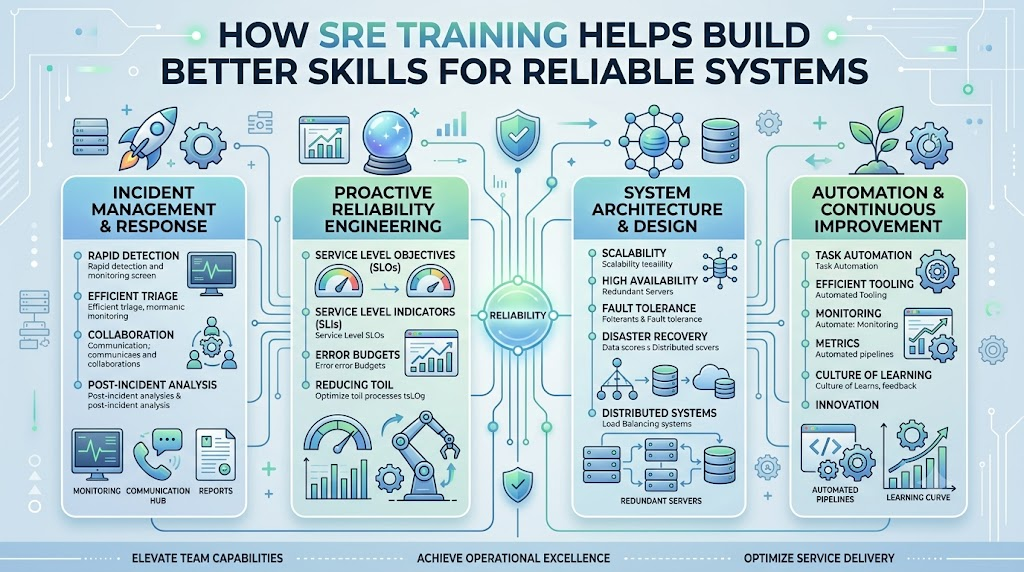
Introduction
Modern apps need to work well every day. Users expect fast and steady services. Even small problems can affect many users.
This is where Site Reliability Engineering, or SRE, helps. SRE teams work to keep systems safe, fast, and reliable.
An SRE Engineer uses code, cloud tools, and smart processes. The goal is simple. Keep services working and fix problems quickly.
SRESchool.in helps learners understand these skills in a simple way. Its learning focus covers cloud systems, automation, monitoring, and incident work.
SRE Training can help beginners learn the basics. An SRE Course can also help working professionals build stronger skills.
The key is not just learning tools. You must understand why those tools matter. You must also learn how to use them in real work.
What Does SRE Mean?
SRE means Site Reliability Engineering. It brings software and system work together.
An SRE team helps keep online services reliable. It also looks for ways to reduce manual work.
For example, imagine an online store. Users visit the store to buy products. The service must stay available during busy times.
If the service slows down, users may leave. An SRE team watches the system and finds the cause.
SRE also uses clear goals. These goals help teams decide what level of service they need.
SLI, SLO, and SLA
These three terms often appear in SRE work.
An SLI is a measure of service performance. For example, it can measure response time.
An SLO is a reliability goal. It says how well a service should work.
An SLA is an agreement about service quality. It may include rules for service availability.
An error budget shows how much failure a service can accept. Teams use it to balance speed and reliability.
| Term | Simple meaning |
|---|---|
| SLI | A way to measure service performance |
| SLO | A clear reliability goal |
| SLA | An agreement about service quality |
| Error budget | The allowed amount of service failure |
These ideas help teams make better choices. They also give teams clear ways to measure progress.
Why SRE Skills Matter for IT Teams
Reliable systems do not happen by chance. Teams need good tools, clear plans, and regular checks.
SRE Best Practices help teams find problems early. They also help reduce repeated manual work.
For example, a team may check server health every day. This can take a lot of time. Automation can do many of these checks instead.
SRE also helps teams learn from failures. A service problem can show where a system needs change.
Monitoring and Observability
Monitoring means watching a system for problems. It can show errors, slow requests, or high server use.
Observability goes one step further. It helps teams understand what happens inside a system.
Logs record useful events. Metrics show numbers about system health. Traces show how requests move through a system.
Together, these signals help an SRE team find problems faster.
For example, a website may become slow. Metrics may show high server use. Logs may then show the cause.
This gives the team a clear path toward a fix.
Incident Management
An incident is a problem that affects a service. It may cause downtime, errors, or slow service.
SRE teams need a clear response plan. They must find the issue, reduce its impact, and restore service.
After the incident, teams should review what happened. They can then fix the root cause.
A good review should focus on learning. It should not focus on blaming people.
Key Skills Every SRE Engineer Should Build
An SRE Engineer needs many skills. These skills cover software, systems, cloud, and teamwork.
First, learn basic programming. Python, Go, and other languages can help with automation.
Next, learn Linux and networking. These skills help when systems fail.
Cloud knowledge also matters. Many modern systems run on cloud platforms.
Kubernetes is another useful skill. It helps teams run and manage containers.
Automation Skills
SRE teams try to reduce repeated manual work. Automation can make common tasks faster and safer.
For example, a script can check service health. Another script can restart a failed process.
Infrastructure tools can also help teams manage systems with code.
| Skill | Why it helps |
|---|---|
| Linux | Helps manage servers and systems |
| Python | Helps create useful automation |
| Cloud | Helps manage modern infrastructure |
| Kubernetes | Helps run container systems |
| Monitoring | Helps find system problems |
| Automation | Reduces repeated manual work |
A good SRE Course should cover these areas step by step. Learners should first understand the basics.
Then they can move toward harder production tasks.
SRE Tools Used in Real Work
SRE Tools help teams watch, manage, and improve systems.
Monitoring tools help track system health. Alert tools tell teams when something needs attention.
Log tools help teams search system events. Tracing tools help track requests across services.
Cloud tools help manage infrastructure. Deployment tools help teams release new software.
Learning Tools the Right Way
Do not try to learn every tool at once. Start with the problem first.
Ask what the tool should help you do. Then learn the features that solve that problem.
For example, learn monitoring before learning advanced alert rules. Understand logs before building complex log searches.
A SRE Tutorial can help learners follow this step-by-step path.
Practical work also matters. Try small tasks in a safe learning setup.
Create a simple service. Add monitoring. Set an alert. Then test what happens when the service fails.
This gives you useful practice without needing a large system.
SRE Training and Career Skill Building
SRE Training can help learners build a clear learning path. It can start with basic system ideas.
Site Reliability Engineering Training may cover reliability goals, monitoring, automation, and incident response.
An SRE Certification can also help learners study key SRE topics. However, certification alone does not replace practical skills.
Hands-on work is still important. Learners should practice tools and solve simple system problems.
SRE Training in India
SRE Training in India can support students, developers, system teams, and IT workers.
The learning path can start with Linux and networking. It can then move to cloud, DevOps, monitoring, and automation.
SRESchool.in focuses on these core areas. Learners can use its resources to build their SRE knowledge.
The best learning path depends on your current skills. A beginner should start with basic system concepts.
Someone with DevOps experience may move faster into reliability work.
How to Build Strong SRE Best Practices
Good SRE work needs more than tools. Teams also need simple and repeatable habits.
Set clear reliability goals. Track useful system data. Create alerts that need action.
Avoid alerts that fire too often. Too many alerts can make real problems harder to see.
Automate repeated tasks when possible. Keep runbooks simple and easy to follow.
A runbook is a written set of steps for handling a problem. It can help teams respond faster during incidents.
Learn From Every Failure
Failures can teach teams useful lessons. After an incident, review the cause and impact.
Ask what went wrong. Ask what helped. Then ask what should change.
The team can use these answers to improve the system.
This approach helps prevent the same problem from happening again.
Frequently Asked Questions About SRESchool
1. What is SRE?
SRE means Site Reliability Engineering. It helps teams keep software systems reliable. SRE uses coding, automation, monitoring, and system skills. It also helps teams handle incidents and reduce repeated manual work.
2. What is SRE Training?
SRE Training teaches the main ideas and skills used in reliability work. It may cover monitoring, automation, cloud systems, incident response, and reliability goals. Good training should also include practical learning.
3. What is an SRE Course?
An SRE Course gives learners a planned path for studying SRE. It can begin with basic system skills. Later lessons can cover cloud, monitoring, automation, Kubernetes, and incident management.
4. Is SRE Certification useful?
SRE Certification can help show knowledge of SRE concepts. It can also give learners a clear study plan. However, practical skills remain important. Real system practice helps learners understand how SRE works.
5. What does an SRE Engineer do?
An SRE Engineer helps keep software systems reliable. They may monitor systems, fix problems, automate tasks, and improve infrastructure. They also help teams learn from incidents and reduce repeated failures.
6. What are SRE Tools?
SRE Tools help teams manage system reliability. These tools can support monitoring, logs, alerts, tracing, cloud work, and automation. Teams should choose tools based on their actual needs.
7. What is an SLO?
An SLO is a reliability goal for a service. It gives teams a clear target. For example, a team may set a goal for service availability or response time.
8. What is an error budget?
An error budget shows how much failure a service can accept. It helps teams balance new work with reliability work. When failures rise, teams may focus more on system stability.
9. Can beginners learn SRE?
Yes, beginners can learn SRE step by step. Start with Linux, networking, coding, and basic cloud ideas. Then learn monitoring, automation, and incident response. Practice is important at every stage.
10. What can learners find at SRESchool.in?
SRESchool.in focuses on SRE and reliability learning. Its topics include cloud systems, automation, monitoring, DevOps, Kubernetes, and incident management. Learners can use these resources to build practical SRE knowledge.
Final Thoughts
SRE helps teams build systems that users can trust. It combines software skills with system and cloud knowledge.
The main goal is not to learn every tool. The goal is to understand reliability and solve real problems.
Start with simple concepts. Learn monitoring, automation, and incident work next. Then build deeper cloud and system skills.
SRE Training and an SRE Course can give learners a clear learning path. SRESchool.in can also support this learning with focused SRE resources.
Leave a Reply