FinOps Foundation Certification: Eligibility and Prerequisites
Introduction
Cloud has changed the way companies build software. Teams can launch infrastructure in minutes, scale applications automatically, and use services across AWS, Azure, and GCP.But there is another side to this flexibility: cloud spending can become difficult to understand and control.FinOps addresses this challenge by bringing engineering, operations, finance, and business teams into the same conversation. Instead of looking at the cloud bill only at the end of the month, teams learn to connect cloud usage with business value.The FinOps Foundation Certification is designed for professionals who want to build a foundation in cloud financial management and understand how technology decisions influence cloud costs. DevOpsSchool positions the program around cloud financial management, cost optimization, and FinOps practices.
FinOps Foundation Certification: Quick Overview
| Category | Details |
|---|---|
| Certification | FinOps Foundation Certification |
| Track | FinOps / Cloud Financial Management |
| Level | Foundation |
| Who it’s for | Software Engineers, DevOps Engineers, Cloud Engineers, SREs, Architects, Managers |
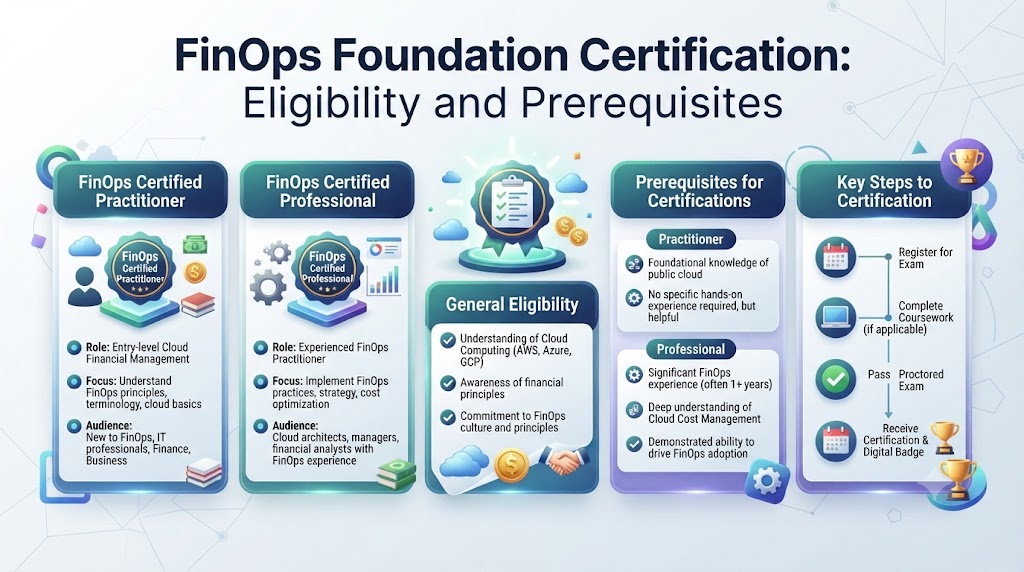
| Prerequisites | Basic cloud and IT knowledge |
| Skills covered | Cloud cost visibility, allocation, optimization, forecasting, budgeting, governance |
| Recommended order | Cloud Basics → FinOps Fundamentals → Certification → Advanced FinOps |
| Provider | DevOpsSchool |
What Is FinOps?
FinOps can be understood as a bridge between technology usage and financial responsibility.When an engineering team increases compute capacity, stores more data, or runs additional environments, there is a financial consequence. FinOps helps teams understand that consequence and make informed decisions.The goal is not to make every cloud service as cheap as possible.The goal is to achieve the right balance between cost, performance, reliability, scalability, and business requirements.
Why FinOps Is Becoming Important
One of the biggest changes in cloud computing is that infrastructure is no longer purchased once and forgotten.Cloud resources are consumed continuously.A development team may create a temporary environment. A product may suddenly receive more traffic. A data pipeline may process a larger dataset. A Kubernetes cluster may scale during peak hours.Each event can change the monthly bill.Without proper visibility, organizations may discover cost problems only after receiving a large invoice.FinOps encourages teams to make cost awareness part of everyday engineering decisions.
FinOps Foundation Certification
What It Is
The FinOps Foundation Certification provides foundational knowledge of cloud financial management and FinOps practices.It introduces the relationship between cloud consumption, financial accountability, optimization, and business outcomes.
Who Should Take It
This certification can be useful for:
- Software Engineers
- Cloud Engineers
- DevOps Engineers
- Platform Engineers
- SRE professionals
- Cloud Architects
- Engineering Managers
- IT Managers
- Technology Consultants
- Professionals moving toward FinOps roles
You do not have to work in finance to benefit from FinOps.
In fact, engineers who make infrastructure and architecture decisions can gain significant value from understanding the financial side of those decisions.
Skills You’ll Gain
The certification can help you develop knowledge in:
- Cloud spending visibility
- Cost allocation
- Resource ownership
- Budget planning
- Cost forecasting
- Cloud utilization analysis
- Cost optimization
- Financial accountability
- Cloud governance
- Cost reporting
- Business-value analysis
- Collaboration between technical and financial teams
Real-World Projects You Should Be Able to Do After It
FinOps becomes useful when you can turn concepts into practical work.After completing the learning, you should be able to contribute to projects such as:
- Creating a cloud spending dashboard
- Analyzing service-level cloud costs
- Finding idle or unused resources
- Reviewing over-provisioned infrastructure
- Building a tagging and cost-allocation approach
- Creating team-wise cloud cost reports
- Comparing budget with actual spending
- Investigating unexpected cost increases
- Preparing optimization recommendations
- Creating cloud cost forecasts
- Setting up spending alerts
- Measuring infrastructure cost against business activity
A good FinOps practitioner should be able to answer more than “How much did we spend?”The better questions are:Why did we spend it? Who owns it? What changed? And what value did the spending create?
Prerequisites
FinOps is accessible to professionals from different technical backgrounds.A basic understanding of cloud computing is recommended. You should be familiar with concepts such as:
- Compute
- Storage
- Networking
- Databases
- Containers
- Cloud environments
- Infrastructure resources
Experience with DevOps or cloud operations can make the subject easier because many FinOps decisions are connected to infrastructure, deployment, automation, and scaling.You should also understand simple financial terms such as budget, forecast, actual spending, variance, and allocation.Advanced accounting knowledge is not the main requirement.
Recommended Learning Order
Instead of jumping directly into cost optimization, follow a logical sequence.
Step 1: Understand Cloud
Learn how cloud services are consumed and how infrastructure is provisioned.
Step 2: Understand Cloud Pricing
Study the major sources of cloud spending, including compute, storage, networking, and databases.
Step 3: Learn FinOps Principles
Understand visibility, accountability, allocation, forecasting, and optimization.
Step 4: Study Cost Behavior
Learn why cloud costs change as workloads, traffic, users, and data volumes change.
Step 5: Practice Analysis
Work through examples of unexpected bills, unused resources, and inefficient infrastructure.
Step 6: Prepare for Certification
Revise the major concepts and focus on understanding scenarios rather than memorizing words.
Step 7: Apply the Knowledge
Build a small cost analysis or optimization project.
Preparation Plan
7–14 Day Plan
For experienced cloud professionals, a two-week preparation schedule can work well.
Days 1–3: Cloud pricing and cost fundamentals
Days 4–6: FinOps principles and accountability
Days 7–9: Allocation, budgeting, and forecasting
Days 10–11: Optimization and governance
Days 12–14: Revision and practical scenarios
Spend at least some time applying each topic to a real or sample cloud environment.
30-Day Plan
A 30-day plan is better if you want a balance between theory and practice.
Week 1
Cloud architecture and pricing basics.
Week 2
FinOps concepts, visibility, ownership, and allocation.
Week 3
Forecasting, budgets, reporting, and optimization.
Week 4
Scenario practice, revision, and a small FinOps project.
60-Day Plan
If you are new to cloud financial management, take a slower approach.
Days 1–15
Build cloud fundamentals.
Days 16–30
Study FinOps concepts and financial accountability.
Days 31–45
Focus on forecasting, budgeting, allocation, optimization, and governance.
Days 46–55
Work on practical cost-analysis exercises.
Days 56–60
Review everything and prepare for certification.
Common Mistakes
Avoid these mistakes when learning FinOps:
- Treating FinOps as simple cost cutting
- Memorizing definitions without understanding them
- Ignoring business requirements
- Looking only at the total monthly bill
- Forgetting who owns individual costs
- Ignoring application architecture
- Choosing the cheapest option without considering reliability
- Skipping hands-on analysis
- Treating FinOps as only a finance-team responsibility
- Failing to measure the value created by cloud spending
The strongest FinOps decisions are not necessarily the cheapest ones. They are the decisions that deliver the best value for the money spent.
Choose Your Path
FinOps can be added to several technology career paths.
1. DevOps
Learning direction:
Cloud → Linux → Git → CI/CD → Containers → Kubernetes → DevOps → FinOps
This is suitable for professionals who want to understand delivery automation and the cost of running infrastructure.
2. DevSecOps
Learning direction:
DevOps → Security → Cloud Security → DevSecOps → FinOps
This combination helps teams consider security, automation, infrastructure, and cost together.
3. SRE
Learning direction:
Cloud → Monitoring → Observability → Reliability → SRE → FinOps
SRE teams often make decisions about capacity, scaling, redundancy, and availability. FinOps adds another dimension to those decisions.
4. AIOps/MLOps
Learning direction:
Cloud → Containers → Kubernetes → AI/ML Infrastructure → MLOps/AIOps → FinOps
AI workloads can consume significant compute resources. FinOps knowledge helps teams evaluate infrastructure costs as AI systems grow.
5. DataOps
Learning direction:
Data Engineering → Cloud Data Platforms → Automation → DataOps → FinOps
Data systems can generate substantial compute, storage, and processing costs. FinOps helps data teams make those costs more visible.
6. FinOps
Learning direction:
Cloud Fundamentals → FinOps Fundamentals → Certification → Advanced FinOps → Cloud Cost Optimization
This is the most direct route for someone who wants to specialize in cloud financial management.
Training and Certification Support Institutions
Professionals looking for structured learning and certification support can explore DevOpsSchool, Cotocus, Scmgalaxy, BestDevOps, DevSecOpsSchool, SRESchool, AIOpsSchool, DataOpsSchool, and FinOpsSchool.These institutions cover different areas of modern technology, from DevOps and cloud to security, reliability, AI operations, data operations, and FinOps.When choosing a training program, look beyond the certificate. Check whether the learning includes practical examples, experienced instructors, assignments, projects, and support that matches your career objective.
What Can You Do With FinOps Knowledge?
FinOps can strengthen both technical and management careers.A software engineer can use it to design more cost-aware applications.A DevOps engineer can use it to improve infrastructure efficiency.An SRE can evaluate the cost of reliability decisions.A cloud architect can compare architecture options using both technical and financial considerations.An engineering manager can use FinOps metrics to understand team-level spending and planning.This makes FinOps a useful cross-functional skill, rather than a narrow specialization.
Best Next Certification After This
The next step should match your career direction.
DevOps
Continue with advanced DevOps, Kubernetes, or cloud certifications.
DevSecOps
Move toward cloud security and DevSecOps certifications.
SRE
Develop deeper skills in SRE, observability, reliability, and cloud architecture.
AIOps/MLOps
Explore MLOps, AIOps, AI infrastructure, and automation.
DataOps
Continue toward data engineering, cloud data platforms, and DataOps.
FinOps
Progress toward advanced FinOps, cloud economics, governance, and cost optimization.
A Practical Career Tip
Do not make certification your only goal.After studying FinOps, take one cloud environment and perform a simple exercise.Look at the resources being used. Group them by application or team. Identify unusual spending. Find resources that appear underused. Then prepare a short report explaining what could be improved and what risks might come from making those changes.That exercise will teach you more than memorizing a long list of terminology.It also gives you a practical story to discuss during interviews or management reviews.
Conclusion
FinOps is becoming an important part of modern cloud engineering because technology and financial decisions are now closely connected.Companies want their teams to move quickly, but they also need to understand whether their cloud investment is producing enough value.That is where FinOps brings a different mindset.The FinOps Foundation Certification can help engineers and managers build a foundation in cloud cost visibility, accountability, planning, and optimization. The knowledge is particularly useful when combined with hands-on cloud, DevOps, SRE, data, or AI experience.For a software engineer, FinOps can turn infrastructure awareness into business awareness.For a manager, it can make cloud spending easier to understand and discuss.For someone pursuing a FinOps career, it provides a starting point for deeper specialization.
Leave a Reply