How to Hire a Kubernetes Freelancer: The Ultimate Guide for Engineering Teams
Introduction
Modern software delivery thrives on microservices, but managing production-grade container environments often strains internal engineering capacity. What starts as a straightforward application deployment can quickly spiral into severe operational friction—from erratic ingress traffic and storage allocation issues to unoptimized cloud spend and control plane bottlenecks. When senior developers spend more time fighting cluster configurations than shipping user-facing features, product velocity collapses.Hiring a full-time container specialist isn’t always practical, especially for finite initiatives like platform migrations, cluster modernizations, or emergency security hardening. Contracting a specialized Kubernetes freelancer offers a high-impact alternative: immediate access to deep architectural expertise without adding permanent payroll overhead. This guide explores the core role of freelance container engineers, critical technical evaluations, security protocols for external contractors, and strategies for seamlessly integrating independent experts into your platform engineering workflow.
What Is a Kubernetes Freelancer?
A Kubernetes freelancer is an independent cloud infrastructure consultant who specializes in container orchestration, resilient architecture design, automated delivery systems, and production platform reliability. Rather than operating as generalist application developers or basic systems administrators, these contractors bring focused experience in engineering and maintaining production environments across Amazon EKS, Google GKE, Azure AKS, and self-hosted cloud setups.
Operating on a flexible contract basis, these specialists help organizations navigate complex cloud migrations, execute zero-downtime control plane upgrades, resolve production outages, and implement automated GitOps pipelines.
Why Container Orchestration Demands Specialized Focus
While containerizing an application locally using Docker is straightforward, operating high-availability, multi-tenant Kubernetes clusters at scale requires dedicated platform expertise.
- Architectural Depth: Proper configuration of custom resources (CRDs), ingress controllers, service meshes, and dynamic storage provisioners requires deep system knowledge.
- Security & Governance: Default cluster configurations often leave internal network traffic unencrypted and administrative endpoints vulnerable to unauthorized access.
- Cost Controls: Unoptimized pod CPU/memory requests and poorly configured node autoscalers directly drive up cloud compute expenditure.
- Operational Maintenance: Managing version lifecycles, upstream API deprecations, and telemetry collection platforms demands continuous operational oversight.
Key Responsibilities of a Kubernetes Freelancer
When engaged on an infrastructure initiative, a freelance container specialist handles critical technical domains:
- Production Cluster Design: Provisioning reproducible, infrastructure-as-code (IaC) environments utilizing Terraform, OpenTofu, or Pulumi.
- Continuous Delivery & GitOps: Integrating container registries with declarative release tools like ArgoCD or Flux to establish automated deployment workflows.
- Observability Architecture: Configuring metric aggregation, log routing, and distributed tracing using Prometheus, Grafana, OpenTelemetry, and Fluentbit.
- Security & Access Policy Enforcement: Establishing Role-Based Access Control (RBAC), Pod Security Standards, container image scanning, and secrets management via HashiCorp Vault.
- System Optimization & Remediation: Diagnosing performance degradation, resolving crash loop backoffs, debugging network latency, and optimizing pod scheduling.
When Should You Hire a Kubernetes Freelancer?
Contracting an independent specialist is often the most resource-efficient strategy during pivotal technical transitions:
- Cloud-Native Migrations: Moving legacy virtual machines or monoliths into managed cloud container environments (EKS, GKE, AKS).
- Cluster Modernization: Executing complex, major-version Kubernetes upgrades without causing application downtime.
- Emergency Outage Resolution: Diagnosing and stabilizing fragile production environments experiencing persistent crashes or scaling failures.
- Bridging Skill Gaps: Providing high-level platform guidance and hands-on execution while building out a permanent internal DevOps team.
- Infrastructure Cost Audits: Restructuring cluster resource requests, limits, and node sizing to eliminate unnecessary cloud spending.
Core Skills to Evaluate in Candidates
To ensure a freelance engineer can navigate production systems safely, assess their technical depth across these key areas:
- Container Runtimes: Deep understanding of Docker, containerd, and container image optimization techniques.
- Managed Cloud Platforms: Direct operational experience with cloud-native engines like Amazon EKS, Google GKE, or Azure AKS.
- Declarative Infrastructure: Advanced proficiency in Terraform or OpenTofu for managing underlying cloud networks and compute fleets.
- Package Management & Deployment: Mastery of Helm, Kustomize, and GitOps release models.
- Networking & Traffic Management: Experience with Container Network Interfaces (CNI) like Cilium or Calico, Ingress routing, TLS management, and service meshes like Istio.
- Platform Observability: Ability to build actionable alerts and clear dashboards using Prometheus and Grafana.
Freelancer vs. Full-Time Engineer vs. Consulting Firm
| Engagement Factor | Kubernetes Freelancer | Full-Time Engineer | Managed Service / Agency |
| Onboarding Velocity | Immediate (Days) | Extended (Weeks/Months) | Moderate (1–3 Weeks) |
| Financial Structure | Hourly/Project-based | Fixed salary + benefits | High monthly retainer |
| Scope Suitability | Targeted projects, audits, migrations | Continuous product development | Broad, end-to-end digital transformations |
| Specialization | Niche, immediate domain expertise | Context-rich across internal products | Generalized across agency teams |
| Knowledge Retention | Transfer via documentation | Long-term organizational memory | Depends on staff rotation |
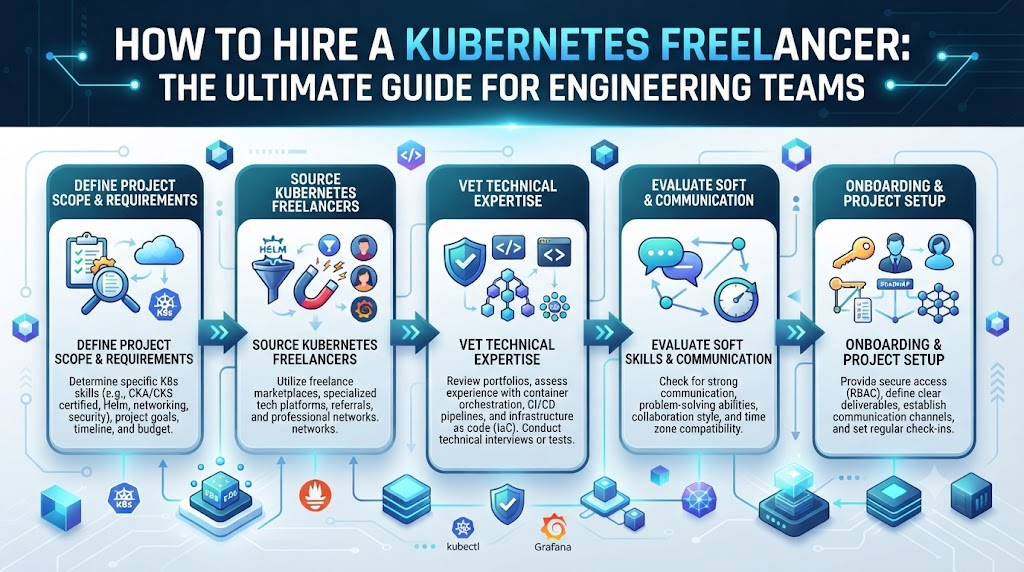
Hiring and Evaluation Framework
Evaluating external technical talent requires assessing real-world problem-solving rather than reviewing certificates alone:
- Establish Clear Scope Requirements: Define exact technical expectations (e.g., “Provision an EKS cluster via Terraform and configure automated deployment pipelines with ArgoCD”).
- Conduct Architectural Reviews: Have candidates explain past cluster designs, high-severity outages they resolved, or complex migrations they executed.
- Run Scenario-Based Evaluations: Walk through real-world scenarios—such as debugging a failing control plane upgrade or fixing a network policy misconfiguration—to gauge diagnostic skills.
- Inspect Documentation Quality: Request sanitized runbooks, architectural decision records (ADRs), or setup guides from previous engagements to verify technical clarity.
Security and Access Control Best Practices
Integrating external technical contractors into production environments requires robust security controls:
- Least-Privilege Enforcement: Provide role-restricted access isolated to development or staging environments initially.
- Ephemeral Credentials: Use identity federation (such as AWS IAM Identity Center or Azure Active Directory) with short-lived sessions instead of static access keys.
- Audit Trail Monitoring: Enable full audit logging for Kubernetes API requests and cloud account activities (e.g., AWS CloudTrail).
- Isolated Secrets Management: Keep production credentials, TLS keys, and database passwords inside dedicated secret managers rather than hardcoded scripts.
- Structured Offboarding: Automatically revoke IAM permissions, access tokens, and VPN connections immediately upon project sign-off.
Common Hiring Mistakes to Avoid
Avoid these frequent hiring traps when contracting external platform engineers:
- Selecting solely on Rate: Low-cost contractors can introduce structural flaws that result in costly outages or inflated cloud bills later.
- Ignoring Business Context: Failing to share application traffic patterns or regulatory compliance rules can result in over-engineered platform setups.
- Omitting Knowledge Transfer: Ensure the contract mandates formal documentation and handover sessions for internal developers.
- Leaving Scope Undefined: Vague project boundaries lead to architectural drift, missed deadlines, and unexpected budget increases.
How DevOpsFreelancer.com Supports Your Hiring Goals
Sourcing thoroughly vetted contractors who understand production container management can be challenging. Platforms like DevOpsFreelancer.com streamline this process by matching organizations with experienced specialists across dedicated domains—including cloud architects, AWS DevOps engineers, Kubernetes freelancers, Terraform specialists, DevSecOps practitioners, and SRE professionals. Whether you need a short-term infrastructure assessment or an embedded specialist to execute a migration, leveraging on-demand technical talent keeps projects moving forward efficiently.
Practical Tips / Key Takeaways
- Define Objectives Early: Clearly write out technical requirements before starting interviews to find the right skill match.
- Focus on Diagnostic Ability: Evaluate how candidates handle real-world system failures, not just how they write YAML files.
- Enforce Scoped Access: Grant temporary, audited access using centralized identity management platforms.
- Demand Operations Documentation: Make architecture diagrams and operational runbooks mandatory project deliverables.
- Prioritize Operational Stability: Ensure initial setups focus on security policies, resource bounds, and monitoring before adding complex feature sets.
10 FAQs
1. How does a specialized Kubernetes freelancer differ from a general DevOps consultant?
A general DevOps consultant usually handles broad CI/CD automation, cloud administration, and build tools. A Kubernetes freelancer specializes specifically in container orchestration, CNI networking, ingress controllers, custom operators, and scaling cluster infrastructure.
2. What is the typical duration of a freelance Kubernetes engagement?
Engagement lengths depend on scope. Targeted audits or pipeline setups may take one to two weeks, whereas end-to-end platform migrations, multi-region cluster builds, or security overhauls typically range from one to three months.
3. Can a freelance container specialist help reduce our cloud bill?
Yes. Independent specialists analyze pod resource requests and limits, configure cluster autoscalers, implement spot/preemptible instances, and eliminate unattached storage volumes to reduce unnecessary infrastructure spend.
4. Is it better to run managed Kubernetes (EKS/GKE/AKS) or build custom control planes?
Managed Kubernetes services are recommended for most organizations. Cloud providers manage control plane availability and updates, allowing your team to focus on application logic and cluster security.
5. How should we grant an external freelancer access to our environment?
Use temporary, role-based access control (RBAC) via identity federation platforms. Avoid sharing static root credentials or unencrypted SSH keys, and ensure all administrative actions are logged to audit trails.
6. Do we need an SRE freelancer or a Kubernetes freelancer during system instability?
An SRE freelancer focuses broadly on platform availability, SLOs/SLIs, and incident response frameworks. If outages stem directly from crashing pods, broken ingress routes, or control plane limits, a specialized Kubernetes freelancer is the right choice.
7. How do freelancers execute cluster upgrades without causing application downtime?
Specialists use rolling node updates, blue-green deployment patterns, canary strategies, and node drain procedures to update control planes and worker pools without disrupting live user traffic.
8. What core tools should a qualified Kubernetes contractor master?
Look for expertise in Docker, Helm, Kustomize, Terraform, Prometheus, Grafana, ArgoCD or Flux, CNI plugins (Cilium/Calico), and managed cloud platforms like EKS, GKE, or AKS.
9. Can a freelance container engineer improve our security posture?
Yes. Experienced contractors implement vulnerability scanning in CI/CD pipelines, enforce Pod Security Standards, configure RBAC policies, manage secrets with HashiCorp Vault, and set up network isolation policies.
10. How can we test a freelancer’s technical competence during the hiring process?
Use scenario-based technical discussions. Ask candidates to explain how they diagnosed past production outages, managed stateful workloads, or configured cluster autoscaling to handle sudden traffic spikes.
Conclusion
Kubernetes offers powerful automation for modern cloud applications, but managing its operational demands requires dedicated expertise. Partnering with a qualified Kubernetes freelancer allows companies to fix platform bottlenecks, automate delivery pipelines, and complete cloud migrations without the delays and overhead of hiring full-time staff. By establishing defined project goals, applying secure access controls, and selecting candidates with proven production experience, engineering teams can build resilient container infrastructure. Platforms like DevOpsFreelancer.com provide on-demand access to technical experts who can help keep your systems stable, secure, and scalable.
Leave a Reply