Architectural Challenges in Multidomain Defense: Sensor Networks to Supply Chains
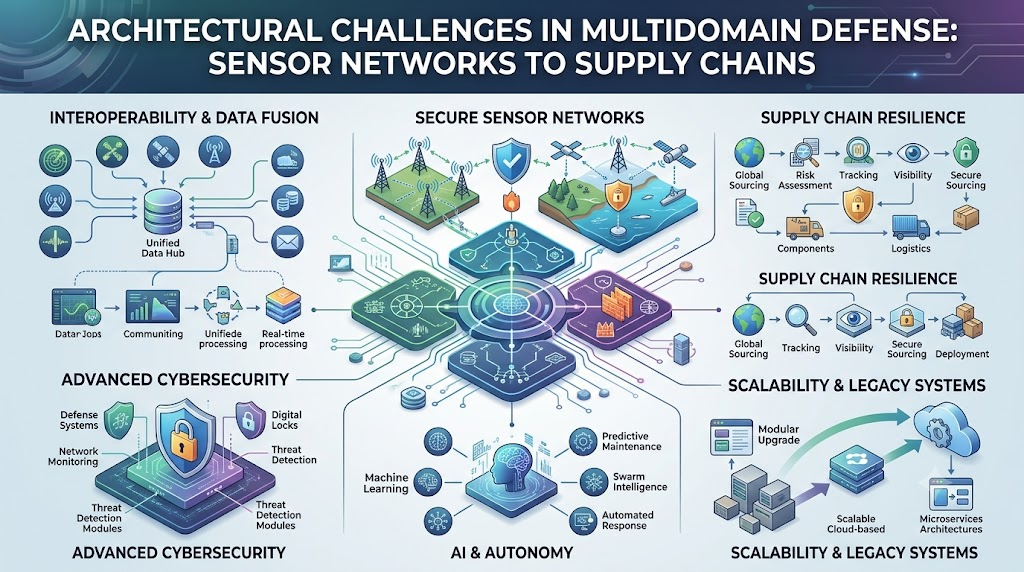
Introduction
How do contemporary security organizations manage complex operations when traditional operational boundaries blur? Modern national defense no longer occurs in isolated silos. Instead, strategic success relies on orchestrating assets across land, sea, air, outer space, and digital networks in real time.This interconnected strategic approach is known as Multidomain Operations (MDO). For policy analysts, historians, and defense studies scholars, understanding MDO is essential to evaluating how modern institutions manage information, design command structures, and sustain logistical readiness.This comprehensive guide breaks down the core tenets of multidomain strategy, its evolution, key challenges, and how researchers analyze modern defense ecosystems. To explore further educational content on defense studies and strategic history, visit WarOpsX.com.
What are Multidomain Operations?
Multidomain Operations (MDO) refers to the strategic and operational theory focused on integrating capabilities across all operating environments—land, sea, air, space, and cyber—to achieve relative advantage and strategic alignment.
       [ Command & Control / ISR Core ]
                      │
   ┌───────────┬──────┴──────┬───────────┐
   ▼           ▼             ▼           ▼
[ Land ]   [ Maritime ]    [ Air ]   [ Cyber/Space ]
Core Concepts and Terminology
- Operational Domain: A distinct sphere of activity containing unique environmental, technological, and physical properties (e.g., ground maneuvers vs. orbital satellite paths).
- Cross-Domain Synergy: The deliberate alignment of assets in one domain to create operational openings in another (e.g., using cyber capabilities to temporarily blind sensor systems, allowing air transport to proceed safely).
- Interoperability: The technical and organizational ability of distinct service branches, hardware platforms, and software systems to share information securely without friction.
In defense studies, MDO shifts the primary analytical lens away from individual weapon platforms toward information velocity, network resilience, and system-wide synchronization.
Historical Evolution: From Combined Arms to Multidomain Strategy
The concept of cross-domain coordination is not an overnight creation; it represents decades of institutional adaptation across military history.
+------------------+     +------------------+     +------------------------+
|  Combined Arms   | --> | Joint Operations | --> | Multidomain Strategy   |
| (Ground + Air)   |     | (Service Branch) |     | (Physical + Synthetic) |
+------------------+     +------------------+     +------------------------+
1. The Era of Combined Arms
In the early 20th century, mechanized warfare required ground forces to coordinate infantry, armor, and field artillery. The introduction of aviation during World War I and World War II expanded this model into air-ground synchronization, where tactical air support directly aided land maneuvers.
2. The Joint Operations Era
By the late 20th century, defense institutions recognized that air, naval, and ground forces often operated with competing priorities. Strategic reforms led to Joint Operations, focusing on unifying command structures across distinct service branches so they could execute unified campaigns.
3. The Digital and Orbital Integration Shift
The 21st century introduced fast-paced network technology, satellite navigation, and global digital infrastructure. Modern planners quickly recognized that cyber networks and orbital satellites were no longer merely supportive tools—they formed entire operational domains essential to basic command, communication, and logistical movement.
The Five Core Operational Domains
Modern security frameworks categorize operating environments into five primary domains:
- Land: Infantry, armored mobility, and territorial governance. Land operations require sustained physical presence and heavy logistical supply chains.
- Maritime: Subsurface, surface, and amphibious platforms responsible for securing sea lines of communication and global trade routes.
- Air: Fixed-wing, rotary, and uncrewed aerial systems providing rapid transit, aerial surveillance, and defense.
- Space: Orbital satellite networks providing precise global positioning (GPS), early warning metrics, weather modeling, and strategic communications.
- Cyber and Information: Digital architecture, server networks, data transmission channels, and cognitive communications that form the operational backbone of all other physical domains.
Command and Control (C2) and ISR Systems
Operating across five domains simultaneously requires clear decision-making processes and precise situational awareness.
Command and Control (C2) Architecture
C2 systems provide the organizational framework for leaders to process data, weigh risks, allocate resources, and issue operational guidance. In a multidomain context, C2 systems must avoid rigid hierarchies and favor decentralized decision-making models that allow units to react quickly to changing information.
Intelligence, Surveillance, and Reconnaissance (ISR)
ISR constitutes the system of collecting, processing, and evaluating data. Sensor platforms—ranging from orbital imaging satellites and high-altitude aircraft to digital network monitoring tools—feed continuous streams of data into analytical hubs. This continuous monitoring helps planners reduce uncertainty and make evidence-based strategic decisions.
Comparative Domain Overview
| Domain | Operational Environment | Primary Supporting Infrastructure | Fundamental Strategic Challenge |
| Land | Physical terrain, urban zones | Transport networks, bases, fuel supply | High logistics volume & terrain friction |
| Maritime | Oceans, coastlines, choke points | Ports, replenishment ships, naval yards | Vast geographic scale & transit time |
| Air | Atmosphere, low-to-high altitude | Airfields, maintenance hubs, radar sites | High energy/fuel demands & short window |
| Space | Low Earth Orbit (LEO) to Geostationary | Ground stations, launch facilities | Extreme cost & vulnerability to debris |
| Cyber | Digital networks, servers, data links | Data centers, software, fiber optics | Rapid iteration & constant perimeter security |
Logistics, Technology, and System Integration
Logistics Resilience
No strategy survives without sustainment. Military Logistics in an MDO context involves orchestrating fuel, maintenance, medical aid, and transport across vast distances while ensuring the underlying digital supply-chain management tools remain protected from cyber intrusions.
Technological Drivers
- Data Fusion Platforms: Advanced software suites that combine raw inputs from air, space, and sea sensors into a single clear map.
- Autonomous Support Systems: Uncrewed transport vehicles and automated surveillance drones that perform high-risk or routine supply tasks.
- Artificial Intelligence (AI) Decision-Support: Analytical algorithms that parse mass amounts of sensor telemetry to highlight priorities for human managers, preventing information fatigue.
Strategic Analysis Framework
Students and security researchers can use this 8-step framework to evaluate multidomain concepts, policy updates, or historical exercises:
Step 1: Define Strategic Goals
Identify the overarching purpose or policy objective of the defense organization.
Step 2: Map Participating Organizations
Catalog the service branches, government agencies, or international allies involved in the framework.
Step 3: Identify Resource Constraints
Evaluate budget parameters, hardware limits, and industrial capacities.
Step 4: Assess Information & ISR Capability
Determine how data is collected, filtered, and distributed across operating units.
Step 5: Analyze Command Relationships
Examine whether leadership structures are flexible enough to delegate decision authority under pressure.
Step 6: Evaluate Logistical Sustainment
Investigate supply chain pathways, maintenance infrastructure, and digital security.
Step 7: Review Interoperability & Tech Integration
Check if legacy hardware can securely exchange data with newer software systems.
Step 8: Consider Risk, Law, and Ethics
Analyze unintended consequences, international legal frameworks, and human oversight mechanisms.
Key Challenges and Institutional Constraints
- Data Saturation: Modern sensors generate far more information than human operators can analyze. Without effective filtering, decision-makers face information overload.
- Legacy System Friction: Older hardware systems often lack the standardized communication protocols required to link directly into cloud-based data networks.
- Cyber Vulnerability: Increasing reliance on interconnected digital software creates soft targets for hostile network disruptions.
- Resource Allocation Dilemmas: Planners must balance high capital costs between physical assets (ships, armored vehicles) and intangible systems (cybersecurity, software R&D).
Common Misconceptions in Defense Studies
- Misconception 1: MDO is merely “Joint Operations” re-branded.
- Correction: Joint operations focus on cooperation between physical branches (Army, Navy, Air Force). MDO elevates cyber and space into full, active operational spaces alongside physical branches.
- Misconception 2: Advanced networks eliminate the “Fog of War.”
- Correction: Technology improves operational visibility, but unexpected environmental factors, equipment failures, and human decision limits will always introduce uncertainty.
- Misconception 3: Cyber and Space capabilities replace ground forces.
- Correction: Digital and orbital capabilities enable better coordination, but land, sea, and air forces remain fundamental to long-term presence and logistics sustainment.
Ethical Considerations and Governance
As modern strategic frameworks embrace digital automation and satellite networks, defense policy research must account for ethical and legal frameworks:
- Human Control: Maintaining human oversight over critical decision-making processes.
- International Law: Applying traditional frameworks (such as the Law of Armed Conflict) to abstract environments like cyberspace and outer space.
- Infrastructure Protection: Ensuring shared civilian infrastructure—such as undersea internet cables or commercial satellites—is protected from unintended operational exposure.
Practical Case Studies
Historical Example: The Battle of the Atlantic (Cross-Domain Precursor)
During World War II, Allied convoys faced severe shipping losses from naval blockades. Victory was achieved not through naval ships alone, but by linking long-range air patrols, naval convoy escorts, and code-breaking signal intelligence into a unified operational pattern. This early integration of air, sea, and information domain intelligence laid the foundation for modern multidomain thinking.
Hypothetical Organizational Scenario: Regional Disaster Response
Imagine a regional task force responding to a severe natural disaster affecting maritime ports and coastal roads:
- Space Assets: Weather and imaging satellites map flooded infrastructure in real time.
- Air Assets: Uncrewed aircraft deliver emergency medical supplies to isolated communities.
- Maritime Assets: Transport ships set up off-shore power and clean-water facilities.
- Cyber/Logistics: Protected data networks ensure relief requests match available inventory without delay.
- Command Hub: Leaders view a synchronized digital map to deploy resources where needed most.
Practical Takeaways
- System-Wide Focus: Multidomain Operations require viewing security through interconnected networks rather than isolated military branches.
- Evolutionary Trajectory: The framework builds naturally upon historical combined arms tactics and joint operational models.
- Information Integration: Modern success hinges on data clarity, sensor interoperability, and decision speed.
- Logistics Essentiality: Supply lines must be maintained physically on the ground and protected digitally against network outages.
- Human Centricity: Despite rapid technological advances, leadership, clear communication, and ethical governance remain the core pillars of sound strategy.
Frequently Asked Questions (FAQs)
1. What is the fundamental goal of Multidomain Operations?
MDO aims to synchronize actions across land, maritime, air, space, and cyberspace to create operational advantages that a single service branch could not achieve alone.
2. How do cyber and space domains differ from land, air, and sea?
Land, air, and sea are physical geographical domains, whereas space relies on orbital dynamics and cyber operates within digital software, electronic signals, and networked data infrastructure.
3. Why is interoperability crucial in multidomain strategies?
Interoperability ensures that hardware and software systems across different branches can exchange data instantly without technical barriers, preventing delays during operations.
4. What role does artificial intelligence play in modern defense strategy?
AI tools help organize, filter, and analyze large volumes of sensor data, giving decision-makers clear insights without overwhelming them with raw telemetry.
5. How does MDO impact military logistics?
MDO expands logistics planning to include securing both physical supply routes (roads, sea channels) and digital supply-chain management software against disruption.
6. What is the difference between strategy and tactics?
Strategy defines high-level objectives and resource allocation over time, while tactics refer to specific, localized methods used to achieve immediate tasks.
7. Why is military history important to modern defense studies?
Studying history provides insights into how large organizations adapt to technological changes, manage resource constraints, and respond to strategic uncertainty over time.
8. What is situational awareness in C2 systems?
Situational awareness refers to having an accurate, up-to-date understanding of environmental conditions, resource statuses, and operational events across all active domains.
9. How do defense institutions evaluate strategic risks?
Planners weigh factors such as supply limits, technological failure rates, policy constraints, and potential unintended consequences using structured analytical frameworks.
10. How can students research defense concepts on WarOpsX.com?
WarOpsX.com offers clear, educational resources explaining strategic concepts, defense technology, historical developments, and organizational systems for academic study.
Conclusion
Multidomain Operations represents a fundamental shift in how security scholars, policy planners, and history researchers conceptualize modern defense systems. By integrating land, sea, air, space, and digital networks into a single cohesive framework, modern institutions adapt to an increasingly complex world. Understanding these systems requires looking beyond hardware to evaluate logistics resilience, human leadership, communications infrastructure, and ethical responsibility. To deepen your understanding of modern defense studies and strategic history, explore the educational guides at WarOpsX.com.
Leave a Reply