DataOps Certified Professional Guide to Automation and Governance
Introduction
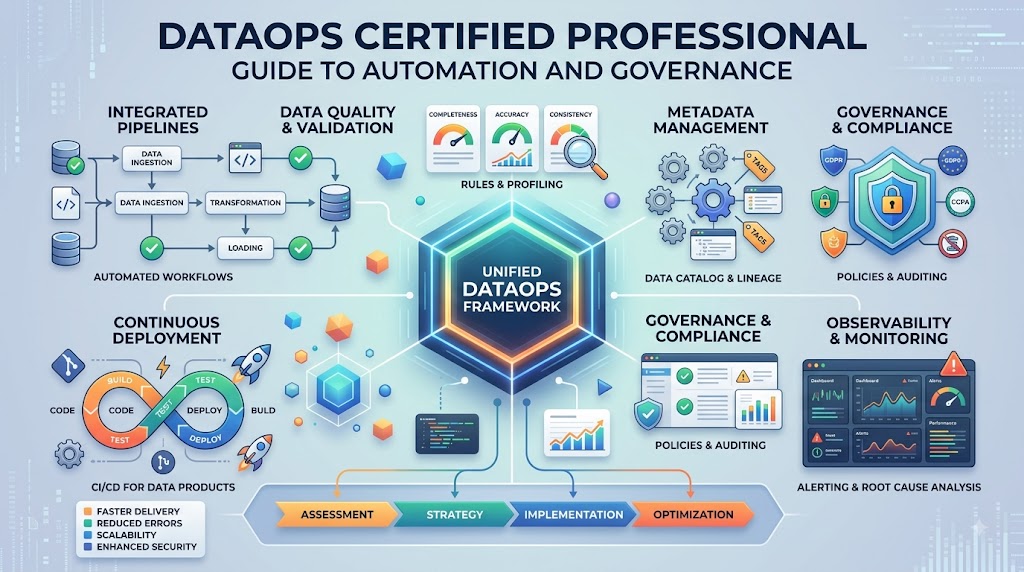
Modern businesses depend on data for reporting, customer insights, automation, artificial intelligence, and strategic decisions. But collecting data is only the beginning. The real challenge is making sure that data is accurate, available on time, secure, and easy to manage.This is where DataOps becomes valuable.DataOps brings together data engineering, automation, testing, monitoring, collaboration, and governance. Its goal is to make data pipelines more dependable and easier to operate.The DataOps Certified Professional certification from DevOpsSchool is designed for engineers, managers, and technology professionals who want to understand how modern data systems are built and managed in production environments.
Certification Snapshot
| Category | Information |
|---|---|
| Track | DataOps and Data Engineering |
| Level | Professional |
| Ideal for | Engineers, Data Professionals, DevOps Teams, Cloud Teams, Managers |
| Helpful Background | Linux, Git, cloud, scripting, databases, data concepts |
| Main Skills | Pipeline automation, CI/CD, monitoring, cloud, governance, security |
| Suggested Learning Flow | Basics → Automation → Cloud → Deployment → Monitoring → Governance |
What Is This Certification About?
The DataOps Certified Professional program introduces the practices required to manage data as a production system.Instead of focusing only on creating data pipelines, the certification encourages professionals to think about reliability, automation, quality, observability, security, and continuous improvement.The learning approach is useful for anyone who wants to understand how data platforms operate from development to production.
Who Can Benefit From It?
This certification is suitable for professionals such as:
- Data Engineers
- Software Engineers
- DevOps Engineers
- Cloud Engineers
- Platform Engineers
- SRE Professionals
- Analytics Engineers
- Data Platform Engineers
- Technical Leads
- Solution Architects
- Engineering Managers
- Professionals planning to move into MLOps or AIOps
It is especially useful for professionals who already understand software or cloud engineering and now want to work more closely with data platforms.
Important Skills You Can Develop
A strong DataOps foundation should help you understand:
- Data pipeline design
- Pipeline automation
- Linux and scripting
- Python for data workflows
- Git-based collaboration
- CI/CD for data projects
- Docker and containerization
- Kubernetes fundamentals
- Cloud data services
- Infrastructure as Code
- Data testing and validation
- Pipeline monitoring
- Logging and alerting
- Security practices
- Data governance
- Data lineage and access control
The main goal is not simply learning tools. It is understanding how these technologies work together to create a reliable data delivery process.
Practical Projects to Build
Hands-on work is one of the best ways to understand DataOps.
After completing your preparation, you should try to build projects such as:
- A cloud-based data ingestion pipeline
- An automated data transformation workflow
- A Python data-processing application
- A Docker-based data service
- A CI/CD pipeline for data engineering
- Automated data-quality checks
- Terraform-managed data infrastructure
- Kubernetes-based data workloads
- Monitoring dashboards for pipelines
- Data freshness and failure alerts
- A governed data platform with controlled access
These projects help you move from theoretical knowledge to practical engineering skills.
How to Prepare
7–14 Day Plan
This path is suitable for professionals with previous experience in DevOps, cloud, or data engineering.
Focus on:
DataOps concepts → Git → Python → Docker → CI/CD → Cloud → Kubernetes → Monitoring → Governance
Try to spend more time practicing than reading.
30 Day Plan
This option works well for busy working professionals.
During the first week, cover DataOps basics, Linux, Git, and scripting.
Use the second week for cloud, containers, and CI/CD.
Spend the third week on Kubernetes, infrastructure automation, and monitoring.
Use the final week for security, governance, troubleshooting, and project practice.
60 Day Plan
Beginners can follow a slower and more detailed approach.Start with Linux, Python, Git, SQL, and cloud fundamentals. Once these basics are clear, move into containers, CI/CD, automation, Kubernetes, observability, security, data quality, and governance.Use the final stage of preparation to build one complete DataOps project.
Mistakes to Avoid
Many learners focus too heavily on tools. That can make DataOps appear more complicated than it really is.
Avoid mistakes such as:
- Learning commands without understanding workflows
- Ignoring hands-on practice
- Trying to learn several cloud platforms at once
- Skipping Linux and scripting
- Forgetting data-quality checks
- Treating monitoring as an optional activity
- Ignoring security
- Managing infrastructure manually
- Building pipelines without Git
- Avoiding troubleshooting practice
A better learning cycle is:
Understand → Build → Test → Monitor → Fix → Automate
This approach reflects how real DataOps teams work.
Where Can You Go After DataOps?
The next learning path depends on your role.If you enjoy software delivery and automation, continue with DevOps.If security is your main interest, move toward DevSecOps.If you prefer reliability, monitoring, and incident management, explore SRE.If you want to work with machine learning platforms, choose AIOps/MLOps.If your main focus remains data platforms, continue deeper into DataOps.If you manage cloud spending and platform economics, add FinOps skills.
Choose Your Learning Path
DevOps
Best for professionals working with application delivery, automation, cloud, containers, and CI/CD.
DevSecOps
Suitable for professionals who want to integrate security into development pipelines and infrastructure.
SRE
Focused on reliability, monitoring, performance, incident management, and production stability.
AIOps/MLOps
Useful for professionals interested in AI operations, machine learning pipelines, model deployment, and intelligent automation.
DataOps
Ideal for people working with data pipelines, data platforms, data reliability, governance, and analytics infrastructure.
FinOps
A useful path for professionals responsible for cloud cost management, optimization, budgeting, and financial accountability.
Institutions That Can Support DataOps Learning
DevOpsSchool
DevOpsSchool provides structured learning and certification programs related to DataOps, DevOps, cloud, automation, and modern engineering practices.
Cotocus
Cotocus supports technology professionals and organizations with consulting, engineering, cloud, and automation-related knowledge.
Scmgalaxy
Scmgalaxy offers learning resources related to DevOps tools, software configuration management, CI/CD, cloud, and automation.
BestDevOps
BestDevOps focuses on practical DevOps knowledge, technology awareness, certification guidance, and modern engineering practices.
devsecopsschool
This platform is useful for learners who want to strengthen security automation, secure software delivery, and DevSecOps knowledge.
sreschool
sreschool focuses on Site Reliability Engineering, observability, incident response, monitoring, and production reliability.
aiopsschool
aiopsschool helps professionals explore AIOps, automation, monitoring, intelligent operations, and related technologies.
dataopsschool
dataopsschool concentrates on DataOps concepts, data pipeline automation, modern data engineering, and platform practices.
finopsschool
finopsschool supports learning around cloud financial management, cost optimization, budgeting, and FinOps principles.
Conclusion
The DataOps Certified Professional certification can be a useful learning path for professionals who want to understand how modern data environments are automated, tested, monitored, secured, and governed. It is relevant not only for Data Engineers but also for Software Engineers, DevOps professionals, cloud teams, architects, and technical managers.The strongest way to learn DataOps is to focus on complete workflows rather than individual tools. Build a pipeline, automate its deployment, test the data, monitor its performance, secure the environment, and improve the process continuously. This practical mindset can help you prepare for certification while also developing skills that are useful in real production environments.
Leave a Reply