Modern Enterprise Cloud Migration Services: A Strategic Roadmap to Legacy Modernization
Introduction
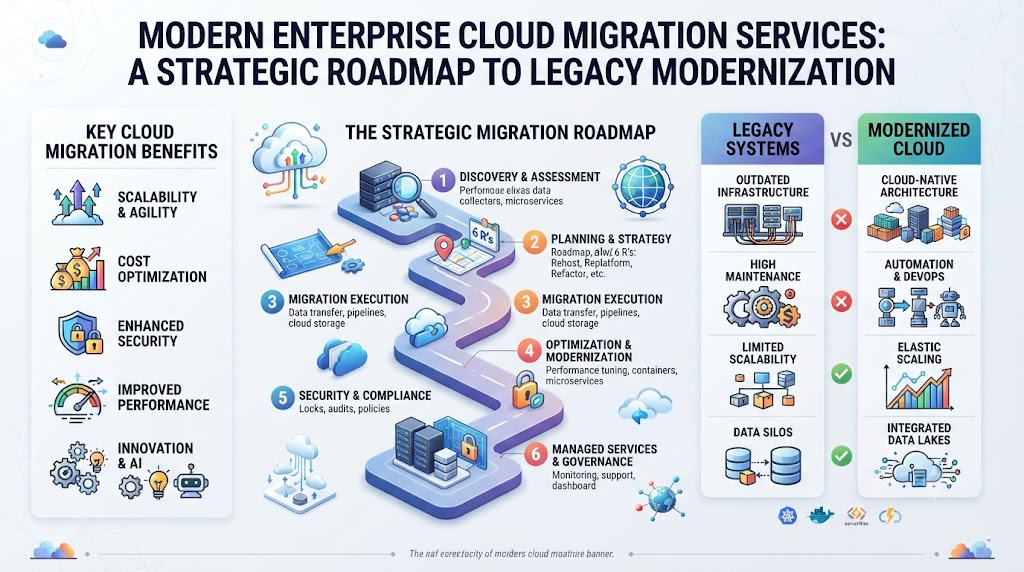
Carrying the operational weight of aging on-premises infrastructure often traps organizations in a cycle of high maintenance overhead and rigid software delivery pipelines. Shifting workloads to the cloud is rarely as simple as copying data from one server to another; a poorly planned move frequently results in compounding architectural bottlenecks and unmanaged cloud expenses. True infrastructure modernization demands a deliberate strategy that aligns technical capabilities with overarching business objectives. Whether an organization is simply rehosting legacy virtual machines or entirely re-architecting applications for cloud-native delivery, structured planning is essential. Professional cloud migration services guide engineering teams through exhaustive readiness assessments, application mapping, and secure deployment workflows, allowing businesses to transition smoothly without halting day-to-day operations.
Understanding Cloud Migration Services
Cloud migration services involve the disciplined transfer of enterprise workloads, databases, and IT systems from local data centers or legacy environments to major cloud platforms like AWS, Microsoft Azure, or Google Cloud. Rather than viewing this as a simple data transfer exercise, mature cloud initiatives treat migration as a critical step toward organizational agility.
A thorough migration plan goes beyond moving virtual servers. It involves redesigning network topologies, tightening security perimeters, restructuring data storage, and preparing applications to leverage elastic cloud resources. Properly executed migrations lay the foundational infrastructure necessary for advanced automation, CI/CD pipelines, and container orchestration workflows.
Core Migration Strategies
Organizations typically approach cloud transitions through distinct pathways, commonly categorized by how deeply they alter the underlying applications. Choosing the correct strategy relies heavily on balancing timelines, budget constraints, and long-term technical debt.
1. Rehosting (The Lift-and-Shift Approach)
Rehosting moves existing applications directly to cloud infrastructure with minimal alterations. This strategy works well for businesses facing strict timelines or urgent data center lease expirations. While it offers a fast route out of legacy hardware, it rarely unlocks the full economic and architectural benefits of the cloud.
2. Replatforming (The Optimized Lift-and-Shift)
Replatforming introduces targeted modifications to applications to take advantage of managed cloud capabilities without rewriting core code. For example, migrating a self-managed database to a fully managed service reduces administrative overhead while keeping migration risks low.
3. Refactoring (Re-architecting for the Cloud)
Refactoring involves completely rebuilding applications to leverage cloud-native paradigms, such as microservices, serverless components, and containerized architectures. Although this path demands higher upfront engineering investment, it delivers maximum scalability, operational resilience, and long-term cost optimization.
The Migration Lifecycle
Successful cloud transformations follow a repeatable lifecycle designed to mitigate risk and prevent unforeseen production outages.
[Readiness Assessment] ➔ [Application Discovery] ➔ [Target Architecture Design] ➔ [Phased Execution] ➔ [Continuous Optimization]
Discovery and Dependency Mapping
Before executing any movement of data, teams must audit their existing IT landscape. Comprehensive automated discovery tools reveal hidden dependencies between applications, databases, and network ports, preventing catastrophic service disruptions during cutover.
Pilot Testing
Migrating lower-tier or non-critical workloads first provides a controlled environment to validate security configurations, identity management, and backup routines before touching core production systems.
Cutover and Validation
Once the pilot environment demonstrates stability, engineers execute final data synchronization and application cutover during planned maintenance windows, immediately followed by rigorous end-to-end testing.
Intersecting Practices for Modern Cloud Environments
Migrating to the cloud rarely occurs in isolation. It thrives when paired with complementary engineering practices that safeguard long-term stability.
Infrastructure as Code (IaC)
Manual configuration in cloud consoles invites human error and configuration drift. Utilizing tools like Terraform allows teams to define target environments through version-controlled code, guaranteeing identical setups across development, staging, and production.
Containerization and Kubernetes
Many migration initiatives coincide with containerizing monolithic codebases. For organizations scaling container workloads, specialized Kubernetes consulting services help design resilient, autoscaling clusters on managed platforms like Amazon EKS, Azure AKS, or Google GKE.
Security Integration
Moving to the cloud requires an immediate evolution of security policies. Integrating DevSecOps practices ensures that identity access controls, encryption standards, and automated vulnerability scanning are embedded directly into the deployment pipeline from day one.
Common Pitfalls to Avoid
Anticipating frequent migration missteps helps engineering leaders protect project timelines and budgets.
- Ignoring Application Dependencies: Moving a component without mapping its upstream and downstream connections often breaks critical business features.
- Failing to Govern Cloud Costs: Without automated budgeting, proactive resource tagging, and autoscaling policies, cloud expenses can spiral out of control.
- Siloing the Migration Project: Treating migration strictly as an IT task rather than an enterprise-wide initiative often results in applications that fail to meet user expectations.
- Overlooking Team Enablement: Transitioning infrastructure without upskilling internal engineers leaves teams ill-equipped to operate the new environment. Comprehensive corporate DevOps training bridges this critical capability gap.
Organizations seeking specialized support often collaborate with experienced partners like Cotocus to streamline timelines, mitigate risk, and design resilient cloud architectures tailored to unique operational demands.
Comparison Table — Cloud Migration Approaches
| Approach | Primary Focus | Resource Investment | Long-Term Advantage |
| Rehosting | Rapid data center exit | Minimal | Immediate hardware relief; limited architectural gain |
| Replatforming | Balanced optimization | Moderate | Lower administrative overhead with managed tools |
| Refactoring | Full cloud-native redesign | High | Maximum agility, scalability, and performance |
Practical Tips / Key Takeaways
- Audit Before You Move: Build a comprehensive inventory of all software, databases, and network routes prior to scheduling migration windows.
- Test with Low-Risk Workloads: Run a pilot migration on internal applications to validate your cloud networking, security, and IAM setups.
- Embrace Automation: Leverage Infrastructure as Code to provision consistent environments across all deployment stages.
- Embed Security Early: Enforce least-privilege access rules, encryption standards, and automated vulnerability checks before handling sensitive data.
- Establish Continuous Monitoring: Set up performance observability and granular cost tracking immediately after completing the production cutover.
FAQs
What do enterprise cloud migration services include?
Enterprise cloud migration services encompass the strategic planning, architectural design, application discovery, risk assessment, and secure execution required to move legacy workloads to cloud platforms like AWS, Azure, or Google Cloud.
How do I decide between rehosting and refactoring?
Rehosting is ideal for rapid migrations with tight deadlines, whereas refactoring is chosen when applications require complete modernization to leverage microservices and cloud-native scalability.
What factors influence the timeline of a cloud migration?
Timelines depend on the total portfolio size, application complexity, data volume, and the chosen migration strategy. Simple migrations take weeks, while enterprise-wide overhauls often span several months.
How can downtime be minimized during cutover?
Downtime is mitigated through thorough dependency mapping, phased batch migrations, pilot testing, and scheduling final production switches during off-peak hours.
What is the significance of Infrastructure as Code during migration?
Infrastructure as Code replaces error-prone manual console configurations with repeatable, version-controlled scripts that guarantee environment consistency.
How do cloud migrations affect security posture?
Migrations offer an ideal opportunity to modernize security by implementing centralized identity and access management, robust encryption protocols, and automated compliance policies.
When should containerization be introduced during a migration?
Containerization is valuable when applications need consistent behavior across multiple environments or when preparing workloads for orchestration platforms like Kubernetes.
How does Cotocus assist with cloud migrations?
Cotocus provides expert cloud consulting and migration services, guiding organizations through architectural design, infrastructure automation, and secure workload transitions.
What are the primary causes of cloud migration failure?
Common causes include poor preparation, ignored application dependencies, lack of cross-functional alignment, insufficient team training, and inadequate cost governance.
How can organizations control costs after migrating?
Post-migration financial control is maintained by enforcing strict tagging policies, setting up automated spending alerts, rightsizing cloud instances, and utilizing managed dashboards.
Conclusion
Successfully transitioning legacy workloads to the cloud demands rigorous planning, technical foresight, and a deep understanding of application relationships. Whether opting for a fast rehosting strategy or investing in full-scale refactoring, organizations that modernize their infrastructure position themselves for greater reliability and operational efficiency. Collaborating with trusted domain experts can further simplify this complex journey. For businesses seeking reliable guidance, Cotocus delivers expert cloud consulting and migration services tailored to help engineering teams build secure, scalable, and high-performing cloud environments.
Leave a Reply