Building Resilient Data Systems Through Better Operational Discipline
Introduction
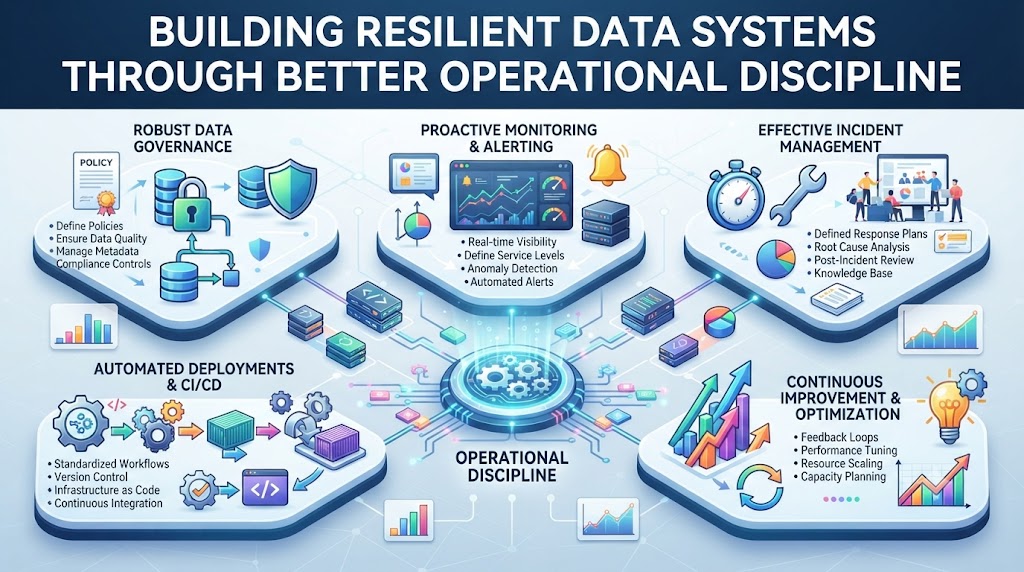
If you have ever spent your Monday morning untangling why an executive dashboard is showing zero revenue—only to discover that an upstream API silently changed a timestamp format over the weekend—you already know the hidden tax of modern data engineering. Traditional pipelines are fragile. When scripts break, engineers drop everything to firefight, while business stakeholders lose confidence in the numbers.This constant friction is precisely why engineering teams ask What is DataOps when looking for a better way forward. Borrowing the best parts of agile development and DevOps, DataOps treats data pipelines like first-class software products.Instead of relying on manual fixes and blind hope, a DataOps approach introduces automated testing, version control, and continuous monitoring. This shift lets you catch broken schemas and missing records long before anyone in finance or product sees them. Let us look at what makes this approach tick and how you can apply it to make your data infrastructure genuinely dependable.
Deconstructing the DataOps Mindset
DataOps is often mistaken for a specific tool or a plug-and-play piece of software. In reality, it is an operational philosophy. It focuses on collaboration, automation, and continuous improvement across the entire lifecycle of a dataset.
Historically, data engineering operated in a silo. Engineers built ingestion scripts, threw data into a warehouse, and left downstream analysts to figure out why null values were suddenly appearing. DataOps breaks down these barriers. It unites data engineers, analytics engineers, and operations personnel around shared, transparent workflows.
The philosophy rests on three main pillars:
- Agile Iteration: Releasing small, tested updates frequently rather than launching massive, monolithic pipeline overhauls every six months.
- Engineering Rigor: Applying software engineering best practices—like code reviews, automated tests, and CI/CD—to data workflows.
- Continuous Feedback: Using telemetry and observability to monitor data health and catch anomalies before they cascade downstream.
Why Legacy Data Workflows Break Down
Building a data pipeline on day one feels straightforward. You pull from a source, load it into storage, run a few transformations, and serve the data. The trouble starts six months later when business requirements change, sources evolve, and technical debt piles up.
Without a DataOps framework, teams typically encounter familiar bottlenecks:
- Silent Corruptions: A pipeline finishes executing successfully with a green checkmark, but a data type conversion error truncated half the records. Your systems think everything is fine while your analytics are completely skewed.
- Ad-Hoc Deployments: Pushing SQL scripts and Python DAGs directly to production environments without staging tests, rollback plans, or peer reviews.
- Environment Drift: Code that behaves correctly in a local notebook or test database fails catastrophically in production due to volume differences or missing permissions.
- The Blame Game: When a critical metric drops, nobody knows whether the source system, the ingestion job, the transformation layer, or the orchestration schedule caused the failure.
DataOps replaces this reactive chaos with structured guardrails and automated safety nets.
Anatomy of a Reliable DataOps Pipeline
A healthy data pipeline requires a clear, predictable lifecycle from raw source to final consumption.
Data Sources → Ingestion → Storage → Transformation → Quality Checks → Deployment → Monitoring → Consumption
1. Version Control as the Source of Truth
Every line of code—from orchestration DAGs to transformation models—belongs in Git. Infrastructure as Code (IaC) ensures that development, staging, and production environments mirror one another precisely.
2. Intentional Workflow Orchestration
Orchestration tools manage complex task dependencies and handle transient failures gracefully. A well-designed orchestrator guarantees that downstream transformations never execute until upstream data dependencies are fully resolved and fresh.
3. Modular Transformations
Moving transformation logic inside the data warehouse using modular SQL or Python allows teams to version-control business logic, write unit tests, and review changes collaboratively before merging.
4. Automated CI/CD Workflows
Continuous integration pipelines automatically lint code, spin up ephemeral preview environments, and run test suites against sample data. Continuous delivery pipelines then promote approved changes to production safely.
5. Built-In Data Quality Assertions
Data quality checks should run automatically as part of the pipeline. Testing for row counts, uniqueness constraints, freshness SLAs, and schema changes stops bad data at the door.
6. Comprehensive Observability
Data observability tracks pipeline health, lineage, and volume trends. When an anomaly occurs, observability tools help isolate the root cause immediately rather than forcing engineers to dig through endless logs.
A Real-World Scenario: Moving from Chaos to Control
Imagine a logistics company pulling shipment tracking data into a cloud warehouse. In a traditional setup, an engineer might manually update a transformation script and push it straight to production, inadvertently dropping a foreign key and breaking the logistics tracking portal.
Under a modern DataOps process, the workflow looks entirely different:
- Branching: The engineer creates a feature branch in Git to update the tracking logic.
- Automated Testing: Opening a pull request triggers an automated CI job. It provisions an isolated testing schema, builds the models, and runs data quality assertions to ensure no primary keys are violated.
- Peer Review & Merge: A colleague reviews the code logic, and once tests pass green, the changes merge into the main branch.
- Automated Deployment: The CI/CD system automatically deploys the updated models to the production environment.
- Continuous Monitoring: Observability tools track the execution runtime and freshness, alerting the team instantly if data volume drops outside historical norms.
Essential Tooling Categories in the DataOps Ecosystem
While tools do not create a culture on their own, having the right stack makes automation achievable.
| DataOps Area | Common Challenge | Useful Practice / Tooling |
| Data Pipelines | Handling retries & complex dependencies | Apache Airflow, Prefect, Dagster |
| Data Transformation | Monolithic, unmaintainable scripts | dbt (Data Build Tool) |
| Data Quality | Undetected corruptions & bad records | Great Expectations, Soda, dbt tests |
| CI/CD & Automation | Risky manual production pushes | GitHub Actions, GitLab CI/CD |
| Observability | Blind spots in data health & lineage | Monte Carlo, Elementary, Datadog |
The key is integration. Avoid assembling a sprawling collection of disconnected point solutions that create more operational overhead than they solve.
Implementation Pitfalls and Best Practices
Transitioning to a DataOps culture requires careful execution. Teams often stumble by trying to change everything at once.
Start with High-Impact Pain Points
Do not attempt to rewrite every pipeline in your organization overnight. Pick one critical data product or domain that suffers from frequent failures, apply testing and CI/CD there first, and use those wins to build momentum.
Treat Data as a Product
Assign clear ownership. Every table, model, and pipeline should have a designated owner who cares about its uptime, documentation, and data quality SLAs.
Common Mistakes to Avoid
- Automating Bad Code: Building shiny CI/CD pipelines on top of messy, undocumented spaghetti code only helps you ship bad data faster. Clean up the foundations first.
- Ignoring Content Testing: Relying solely on infrastructure checks (like verifying a server is up) while ignoring actual data content (like checking if values fall within expected ranges).
- Tool Fatigue: Adopting every trendy tool on the market without a cohesive architecture strategy.
The Professional Evolution of DataOps
As modern enterprises scale their data and machine learning workloads, the demand for specialists who understand pipeline reliability, automation, and platform operations continues to accelerate.
Roles like Certified DataOps Engineer and Certified DataOps Architect focus squarely on bridging software engineering rigor with data platform scale. Professionals pursuing these tracks typically dive deep into workflow orchestration, cloud data warehouse management, and automated testing frameworks. Platforms like DataOpsSchool.com offer focused learning paths and tutorials to help engineers transition from traditional database administration into modern data operations.
Practical Tips / Key Takeaways
- Test Early and Often: Embed schema, freshness, and distribution checks directly inside your transformation and ingestion boundaries.
- Automate Your Deployments: Eliminate manual copy-pasting of scripts by establishing standard Git-driven CI/CD promotion paths.
- Map Your Lineage: Invest in tools that visualize data flow so you can trace downstream impacts instantly when something breaks.
- Establish SLAs with Stakeholders: Agree explicitly with business users on when data needs to be fresh, complete, and available.
10 FAQs
1.What is DataOps?
DataOps is an automated, collaborative methodology that applies agile principles, CI/CD, testing, and observability to data engineering to make pipelines faster and more reliable.
2.Why is DataOps important?
It minimizes manual firefighting, catches data quality issues before they reach production users, shortens development cycles, and builds trust in analytics.
3.How does DataOps differ from DevOps?
DevOps targets software applications and infrastructure, whereas DataOps addresses data-specific complexities like schema drift, data quality, and multi-step pipeline dependencies.
4.What does a DataOps Engineer do?
A DataOps Engineer builds and automates data pipelines, manages workflow orchestrators, implements CI/CD testing, and monitors overall platform health.
5.What is included in DataOps training?
Training typically covers workflow orchestration, data testing frameworks, CI/CD automation, cloud storage platforms, and infrastructure-as-code practices.
6.Which tools are commonly used in DataOps?
Common tools include Airflow or Prefect for orchestration, dbt for transformations, Great Expectations for quality testing, and GitHub Actions for automation.
7.How does DataOps improve data quality?
By weaving automated data assertions and tests into the CI/CD process, DataOps intercepts bad records and schema breaks before they hit production environments.
8.What is a Certified DataOps Engineer?
A Certified DataOps Engineer is an individual who has validated their technical competency in building, testing, and maintaining reliable enterprise data operations.
9.What does DataOps consulting involve?
DataOps consulting helps enterprises modernize their data stacks, implement pipeline automation, and establish robust observability and governance frameworks.
10.How can beginners start learning DataOps?
Beginners should start by learning Git version control, basic SQL-based transformations with dbt, pipeline orchestration fundamentals, and Python scripting.
Conclusion
Data operations is no longer an afterthought; it is the backbone of any data-driven organization. Moving away from fragile manual scripts and adopting automated testing, CI/CD pipelines, and deep observability transforms your data infrastructure from a constant source of stress into a reliable engine for the business. Whether you are optimizing a single ingestion workflow or scaling enterprise infrastructure, embracing DataOps ensures your data remains trustworthy, traceable, and ready for production.
Leave a Reply