Optimizing Production Clusters with a Dedicated Kubernetes Freelancer
Introduction
Running containerized workloads in production demands specialized knowledge that many growing engineering teams simply do not have in-house. As architectures shift toward microservices, managing cluster networking, stateful storage, and automated rollouts can quickly overwhelm developers who should be focusing on product features. When infrastructure bottlenecks start slowing down feature releases or unexpected downtime hits, bringing in outside help becomes essential. Engaging an experienced Kubernetes freelancer gives organizations immediate access to elite container expertise precisely when project milestones demand it, bypassing the lengthy hiring cycles associated with full-time recruitment.Container orchestration platforms are powerful, but they leave very little room for configuration errors. Understanding how to integrate a specialist into your workflow, what technical competencies to prioritize, and how to avoid standard operational pitfalls ensures your cloud infrastructure remains resilient, secure, and cost-effective.
Main Article
Understanding Kubernetes Complexity and Why Specialists Matter
Kubernetes has become the industry standard for managing containerized applications across cloud providers. Yet, beneath its powerful orchestration capabilities lies a notoriously steep learning curve. The platform is not a single tool; it is an expansive ecosystem of interconnected components.
Managing a production cluster effectively requires deep familiarity with several architectural layers:
- Control Plane and Worker Nodes: Keeping the core management components and underlying compute resources healthy and synchronized.
- Ingress Controllers and Services: Controlling how external traffic routes securely to internal microservices.
- Persistent Storage Drivers: Handling stateful data workloads that outlive ephemeral container lifecycles.
- Helm and Package Management: Standardizing application deployments across different environments.
- Role-Based Access Control (RBAC): Defining exact user and service account permissions to prevent unauthorized access.
Because these moving parts interact in complex ways, teams frequently run into issues like misconfigured networking, unmanaged resource consumption, or sudden cluster instability. This friction is usually the exact moment organizations recognize the need for a specialized Kubernetes freelancer to stabilize operations.
Common Scenarios for Bringing in a Container Expert
Organizations hire independent infrastructure specialists for targeted, high-impact initiatives where internal teams lack bandwidth or deep domain experience.
Ground-Up Cluster Architecture
Deploying a secure, production-grade cluster on AWS EKS, Azure AKS, or Google GKE requires strict adherence to best practices. A specialist provisions the infrastructure using Infrastructure as Code tools like Terraform, setting up secure networking topologies and automated scaling policies right from the start.
Refactoring and Cloud Migration
Transitioning monolithic legacy applications into containerized microservices requires careful refactoring. Freelancers write optimized Dockerfiles, design CI/CD deployment pipelines, and execute the migration path with minimal disruption to live users.
Performance and Cost Optimization
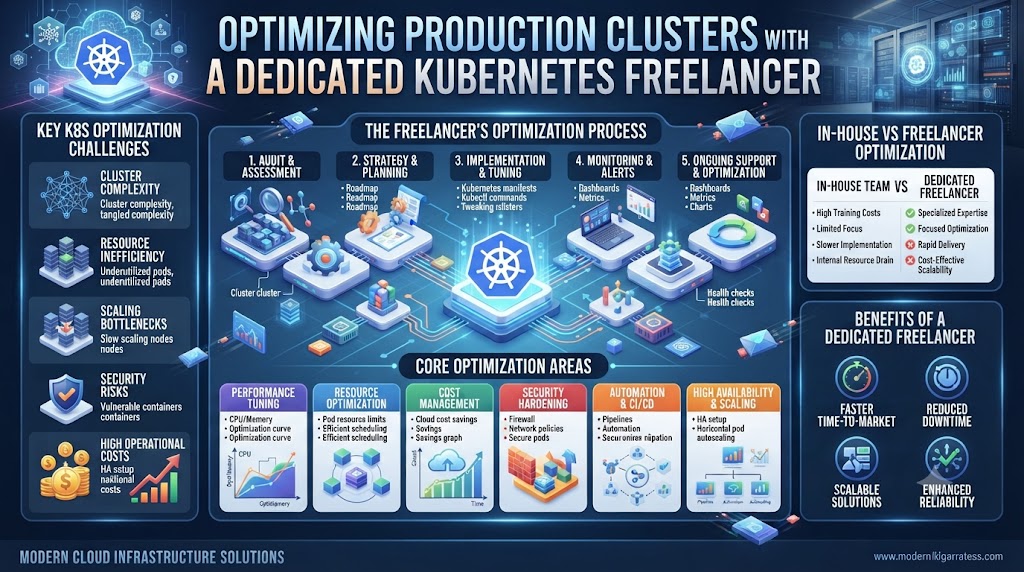
Unoptimized clusters often burn through cloud budgets due to idle nodes and poorly configured resource limits. An expert audits your cluster, implements Horizontal Pod Autoscalers, and fine-tunes resource requests to match actual application load.
Security and Compliance Hardening
Default cluster setups are rarely secure. Independent specialists audit existing environments, implement strict network policies, configure robust secret management, and align infrastructure with compliance standards like SOC 2 or HIPAA.
Freelancer vs. Internal Team: Finding the Right Balance
Deciding whether to engage an external contractor or recruit a full-time site reliability engineer depends entirely on your current project timeline and long-term technical roadmap.
| Project Scope | Freelancer Approach | Internal Team Approach |
| Duration & Commitment | Short-term sprints, audits, or advisory work | Permanent, ongoing operational ownership |
| Time to Productivity | Immediate deployment; zero recruiting delay | Weeks or months spent interviewing and onboarding |
| Budget Impact | Flexible hourly or project-based billing | Fixed salary, benefits, and administrative overhead |
| Skill Set | Niche, high-level expertise for specific blockers | Broad, generalized focus across all company systems |
When a company faces an urgent infrastructure challenge—such as preparing for a massive traffic surge or troubleshooting a persistent memory leak—bringing in a targeted AWS DevOps freelancer or container expert provides a faster, more cost-effective resolution than opening a permanent headcount.
Essential Technical Competencies to Evaluate
When searching for talent through platforms like DevOpsFreelancer.com, look for a proven track record across the broader cloud-native toolchain rather than just a list of popular certifications.
- Container Architecture: Deep understanding of Docker image layering, multi-stage builds, and container vulnerability scanning.
- Infrastructure as Code (IaC): Advanced proficiency in Terraform or OpenTofu to provision and manage cloud infrastructure declaratively.
- CI/CD Automation: Experience linking tools like GitHub Actions, GitLab CI, or Argo CD directly to cluster deployment workflows.
- Observability Setup: Hands-on skill configuring Prometheus, Grafana, and centralized logging stacks to monitor application health and track metrics.
- Networking and Storage: Practical knowledge of Container Network Interfaces (CNI), service meshes, and persistent volume management.
Pitfalls to Avoid in Container Operations
Teams new to container orchestration frequently fall into traps that create technical debt and compromise system stability.
- Treating Containers Like Traditional VMs: Logging into running worker nodes to make manual fixes violates the immutable nature of containers. Everything must be managed through declarative code.
- Neglecting Resource Constraints: Failing to define strict CPU and memory boundaries allows runaway pods to consume all available node resources, starving other services.
- Failing to Test Disaster Recovery: Assuming that managed cloud providers handle all backup responsibilities without validating etcd state backups or data recovery procedures.
- Over-Engineering Early: Implementing complex multi-cluster architectures or advanced service meshes before mastering basic single-cluster operations.
Security Best Practices for Production Clusters
Security must be embedded into every phase of the development lifecycle. When an independent expert configures your environment, they should enforce strict security protocols:
- Least-Privilege Access: Limit user and service permissions using precise RBAC policies so components only access what is strictly necessary.
- Secure Secret Management: Never store database credentials or API keys in plain text configuration files or Git repositories; utilize dedicated vaults or cloud secret managers.
- Vulnerability Scanning: Embed image scanners into the CI/CD pipeline to block insecure base images before they reach production clusters.
- Network Isolation: Utilize Kubernetes Network Policies to restrict pod communication, stopping lateral movement if a container is compromised.
How to Select and Onboard the Right Professional
To maximize the value of an external engagement, define explicit project outcomes before kicking off your search.
- Clarify Objectives: Determine whether you need an infrastructure audit, a greenfield deployment, a migration roadmap, or routine maintenance support.
- Examine Past Work: Inquire about previous production environments they have managed, peak traffic volumes handled, and how they approach incident response.
- Run a Scenario-Based Interview: Present a real technical challenge your team is facing—such as slow rolling updates or pod eviction loops—to gauge their diagnostic process.
- Demand Thorough Documentation: Ensure the specialist documents architecture decisions, deployment steps, and recovery runbooks so your internal engineers retain full operational control.
Organizations seeking vetted talent for project-based engineering work can explore DevOpsFreelancer.com to connect with specialized cloud professionals.
Practical Tips / Key Takeaways
- Evaluate whether your application architecture is truly ready for microservices before containerizing your workloads.
- Always enforce explicit CPU and memory requests and limits on every pod to protect cluster stability.
- Insist that all provisioned infrastructure is delivered as Infrastructure as Code (IaC) so your team owns the source code.
- Pair your container deployment with an active monitoring stack (Prometheus and Grafana) from day one.
- Implement a formal offboarding protocol, including credential rotation and access revocation, once the project concludes.
10 FAQs
- What is the primary role of a Kubernetes freelancer?A Kubernetes freelancer designs, deploys, secures, and optimizes container orchestration environments. They manage cluster provisioning, rolling updates, CI/CD integrations, autoscaling, and production troubleshooting.
- When is the right time to hire a Kubernetes freelancer?Companies typically bring in freelancers when migrating legacy software to containers, setting up a new production cluster, troubleshooting persistent performance bottlenecks, or preparing for security audits without adding permanent staff.
- What core technical skills should a freelance container expert possess?Look for extensive experience with Docker, managed cloud Kubernetes services (EKS, AKS, GKE), Infrastructure as Code tools like Terraform, CI/CD automation systems, and observability platforms like Prometheus and Grafana.
- How should businesses evaluate a Kubernetes freelancer?Focus on their practical production experience, diagnostic methodology during troubleshooting, approach to security, and ability to document systems clearly, rather than relying strictly on paper certifications.
- How does a container specialist differ from a general DevOps engineer?While a general DevOps engineer handles broad cloud operations, automation, and delivery pipelines, a container specialist focuses heavily on cluster architecture, pod networking, container security, and orchestration optimization.
- Can a freelancer help lower our monthly cloud bills?Yes. An experienced specialist can audit existing resource allocations, eliminate idle capacity, configure node autoscaling, and adjust pod resource requests to significantly trim unnecessary cloud expenditure.
- How do freelancers maintain cluster security?Specialists secure environments by implementing strict RBAC policies, configuring secure secret stores, applying network segmentation rules, integrating vulnerability scans into pipelines, and enforcing strict security baselines.
- Will our internal team be able to manage the cluster after the freelancer leaves?Yes, provided the expert builds comprehensive documentation, delivers clean Infrastructure as Code scripts, and trains your internal engineers on routine operational maintenance.
- Where can companies find pre-vetted Kubernetes and cloud specialists?Businesses looking for specialized technical talent can explore DevOpsFreelancer.com to connect with vetted engineers skilled in container orchestration and infrastructure automation.
- How are freelance DevOps projects typically structured?Engagements range from fixed-price infrastructure audits and migration sprints to hourly advisory retainers, depending on the scope and urgency of the engineering requirements.
Conclusion
Implementing container orchestration successfully requires a careful blend of robust architecture, security hardening, and ongoing operational discipline. While Kubernetes delivers exceptional scalability and deployment agility, running it without proper expertise often introduces avoidable technical debt and systemic risk. Bringing in a skilled Kubernetes freelancer allows engineering teams to deploy production-grade clusters, streamline delivery pipelines, and optimize cloud infrastructure efficiently. By prioritizing practical technical execution, thorough documentation, and rigorous security standards, businesses can build a resilient cloud foundation designed for long-term reliability.
Leave a Reply