Quantum Computing Explained: A Beginner-Friendly Look at Qubits, Circuits, Algorithms, and Future Uses
Introduction
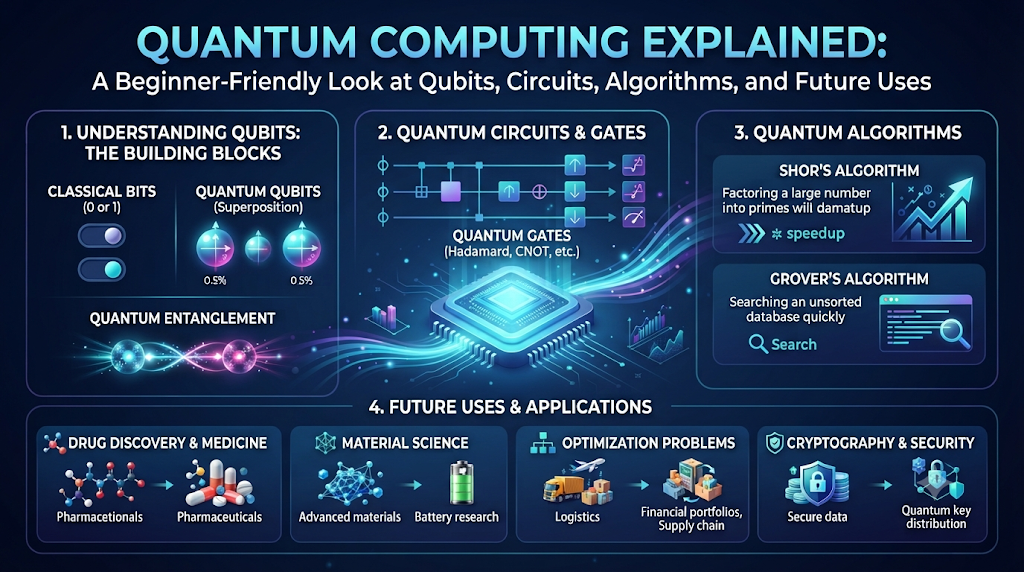
Quantum computing is an interesting area of modern computer science. It uses ideas from quantum physics to process information. Unlike normal computers, it works with special units called qubits. These units behave differently from traditional computer bits. This difference creates new ways to study difficult problems. However, quantum computing also brings new terms and concepts. Beginners need clear explanations before exploring advanced topics. Understanding the basic ideas makes the subject easier. QuantumUting computing for beginners starts with simple concepts. These include qubits, superposition, entanglement, and quantum gates. Each concept explains a different part of quantum technology.
What Is Quantum Computing?
Quantum computing is a computing method based on quantum mechanics. Quantum mechanics explains how very small particles behave. These particles include electrons, atoms, and photons. Traditional computers process information through bits. Each bit stores either zero or one. Quantum computers use qubits to represent information. A qubit can have a quantum state with different possible measurement outcomes.
Quantum computing uses special operations to change these states. These operations help create and process quantum information. The computer then measures its qubits to collect results.
A useful example is scientific research. Researchers may want to study complex molecules. Quantum computers could help model certain molecular systems. However, practical uses still need more research.
Why Is Quantum Computing Important?
Quantum computing is important because it introduces another way to solve computing problems. Some mathematical and scientific tasks are difficult for classical computers. Quantum methods may help with selected problems.
Students can explore the connection between physics and computer science. Developers can learn new programming methods. Researchers can study different approaches to complex calculations.
Security professionals also follow quantum computing research. Some current encryption systems depend on difficult mathematical problems. A sufficiently powerful quantum computer could affect certain public-key methods.
However, today’s quantum computers have major limits. Hardware noise can affect calculations. Researchers continue working on better control and error correction.
Quantum Computing for Beginners
Quantum computing for beginners means understanding how quantum computers process information. These computers use qubits instead of ordinary bits. They also use quantum gates and circuits.
A quantum computer does not work like a regular desktop computer. It does not automatically complete every task faster. Its possible benefits depend on the problem.
For example, a normal computer can easily open websites. It can also edit documents and run common applications. These tasks do not need quantum hardware.
Quantum computers focus on specialized calculations. Researchers explore areas such as chemistry and materials science. They also study mathematical problems and quantum security.
Learning quantum computing for beginners requires patience. Start with basic concepts before studying advanced algorithms. This makes each new topic easier to understand.
What Is a Qubit?
The keyword what is a qubit explains the foundation of quantum computing. A qubit is the smallest basic unit of quantum information. It performs a role similar to a bit in classical computing.
However, qubits follow different physical rules. A classical bit stores zero or one. A qubit has a quantum state that describes possible measurement outcomes.
Understanding Superposition
Superposition describes a quantum state with possible measurement outcomes. It allows a qubit to have probabilities for zero and one. This is not the same as storing two ordinary values.
Think about a spinning coin. Before it stops, its final result is unknown. This gives a simple picture of uncertainty. However, a qubit follows quantum rules, not coin behavior.
Superposition is useful in quantum calculations. Quantum operations can change the probabilities of measurement outcomes. The final measurement gives one result.
Understanding Measurement
Measurement means checking the state of a qubit. It produces one result, either zero or one. The measurement also changes the quantum state.
For example, a qubit may have equal probabilities for both results. Measuring it produces only one outcome. Repeated measurements can show the probability pattern.
Understanding Entanglement
Entanglement creates a strong connection between qubits. Their shared state cannot be fully described separately. Measuring one qubit can reveal information about the shared state.
Entanglement does not allow faster-than-light communication. It is a special property of quantum information.
Understanding what is a qubit helps explain other topics. It provides the starting point for circuits and algorithms.
Quantum Computing vs Classical Computing
Quantum computing vs classical computing explains two different computing methods. Classical computers use bits. Quantum computers use qubits.
Classical Computing
Classical computers process information through ordinary logic gates. These gates change and combine bit values. They support common digital tasks.
Examples include web browsing, office software, gaming, and databases. Classical systems are useful across almost every industry.
Quantum Computing
Quantum computers use quantum gates to change qubit states. These gates form circuits that perform selected operations.
Quantum systems may help with certain scientific and mathematical problems. Their usefulness depends on the task and hardware.
Main Differences
The basic difference in quantum computing vs classical computing involves information storage and processing.
- Information units: Classical systems use bits. Quantum systems use qubits.
- Operations: Classical systems use logic gates. Quantum systems use quantum gates.
- Processing: Classical systems follow classical computing rules. Quantum systems follow quantum physics.
- Applications: Classical computers support everyday tasks. Quantum computers target selected problems.
- Hardware: Classical computers are widely used. Quantum computers remain limited and noisy.
Both technologies have important roles. Quantum computers are not replacements for classical systems. They are expected to work together.
Quantum Gates Explained
Quantum gates explained refers to operations that change qubit states. They are important parts of quantum circuits. Each gate performs a specific operation.
Hadamard Gate
The Hadamard gate creates an even mix of measurement outcomes from a basic state. It helps prepare a qubit for further operations.
This gate is useful when creating superposition. It appears in many introductory quantum circuits.
Pauli-X Gate
The Pauli-X gate flips a basic qubit state. It changes zero to one and one to zero.
It is similar to a simple switch. However, this comparison does not explain every quantum state.
Pauli-Z Gate
The Pauli-Z gate changes a sign in the quantum state. This change can affect later circuit operations.
It does not simply change zero into one. Its role becomes clearer when several gates work together.
CNOT Gate
The CNOT gate operates on two qubits. It flips one qubit depending on another. One qubit controls the operation.
These gates help create different quantum circuits. Understanding quantum gates explained makes circuit diagrams easier to follow.
Quantum Circuits Tutorial
A quantum circuits tutorial explains how quantum gates work together. A quantum circuit is an ordered series of operations. It begins with qubits and usually ends with measurement.
Step One: Prepare Qubits
First, the circuit starts with one or more qubits. Each qubit has an initial state. This state provides the starting point.
Step Two: Apply Gates
Next, the circuit applies selected quantum gates. A Hadamard gate may create an even mix of outcomes. A Pauli-X gate may flip a basic state.
The order of these operations matters. Different gate sequences can produce different results.
Step Three: Perform Measurement
The circuit measures the qubits after applying the gates. Each measured qubit produces zero or one. Measurement changes the measured state.
Step Four: Study the Results
A quantum program can repeat the same circuit many times. The collected results show a pattern. This helps users study possible outcomes.
A quantum circuits tutorial can also introduce programming tools. Frameworks such as IBM’s Qiskit help users build circuits. They also support circuit testing through simulators.
Quantum Computing Algorithms Explained
Quantum computing algorithms explained means studying special methods for solving selected problems. An algorithm is a set of steps used to complete a task.
Classical algorithms use ordinary computer operations. Quantum algorithms use qubits and quantum gates. They are designed for particular types of calculations.
Quantum Search
Quantum search focuses on finding a target item. It works with a collection of possible choices. The method uses quantum operations to improve the chance of finding the target.
It does not mean checking every answer at once. The algorithm uses controlled quantum effects.
Quantum Factoring
Quantum factoring means finding factors of large numbers. Factors are smaller numbers that multiply together to create another number.
This topic matters because some public-key systems depend on difficult mathematical problems. Quantum factoring is an important area of security research.
Quantum Machine Learning
Quantum machine learning explores the connection between quantum computing and machine learning. Researchers study possible ways to use quantum methods in learning tasks.
Its practical value remains under investigation. More research is needed to understand its limits.
Quantum computing algorithms explained helps learners understand the purpose of each method. It also shows why different algorithms need different circuits.
Shor’s Algorithm Explained
Shor’s algorithm explained refers to a quantum method for finding factors of large numbers. It is an important subject in quantum computing research.
Factoring means finding numbers that multiply together. Small numbers are easy to factor. Very large numbers can be difficult for classical computers.
Some public-key cryptography systems depend on factoring or related mathematical problems. These systems help protect digital information and communication.
Shor’s algorithm could threaten certain systems if run on sufficiently powerful quantum hardware. However, current quantum computers cannot run it at real encryption scale.
Running Shor’s algorithm on numbers used in real encryption needs a large, error-corrected quantum computer. Such machines do not exist today.
Quantum error correction helps protect quantum information from hardware errors. It remains a major research challenge.
Understanding Shor’s algorithm explained helps readers understand future security concerns. It does not mean current quantum computers can break encryption.
Post-Quantum Cryptography Explained
Post-quantum cryptography explained focuses on new encryption methods. These methods aim to resist attacks from classical and quantum computers.
Unlike quantum cryptography, post-quantum cryptography runs on ordinary computers. It uses mathematical methods rather than quantum communication.
Quantum key distribution is different. It uses quantum physics to support secure key exchange. The two security approaches should not be confused.
Why Post-Quantum Security Matters
Organizations store sensitive information for long periods. Some information must remain private for many years. This creates a need to study future security risks.
Security teams need to understand where public-key cryptography is used. They also need to follow changes in security standards.
Standards bodies have been working on and publishing standards. These efforts support the development of quantum-resistant protection methods.
Readers should check current official sources for updates. Security planning should also follow expert guidance.
Post-quantum cryptography explained helps readers understand how digital protection may change. It also connects quantum computing research with everyday online security.
Real-World Applications of Quantum Computing
Real-world applications of quantum computing are still being explored. Researchers and companies are studying possible uses. Most applications remain in the research stage.
Chemistry Research
Quantum computers may help researchers study molecules. Chemical systems follow quantum physics. Simulating their behavior can be difficult for classical computers.
Researchers are exploring quantum methods for molecular studies. Practical benefits still need careful testing.
Materials Science
Materials science studies the structure and behavior of materials. Researchers explore substances with useful properties.
Quantum computers may help model certain material systems. These methods remain under investigation.
Optimization
Optimization means finding a suitable choice among many options. Researchers are exploring quantum methods for selected optimization problems.
Possible areas include planning and resource allocation. No general business benefit should be assumed.
Cybersecurity
Quantum computing has an important connection with digital security. Shor’s algorithm creates concerns about certain public-key systems. Post-quantum cryptography explores ways to address these concerns.
Quantum Machine Learning
Researchers are studying possible links between quantum computing and machine learning. These studies explore new ways to process information.
Real-world applications of quantum computing need more testing. Current hardware still has important limits. Researchers must check results before claiming practical benefits.
How to Learn Quantum Computing
How to learn quantum computing starts with basic concepts. Beginners can understand the subject before studying advanced mathematics. A clear learning path makes the process easier.
Step One: Understand Basic Concepts
Start with bits and qubits. Learn superposition, measurement, and entanglement. Basic probability also helps explain measurement outcomes.
Step Two: Explore Quantum Gates
Study Hadamard, Pauli-X, Pauli-Z, and CNOT. Understand the purpose of each gate. Focus on how gates change quantum states.
Step Three: Study Quantum Circuits
Learn how different gates form circuits. Follow simple circuit examples. Understand how measurement produces results.
Step Four: Try a Programming Framework
Explore a framework such as Qiskit. It helps users create and test quantum circuits. Simulators provide a way to explore basic operations.
Basic programming knowledge can help with this step. Some linear algebra also supports deeper learning.
Step Five: Study Quantum Algorithms
Explore quantum search and quantum factoring. Then study Shor’s algorithm. Learn which problems each method addresses.
Step Six: Understand Quantum Security
Study public-key cryptography and encryption. Learn the difference between quantum and post-quantum cryptography. Explore the purpose of quantum-safe methods.
How to learn quantum computing becomes easier with regular practice. Start with concepts before moving toward technical subjects.
Quantum Topics at a Glance
| Topic | What It Means | Why It Matters |
|---|---|---|
| Qubit | Basic unit of quantum information | Stores quantum states |
| Superposition | State with possible measurement outcomes | Supports quantum operations |
| Entanglement | Strong connection between qubits | Creates shared quantum states |
| Quantum gates | Operations that change qubit states | Build quantum circuits |
| Quantum circuits | Ordered quantum operations | Process quantum information |
| Quantum algorithms | Methods for selected problems | Guide quantum calculations |
| Shor’s algorithm | Quantum method for factoring numbers | Raises security concerns |
| Post-quantum cryptography | Methods designed to resist quantum attacks | Supports digital security |
Common Mistakes in Quantum Computing
- Thinking qubits are simply zero and one together: Superposition describes possible measurement outcomes. It needs a proper explanation.
- Expecting quantum computers to solve everything faster: Their possible benefits depend on the problem.
- Ignoring measurement: Measurement gives one result. It also changes the quantum state.
- Confusing entanglement with faster communication: Entanglement cannot send messages faster than light.
- Skipping basic concepts: Qubits and probability support advanced learning.
- Memorizing gates without studying circuits: Gates become easier to understand when studied together.
- Believing current machines can break encryption: Today’s machines cannot run Shor’s algorithm at real encryption scale.
- Mixing quantum and post-quantum cryptography: These terms describe different security methods.
- Learning only one programming framework: Basic concepts matter more than one particular tool.
- Trusting every technology claim: Check current research and official sources.
A Simple Example
Fictional Example: A Student Exploring Quantum Computing
Imagine a student studying computer science. The student wants to understand quantum technology. At first, the technical terms seem difficult.
The student starts by learning bits and qubits. Next, the student studies superposition and measurement. These basic ideas make the subject easier.
After that, the student explores quantum gates. The student studies Hadamard, Pauli-X, Pauli-Z, and CNOT. Then the student follows simple circuit examples.
The student also explores Qiskit and its simulator. This gives the student a way to study circuit operations. Finally, the student reads about algorithms and security.
This fictional example shows a simple learning path. It does not promise a particular result. Understanding grows through study and practice.
How QuantumUting Supports Quantum Learning
QuantumUting.com is an educational technology website. Its theme is “Decoding the Quantum Future.” It explains quantum computing and quantum information science. It also covers new computing technologies in accessible ways.
The website publishes tutorials, beginner guides, technical explanations, and educational articles. Its content supports students, developers, computer science professionals, researchers, and technology fans.
Readers can explore topics such as qubits, quantum states, superposition, measurement, and entanglement. They can also study quantum gates and circuit design.
Its educational content covers Hadamard, Pauli-X, Pauli-Z, and CNOT. Quantum circuit tutorials may include examples using IBM’s Qiskit framework.
Other subjects include Shor’s algorithm, quantum search, and quantum factoring. Readers can also explore quantum software engineering and quantum machine learning.
The website covers quantum security topics as well. These include post-quantum cryptography and quantum-safe encryption. Its articles also explain risks to existing public-key systems.
QuantumUting.com serves as an educational resource. It helps readers explore complex computing ideas through accessible explanations. Its content supports learning at different levels.
Frequently Asked Questions About Quantum Computing
1. Can quantum computing solve every difficult computer problem?
No. Quantum computers are designed for selected types of problems. They may help with certain mathematical and scientific tasks. Classical computers remain better for many everyday activities. Their usefulness depends on the problem, algorithm, and available hardware.
2. Why should students study quantum computing for beginners?
Quantum computing for beginners helps students understand a new area of computer science. It connects physics, mathematics, and programming. Students can learn how qubits and quantum circuits work. These basic ideas also prepare them to explore advanced research topics.
3. What is a qubit used for in a quantum computer?
A qubit stores quantum information. Its state describes possible measurement outcomes. Quantum gates change this state during calculations. Measurement then produces a result. Multiple qubits can also become entangled and form shared quantum states.
4. Can quantum computing vs classical computing be explained through everyday tasks?
Yes. Classical computers handle common tasks such as browsing and document editing. Quantum computers focus on selected specialized calculations. They use different information units and operations. Both systems serve different purposes and can work together.
5. Why are quantum gates important in circuit design?
Quantum gates control changes in qubit states. Each gate performs a particular operation. Several gates can form a quantum circuit. Their order affects the final state. Learning quantum gates explained helps beginners understand how circuits process information.
6. Do beginners need programming knowledge for a quantum circuits tutorial?
Not always. Beginners can first study circuit diagrams and basic operations. Later, they can explore programming frameworks such as Qiskit. Simulators help users test simple circuits. Basic programming knowledge becomes useful during practical learning.
7. What makes Shor’s algorithm explained important for encryption?
Shor’s algorithm explained matters because it can factor large numbers using quantum methods. Some public-key systems rely on difficult factoring problems. However, real encryption requires a large, error-corrected quantum computer. Current machines cannot perform this task.
8. Does post-quantum cryptography explained require a quantum computer?
No. Post-quantum cryptography runs on ordinary computers. It uses mathematical methods designed to resist classical and quantum attacks. Quantum cryptography is different because it uses quantum physics for security tasks. Both approaches have separate purposes.
9. Are real-world applications of quantum computing already common?
No. Most real-world applications of quantum computing remain under research. Scientists are exploring chemistry, materials, optimization, and security. Current hardware has important limits. More testing is needed to establish practical value for these areas.
10. Which subjects should beginners study to understand how to learn quantum computing?
Start with basic probability and qubits. Then study superposition, measurement, and entanglement. Explore quantum gates and circuits next. After that, try Qiskit and study quantum algorithms. Finally, explore security topics and post-quantum cryptography.
Conclusion
Quantum computing introduces a different way to process information. Qubits, superposition, and entanglement form its foundation. Quantum gates and circuits control quantum operations. Algorithms target selected mathematical and scientific problems. However, current quantum computers still face hardware limits. They are not replacements for classical computers. Their practical applications also need further research. Security teams should follow developments in quantum-safe protection. Check current guidance from official standards bodies and security experts. QuantumUting.com helps readers explore these subjects through accessible educational content. Understanding the basics creates a strong starting point for further learning.
Leave a Reply