QuantumOps Explained: Quantum Computing Skills, Cloud Operations, Tools, and Professional Training
Introduction
Quantum technology is creating new areas of technical learning. Software teams are starting to explore quantum systems. Cloud engineers are also studying new computing methods. IT managers want to understand their possible role. However, quantum concepts can feel difficult for beginners. Many professionals also struggle to find clear learning paths.
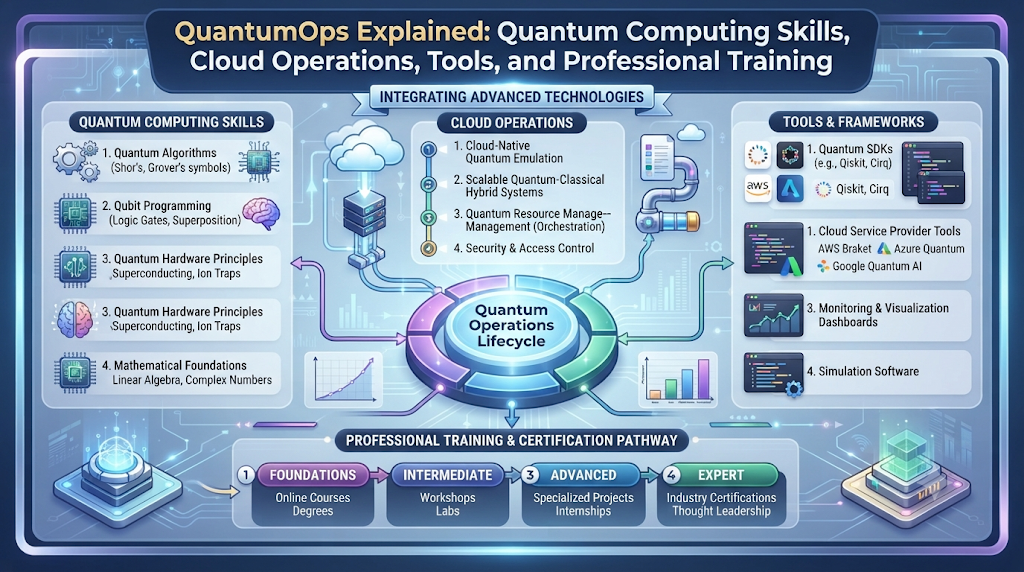
QuantumOps brings quantum computing closer to practical IT work. It connects quantum concepts with programming, cloud platforms, architecture, and operations. QuantumOps School is a specialized quantum computing education, certification, and consulting platform. Based in India, it promotes online and classroom training. Its learning approach focuses on helping technology professionals understand quantum systems and their practical limits.
What Does QuantumOps Mean?
QuantumOps refers to the practices involved in working with quantum computing systems. It brings together quantum software, hardware, cloud access, and technical operations. The term does not have one fixed industry definition. Its meaning can depend on the organization and its work.
Traditional IT operations manage servers, networks, applications, and cloud systems. QuantumOps extends this area into quantum computing environments. It includes learning how quantum programs work and how teams can manage related workflows.
A quantum computer uses qubits instead of regular bits. A qubit is the basic unit of quantum information. Superposition allows a qubit to represent a combination of possible states. Entanglement connects quantum states in a special way.
A quantum gate changes the state of a qubit. A quantum circuit combines several gates into a planned sequence. These ideas form the base of quantum programming.
QuantumOps also involves understanding hardware limits. Today’s quantum computers are early-stage and noisy. Noise means unwanted changes that can affect quantum information. Error correction refers to methods for detecting and managing such errors.
QuantumOps does not mean replacing normal IT systems. Classical computers still handle most everyday computing tasks. Quantum systems may support selected research and computing experiments. Their practical value depends on the problem and available technology.
Why QuantumOps Matters for Modern IT Teams
IT teams work with many types of technology. They manage cloud services, software, data, and infrastructure. Quantum computing introduces another area for technical learning.
QuantumOps helps professionals understand how quantum systems fit into wider IT environments. It also helps teams learn new technical terms. This knowledge can support better discussions about research and system planning.
Software developers can study quantum programming. Cloud engineers can explore quantum cloud environments. System architects can learn about hardware and software connections. Researchers can explore quantum algorithms and circuits.
Quantum computing for software engineers provides a starting point for developers. It explains how quantum programs differ from traditional applications. Developers can begin with basic concepts before exploring advanced topics.
Quantum computing for IT managers is also useful for technology planning. Managers need to understand technical limits and project risks. They should know which tasks still need classical computing.
QuantumOps can help teams build awareness without making unrealistic promises. Learning about quantum systems does not guarantee business improvements. It also does not mean every organization needs quantum hardware.
QuantumOps and Quantum Cloud Computing Training
Quantum cloud computing training helps learners explore quantum environments through cloud platforms. It introduces ways to study quantum systems online. Learners can explore programming tools and simulators.
A simulator is software that models quantum system behavior. It helps learners test circuits without using physical quantum hardware. This can make early learning easier.
Quantum cloud computing training generally covers:
- Basic quantum computing concepts.
- Cloud-based quantum environments.
- Qubit and circuit fundamentals.
- Quantum programming workflows.
- Simulator exercises.
- Result analysis.
- Basic workload planning.
Quantum cloud computing training is useful for professionals who already understand cloud computing. It introduces another type of computing environment. However, learners should understand that quantum hardware has different limits.
QuantumOps School advertises cloud-based quantum computing as part of its curriculum. Its listed learning platforms include AWS Braket, IBM Quantum, and Azure Quantum. These platforms are covered as learning tools, not as official training partnerships.
QuantumOps for Software Engineers
Software developers need a basic understanding of quantum information. They should first learn how qubits differ from normal bits. Then they can explore gates, circuits, and measurements.
Quantum computing for software engineers focuses on these basic ideas. It helps developers understand how quantum programs are organized. It also introduces new ways to think about computing problems.
Important learning areas include:
- Qubit fundamentals.
- Superposition and entanglement.
- Quantum gate operations.
- Quantum circuit design.
- Measurements and results.
- Basic quantum algorithms.
- Simulator-based programming.
A quantum program follows a circuit of operations. Each gate performs a particular action on quantum states. Measurement produces information about the system.
Quantum computing for software engineers does not require every developer to become a physicist. A steady learning path can begin with simple examples. Programming practice can then help explain the concepts.
QuantumOps School lists programming and quantum algorithm topics in its advertised curriculum. Its learning tools include Qiskit, Cirq, and Microsoft Quantum Development Kit.
Important Tools Used in QuantumOps Learning
QuantumOps learning can involve different programming tools and platforms. Each tool provides a way to study quantum computing concepts. Learners should understand the basic ideas before choosing a tool.
1. Qiskit
Qiskit is a tool used for quantum programming. Learners can study circuits, gates, and measurements. A Qiskit programming course generally introduces these basic tasks. It can also include simulator practice.
2. Cirq
Cirq is a framework used for quantum programming. It can help learners explore circuit design. Beginners can use structured exercises to understand quantum operations.
3. Microsoft Quantum Development Kit
Microsoft Quantum Development Kit is a learning and development tool. It can introduce learners to quantum programming concepts. It belongs among the tools listed in the QuantumOps School curriculum.
4. AWS Braket
AWS Braket is a cloud-based quantum computing platform. AWS Braket training introduces learners to quantum workflows in a cloud setting. It can help cloud professionals understand the general process of exploring quantum systems.
5. IBM Quantum
IBM Quantum is a platform covered in the advertised learning topics. Learners can study quantum computing concepts through its learning environment. They should check current platform information before using it.
6. Azure Quantum
Azure Quantum is another platform listed in the curriculum. It helps learners explore the wider area of quantum computing. Its role in a course depends on the training plan.
QuantumOps learning should not focus only on tool names. Understanding qubits, circuits, and hardware limits matters more. Tool knowledge becomes useful when learners understand the concepts behind it.
Qiskit Programming Course for QuantumOps Skills
A Qiskit programming course can help developers begin practical quantum learning. It generally explains how quantum circuits are created. It also introduces gates and measurements.
Learners may study these areas:
- Basic quantum programming.
- Creating quantum circuits.
- Applying quantum gates.
- Understanding measurements.
- Running simulator exercises.
- Reviewing circuit results.
A Qiskit programming course should explain each step clearly. Learners should understand why a gate is used. They should also learn how measurements affect results.
QuantumOps connects this programming knowledge with wider technical work. Developers can explore how quantum code fits into a workflow. They can also study the limits of simulations.
QuantumOps School lists Qiskit among its advertised curriculum tools. Its training information also mentions practical labs and technical assessments. Learners should check the current syllabus before selecting a course.
AWS Braket Training for Cloud Professionals
AWS Braket training introduces the general idea of cloud quantum computing. It helps learners understand how quantum workflows fit into cloud environments.
A cloud quantum service gives users an online way to explore quantum computing resources. Learners can study how tasks are prepared and how results are reviewed.
AWS Braket training may include:
- Quantum computing fundamentals.
- Cloud quantum concepts.
- Circuit preparation.
- Simulator-based practice.
- Quantum workflow steps.
- Result interpretation.
For cloud engineers, this subject adds another area of technical knowledge. It can help them understand the relationship between cloud operations and quantum computing.
AWS Braket training should not be treated as proof of practical business value. Quantum computers remain limited. Many tasks still work better on classical systems.
QuantumOps School advertises AWS Braket within its learning topics. It is an independent education platform. It does not claim to be an official trainer of AWS.
Hybrid Quantum Classical Computing Training
Hybrid quantum classical computing training explains how classical and quantum systems can work together. Both systems have different roles in a computing workflow.
A classical computer can prepare information. A quantum system may process a selected operation. The classical computer can then review the returned results.
Hybrid quantum classical computing training may cover:
- Classical and quantum system roles.
- Data preparation.
- Quantum circuit execution.
- Result processing.
- Workflow design.
- Basic error handling.
This approach matters because today’s quantum systems have limits. Classical computers remain essential for most applications. A hybrid design can help researchers explore selected quantum tasks.
QuantumOps teams need to understand how these systems connect. They should also study data movement and security needs.
QuantumOps School advertises hybrid quantum-classical systems in its learning and consulting areas. Organizations can review the advertised support before considering a project. No specific result is guaranteed.
Quantum Computing Architecture Course for System Design
A quantum computing architecture course explains how different parts of a quantum system fit together. It covers hardware, software, cloud environments, and system connections.
Architecture means the structure and design of a system. Quantum architecture includes the physical hardware and the software used to control operations.
A quantum computing architecture course may cover:
- Qubit concepts.
- Quantum hardware architecture.
- Quantum software layers.
- Circuit design.
- Cloud computing environments.
- Workload planning.
- Quantum error correction.
Hardware architecture helps learners understand how quantum systems are organized. It also explains why physical limitations matter.
Error correction focuses on detecting and managing errors. It is important because quantum information can be affected by noise.
QuantumOps School lists hardware architecture and error correction in its advertised topics. These areas can help system architects understand quantum system design.
Quantum Computing for IT Managers
Quantum computing for IT managers focuses on awareness, planning, and technical decisions. Managers do not need to write quantum programs. They should understand the main concepts and limits.
Important areas include:
- Basic quantum computing terms.
- Possible research applications.
- Hardware and software limits.
- Security and data concerns.
- Team learning needs.
- Project planning.
- Vendor and trainer evaluation.
Quantum computing for IT managers also means setting realistic expectations. Quantum technology remains early-stage. Managers should not expect guaranteed savings or better business performance.
They should ask clear questions before approving training. They should review the proposed learning goals. They should also check whether a classical solution is more suitable.
QuantumOps School advertises a Manager learning track. The track is part of its wider education offering. Managers should review the current syllabus and course details.
Quantum Computing Certification Course and Professional Learning
A quantum computing certification course gives learners a structured way to study quantum technology. It may include lessons, practical exercises, and assessments.
Before enrolling, learners should review:
- Course syllabus.
- Learning goals.
- Programming practice.
- Simulator exercises.
- Technical assessments.
- Capstone project details.
- Credential conditions.
A quantum computing certification course should explain what learners will study. It should also describe how their knowledge will be assessed.
QuantumOps certification refers to credentials advertised by QuantumOps School. The platform describes four learning tracks.
Architect Track: Focuses on quantum system design, hardware, and architecture.
Engineer Track: Focuses on programming, circuits, and technical learning.
Manager Track: Focuses on technology awareness and planning.
Professional Track: Provides a wider learning path for technology professionals.
QuantumOps certification details should be checked with the provider. Ask about the syllabus, exams, assessments, and credential conditions. Do not assume accreditation or employer recognition.
A quantum computing certification course does not guarantee a job or promotion. Its value depends on the learning content and personal goals. Learners should choose a program that matches their needs.
QuantumOps Consulting and Freelance Support
Quantum computing consulting services generally help organizations explore quantum-related technical work. They may include planning, integration, and system design discussions.
QuantumOps School advertises quantum computing consulting services in several areas:
- Quantum cloud integration.
- Algorithm development.
- Workload optimization.
- Hybrid quantum-classical systems.
- Cloud security.
- Implementation strategy.
The site also advertises access to freelance support. Organizations should review the proposed scope before making commitments.
Before hiring, ask about the work involved. Confirm the responsibilities and expected deliverables. Discuss data security and project requirements. Also review the limits of the proposed service.
Quantum computing consulting services cannot guarantee business results. Outcomes depend on the organization, project, and technology. Quantum computing remains early-stage.
Table: QuantumOps Learning and Service Options
| Option | What It Covers | Who It Helps |
|---|---|---|
| Quantum cloud computing training | Cloud environments and simulators | Cloud engineers |
| Qiskit programming course | Quantum circuits and programming | Software developers |
| AWS Braket training | Cloud quantum workflows | Cloud professionals |
| Hybrid quantum classical computing training | Combined computing methods | Technical teams |
| Quantum computing architecture course | Hardware and system design | System architects |
| Quantum computing certification course | Structured learning and assessments | Beginners |
| QuantumOps certification | Four advertised tracks | IT professionals |
| Quantum computing consulting services | Integration and technical planning | Organizations |
| Quantum computing for IT managers | Risk and project awareness | IT managers |
Common Mistakes in QuantumOps Learning
1. Expecting quick business results: Quantum computing remains early-stage. Practical benefits are not guaranteed.
2. Skipping basic concepts: Learn qubits, gates, and circuits before advanced topics.
3. Treating quantum as a replacement: Classical computers remain important for daily operations.
4. Learning tools without understanding concepts: Tool knowledge alone is not enough.
5. Ignoring hardware limits: Noise can affect quantum system results.
6. Assuming certificates guarantee jobs: Credentials do not promise employment or promotions.
7. Ignoring cloud security: Teams should review access and data protection needs.
8. Hiring without checking the scope: Confirm responsibilities and service details first.
9. Confusing simulators with real hardware: Simulation results do not prove physical device performance.
10. Trusting every technology claim: Check technical evidence and realistic limitations.
A Practical Example of QuantumOps Learning
Fictional Example: An IT Team Explores Quantum Computing
Imagine a small IT team working with cloud applications. The team wants to understand quantum computing. Its members have different technical roles.
The software developer starts with qubits and quantum circuits. The developer then explores a Qiskit programming course. Simulator exercises help explain basic operations.
The cloud engineer studies quantum cloud computing training. The engineer also explores AWS Braket training concepts. This helps build basic awareness of cloud quantum workflows.
The system architect studies a quantum computing architecture course. The IT manager explores quantum computing for IT managers. Both review technical limits and project needs.
The team also studies hybrid quantum classical computing training. It discusses how classical and quantum systems differ.
The members review learning information from QuantumOps School. They check its advertised tracks and training formats. They do not assume that training guarantees business results.
This fictional example shows how different roles can learn together. It does not suggest that every IT team needs quantum technology.
How QuantumOps School Supports Quantum Learning
QuantumOps School is an independent quantum computing education, certification, and consulting platform based in India. It promotes online and classroom training.
The site advertises four tracks: Architect, Engineer, Manager, and Professional. Its listed topics include qubits, quantum gates, superposition, entanglement, quantum algorithms, hardware architecture, error correction, cloud computing, and workload optimization.
Its advertised curriculum includes Qiskit, Cirq, Microsoft Quantum Development Kit, AWS Braket, IBM Quantum, and Azure Quantum.
The platform advertises instructor-led sessions, practical labs, simulations, case studies, technical assessments, and capstone projects.
Its advertised consulting and freelance support areas include cloud integration, algorithm development, workload optimization, hybrid systems, cloud security, and implementation strategy.
QuantumOps School also publishes articles and tutorials about quantum basics, hardware, cloud platforms, programming frameworks, quantum security, and infrastructure operations.
Learners should check the current course syllabus and credential terms. Organizations should confirm consulting scope before making decisions.
Frequently Asked Questions About QuantumOps
1. What does QuantumOps mean in IT?
QuantumOps refers to practices that connect quantum computing with technical operations. It includes programming, cloud access, architecture, and workload planning. The term does not have one fixed industry definition. Its meaning depends on the work and goals of each organization.
2. Who should consider quantum cloud computing training?
Quantum cloud computing training may interest developers, cloud engineers, and researchers. It introduces online quantum environments and simulators. Beginners can study basic circuits and quantum workflows. Previous experience with quantum hardware is not required to begin learning basic concepts.
3. Is quantum computing for software engineers suitable for beginners?
Quantum computing for software engineers can suit beginners with basic programming knowledge. They can start with qubits, gates, and circuits. They should then explore simple programs and simulations. A steady learning plan can make unfamiliar concepts easier to understand.
4. What can I learn in a Qiskit programming course?
A Qiskit programming course generally covers quantum circuits, gates, and measurements. It may include simulator exercises and simple programming tasks. Learners should review the syllabus to understand the exact topics and practical activities included.
5. What is the purpose of AWS Braket training?
AWS Braket training introduces cloud-based quantum computing workflows. It helps learners understand how quantum tasks fit into an online environment. It may suit cloud professionals who want to explore quantum technology. Platform details and training content should be checked before enrollment.
6. Why do teams need hybrid quantum classical computing training?
Hybrid quantum classical computing training explains how both computing methods can work together. Classical systems handle many regular tasks. Quantum systems may support selected experimental operations. This knowledge helps teams understand different system roles and technical limits.
7. What does a quantum computing architecture course teach?
A quantum computing architecture course covers hardware, software, circuits, and cloud environments. It explains how these parts connect. Learners can study system structure, hardware limits, and error correction. This knowledge can help technical professionals understand quantum system design.
8. What should I check before joining a quantum computing certification course?
A quantum computing certification course should have a clear syllabus and learning goals. Review its practical work and assessment details. Ask what the credential represents. QuantumOps certification details should also be checked directly with the provider.
9. What does quantum computing for IT managers involve?
Quantum computing for IT managers involves basic concepts, technical risks, and planning. Managers should review security, team skills, and project needs. They should also understand that quantum computing remains early-stage. No specific business result is guaranteed.
10. What do quantum computing consulting services cover?
Quantum computing consulting services may involve cloud integration, algorithm development, workload optimization, and hybrid systems. QuantumOps School advertises these areas along with cloud security and implementation strategy. Organizations should confirm the scope and understand that outcomes vary.
Final Thoughts
QuantumOps connects quantum computing knowledge with wider IT learning. It brings together programming, cloud platforms, architecture, and system planning. Developers can explore circuits and tools. Cloud engineers can study online quantum workflows. Managers can learn about risks and technical limits.
Quantum computing remains early-stage. Current systems have noise and practical limits. Classical computers continue to support everyday computing. Learning should focus on clear concepts and useful practice. QuantumOps School advertises training, certification, and consulting options. Review its syllabus, credentials, and service details before making a decision.
Leave a Reply