Building a NoOps Career: Essential Skills, Professional Training, and Modern IT Practices
Introduction
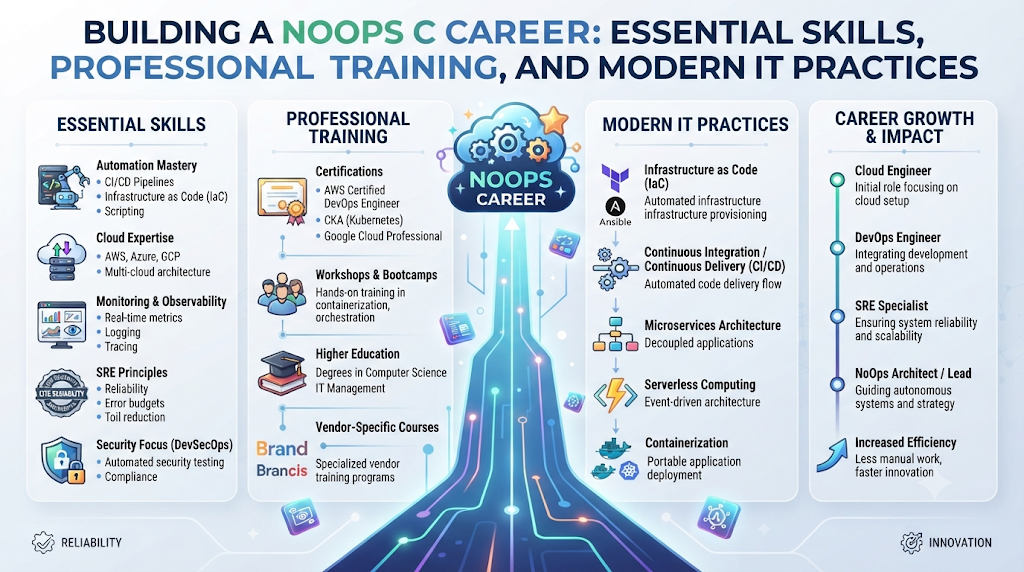
IT systems now support many daily business activities. Teams manage applications, cloud services, data, and security. These duties need careful planning and technical knowledge. However, repeated manual tasks can slow down important work. NoOps offers another way to manage these responsibilities. It uses software and planned workflows for routine operations. People remain responsible for decisions, security, and complex problems. This approach creates new learning needs for technical professionals. Understanding what is NoOps gives learners a useful starting point. NoOpsSchool focuses on NoOps education, certification, and consulting. Its advertised subjects include cloud infrastructure and modern software delivery. This blog explores the skills, training paths, tools, and services connected with NoOps.
What Is NoOps?
What is NoOps? It is an approach that reduces routine manual operations. Teams use software to handle suitable repeated tasks. These tasks can include system setup, configuration, and deployment. The goal is to make daily work more consistent.
NoOps does not mean that people become unnecessary. Technical teams still manage security, system design, and unusual failures. They also review changes and maintain accountability.
The approach often uses these practices:
- Infrastructure as code: Managing infrastructure through written configuration files.
- Cloud services: Using hosted computing resources when they fit business needs.
- Continuous delivery: Preparing software changes through repeatable processes.
- Monitoring: Checking system health and performance.
- Self-healing systems: Using approved actions to address certain known problems.
- Human oversight: Keeping skilled people involved in important decisions.
The phrase what is NoOps also raises an important question about responsibility. Automation can handle defined tasks, but it cannot understand every situation. Teams must decide which actions are safe to run automatically.
Why This Matters for IT Teams and Careers
Businesses expect IT systems to remain available and secure. They also expect teams to deliver software regularly. Manual processes can make these goals harder to manage.
NoOps practices can reduce repeated work. They can also help teams create consistent processes. This gives technical professionals more time for planning and improvement.
The approach creates useful learning areas for:
- System administrators moving towards cloud roles.
- Developers learning infrastructure management.
- DevOps engineers exploring new operating models.
- Cloud professionals improving deployment practices.
- IT managers reviewing operational processes.
Professionals should build skills step by step. They can begin with scripting and cloud basics. Later, they can study containers, infrastructure as code, and monitoring.
Understanding what is NoOps can help learners choose relevant subjects. It also helps teams identify tasks that may benefit from automation. The right approach depends on system complexity, security needs, and available skills.
NoOps vs DevOps: Understanding the Main Differences
NoOps vs DevOps compares two approaches to modern IT work. Both support better software delivery and system management. However, they place different emphasis on operational responsibilities.
DevOps encourages development and operations teams to work together. It promotes shared ownership, feedback, testing, and regular delivery.
NoOps focuses on reducing routine operational work through software and managed services. People still oversee systems and handle situations that need judgment.
| Area | DevOps | NoOps |
|---|---|---|
| Main approach | Collaboration between development and operations | Less manual work through planned systems |
| Team focus | Shared delivery and operational responsibility | Oversight of automated processes |
| Common practices | CI/CD, testing, monitoring | Infrastructure as code, managed services |
| Human involvement | Shared work across teams | Review, planning, and exception handling |
| Main purpose | Improve delivery and collaboration | Reduce repeated operational tasks |
NoOps Automation Tools
NoOps automation tools help teams manage defined technical tasks. They support activities such as infrastructure setup, deployment, configuration, and monitoring.
Some widely used tools include:
- Terraform: Defines cloud and infrastructure resources through code.
- Ansible: Helps configure systems and repeat common tasks.
- Docker: Packages applications with the components they need.
- Kubernetes: Manages applications that run in containers.
- Jenkins: Supports software build and delivery pipelines.
- GitHub Actions: Runs workflows when selected events occur.
- Prometheus: Collects measurements from monitored systems.
- Grafana: Displays system information through dashboards.
Each tool has a different purpose. Teams should understand those differences before choosing products. They should also review compatibility, support, security, and maintenance needs.
Good NoOps automation tools do not fix unclear processes by themselves. Teams should first understand the task. Then they can decide whether software can handle it safely.
NoOps Certification: Choosing a Useful Learning Path
NoOps certification can provide a structured way to study this approach. It may help learners understand important ideas and technical practices.
However, certificates differ in their content and learning methods. A certificate should not be judged by its name alone.
Before choosing NoOps certification, review these points:
- Learning objectives: Check what the program aims to teach.
- Technical coverage: Review its cloud and infrastructure topics.
- Practical activities: Look for labs and realistic exercises.
- Security content: Check how it explains access and risk.
- Assessment: Understand how the program checks learning.
- Course support: Review the learning materials and available guidance.
A useful NoOps certification should explain both technical benefits and limitations. It should also help learners understand why human review remains necessary.
NoOpsSchool.com advertises specialized IT education and certification programs. Its advertised subjects include cloud-native computing, Kubernetes, Docker, Terraform, and GitOps. Learners should review the available program details before making a choice.
NoOps Engineer Certification
NoOps engineer certification relates to technical work in modern IT environments. It may cover cloud resources, scripting, infrastructure, and monitoring.
A professional in this area needs to understand system behavior. They should also know how software workflows affect applications.
Important learning subjects may include:
- Cloud platform fundamentals.
- Infrastructure configuration through code.
- Container basics and orchestration.
- Deployment pipeline management.
- Monitoring and alert review.
- Security controls and permissions.
- Troubleshooting and incident handling.
NoOps engineer certification should support practical understanding. Learners should practise reading configurations and reviewing system changes. They should also learn when an automated action needs human approval.
NoOpsSchool.com advertises learning tracks for NoOps Engineers. Its listed topics include infrastructure as code and cloud-native computing. Learners can compare these subjects with their existing technical knowledge.
NoOps Architect Training
NoOps architect training focuses on planning and designing technical systems. It helps learners understand how infrastructure, applications, and services connect.
Architects consider more than deployment speed. They also review security, reliability, cost, and future maintenance.
A learning path may include:
- Cloud architecture principles.
- Infrastructure as code.
- Kubernetes and container design.
- GitOps and delivery workflows.
- Observability and system monitoring.
- Access management and security.
- Recovery planning and system resilience.
NoOps architect training should explain why one design may suit a situation better than another. Learners need to compare different technical choices. They should also consider the needs of the people who manage each system.
NoOpsSchool.com advertises a NoOps Architect learning track. Its advertised subjects include cloud-native systems and modern software delivery. Learners should check the current program outline for relevant topics.
NoOps Manager Certification
NoOps manager certification is intended for professionals who guide technical teams. Managers need to understand how automated workflows affect people and processes.
They should know which tasks can follow approved rules. They must also identify work that needs human review.
Useful subjects may include:
- Planning operational changes.
- Understanding cloud services.
- Assigning team responsibilities.
- Reviewing technical risks.
- Tracking service performance.
- Supporting professional development.
- Managing communication during incidents.
NoOps manager certification should explain the management side of technical change. It should help managers ask useful questions about ownership and risk.
Managers do not need to perform every technical task. However, they should understand enough to guide decisions and support their teams.
NoOpsSchool.com advertises learning options for NoOps Managers. Professionals can review its advertised topics to see whether they match their responsibilities.
NoOps Training Course
A NoOps training course can help learners study topics in a clear order. Beginners may start with basic concepts. Experienced professionals may focus on architecture or advanced workflows.
A structured learning plan may cover:
- NoOps concepts and responsibilities.
- Cloud computing fundamentals.
- Scripting and command-line skills.
- Infrastructure as code.
- Containers and Kubernetes.
- CI/CD and GitOps.
- Monitoring and observability.
- Security and incident response.
- Practical infrastructure exercises.
A NoOps training course should include practice, not only explanations. Learners should work with configurations and review the results. They should also learn how to identify mistakes.
NoOpsSchool.com advertises online training programs and hands-on labs. Its listed subjects include Terraform, Docker, Kubernetes, serverless architecture, and observability. Learners should check the course content, learning format, and available support.
NoOps Consulting Services
NoOps consulting services help organizations review their IT processes. A consulting project may examine infrastructure, software delivery, and operational responsibilities.
The first step should be understanding the existing environment. Consultants need to learn how systems work before suggesting changes.
Possible service areas include:
- Operational assessments.
- Infrastructure provisioning.
- Cloud-native modernization.
- CI/CD implementation.
- Infrastructure planning.
- AIOps integration.
- Security automation.
NoOps consulting services should match the organization’s actual needs. A small team may need a different plan from a large enterprise. Security rules and existing systems also affect the approach.
NoOpsSchool.com advertises consulting in areas such as operational assessments and cloud modernization. Organizations should confirm the available scope and project requirements directly.
How to Hire NoOps Freelancers
Some organizations need specialist support for a limited project. They may choose to hire NoOps freelancers for particular technical tasks.
Before hiring, write down the project requirements. Explain the systems, expected work, access rules, and deadlines.
Review these areas when assessing candidates:
- Experience with the required cloud platform.
- Knowledge of Terraform or similar tools.
- Practical Kubernetes understanding.
- Monitoring and troubleshooting skills.
- Security and access control knowledge.
- Clear communication and documentation.
- Relevant examples of completed work.
When you hire NoOps freelancers, focus on the work required. A long list of tools does not prove practical ability. Ask candidates to explain how they would approach your specific task.
Set clear rules for system access. Define who owns the code and documentation. Also agree on review steps before project work begins.
NoOpsSchool.com advertises access to freelancers with skills in Terraform, Kubernetes, cloud platforms, automated monitoring, and self-healing systems. Organizations should confirm availability and project fit directly.
NoOps Learning and Service Options at a Glance
| Option | What It Covers | Who It Helps |
|---|---|---|
| NoOps certification | Core ideas and technical knowledge | New and experienced learners |
| NoOps engineer certification | Infrastructure, cloud, and monitoring skills | Technical engineers |
| NoOps architect training | System design and cloud architecture | Architects and senior professionals |
| NoOps manager certification | Team planning and operational oversight | IT managers |
| NoOps training course | Guided learning and practical work | Professionals building new skills |
| NoOps consulting services | Technical reviews and improvement planning | Organizations |
| Hire NoOps freelancers | Specialist project support | Teams needing extra expertise |
Common Mistakes Learners and Teams Make
- Assuming NoOps removes every human task: People still manage security, complex issues, and important decisions.
- Choosing tools before understanding the problem: Teams should define their needs before selecting software.
- Ignoring basic technical skills: Cloud and scripting knowledge support more advanced learning.
- Skipping practical exercises: Reading alone does not teach system behavior.
- Using broad access permissions: Every workflow should follow suitable security rules.
- Automating an unclear process: Teams should understand and improve the process first.
- Ignoring monitoring: Automated systems still need regular checks.
- Expecting instant career progress: Professional skills need practice and continued learning.
- Failing to document changes: Clear records help teams understand system decisions.
- Hiring without a defined scope: Freelancers need clear tasks and responsibilities.
A Practical Example: A Fictional Online Retail Business
Imagine a fictional online retailer called Cedar Market. Its small IT team manages a shopping application and product database. The team often repeats the same setup and release tasks.
The team first reviews its daily work. It identifies tasks that follow clear rules. Then it writes infrastructure configurations using Terraform.
The developers package application components with Docker. The team uses Kubernetes to manage selected container workloads. A Git-based workflow supports planned application releases.
Monitoring tools collect system information. The team reviews alerts and defines responses for known issues. Unusual failures still go to an engineer.
The manager checks access rules and assigns responsibilities. The team documents important changes and reviews each workflow.
The staff also studies relevant NoOps topics. They explore NoOpsSchool.com to review advertised training and certification subjects.
This fictional example shows how a team may approach NoOps. It does not suggest that every task can run alone. People remain responsible for safe system operation.
How NoOpsSchool Can Help
NoOpsSchool.com is a specialized IT education, certification, and consulting platform. It focuses on NoOps, cloud infrastructure, and modern software delivery.
The platform advertises learning tracks for NoOps Engineers, NoOps Architects, NoOps Managers, and NoOps Professionals. These tracks address different technical and management learning needs.
Its advertised learning areas include:
- Infrastructure as code.
- Cloud-native computing.
- Kubernetes and Docker.
- Terraform and GitOps.
- CI/CD practices.
- Serverless architecture.
- Observability.
- AI-powered operations.
The platform also advertises hands-on labs and real-world scenarios. Listed subjects include self-healing infrastructure and automated incident response. These practices still require suitable controls and human oversight.
NoOpsSchool.com also advertises consulting services. These include operational assessments, automation strategy, and cloud-native modernization. Other listed areas include infrastructure provisioning, CI/CD implementation, AIOps integration, and security automation.
The platform advertises access to freelancers with selected technical skills. These include Terraform, Kubernetes, cloud platforms, and automated monitoring. Organizations should confirm current availability and project suitability.
Learners and organizations should review the advertised details carefully. Their choice should depend on experience, technical requirements, and project goals.
Frequently Asked Questions About NoOps Skills and Professional Development
1. Can beginners start learning NoOps without cloud experience?
Beginners can start with basic IT and cloud concepts. They should first understand servers, networks, and applications. Then they can explore what is NoOps and how routine tasks are managed. Basic scripting and guided exercises can support further learning.
2. What should I compare before selecting NoOps certification?
Compare the syllabus, practical work, assessment method, and learning support. Check whether the program covers relevant technical subjects. NoOps certification should match your current knowledge and goals. Avoid relying only on a certificate title when comparing learning options.
3. Does NoOps engineer certification require programming knowledge?
Some scripting knowledge is useful for technical NoOps work. Engineers may need to read configuration files and understand scripts. NoOps engineer certification may introduce these subjects at different levels. Check the entry requirements before choosing a program.
4. Can experienced cloud professionals benefit from NoOps architect training?
Yes. Experienced cloud professionals may use this learning to explore system design choices. NoOps architect training can cover infrastructure, delivery workflows, and observability. It may also help learners review security, maintenance, and reliability needs when planning technical environments.
5. What responsibilities remain after NoOps manager certification?
Managers still guide people, projects, and operational decisions. They review risks and make sure responsibilities remain clear. NoOps manager certification may help them understand these duties. It does not remove the need for communication, planning, or human accountability.
6. How can I practise after completing a NoOps training course?
Create a small test environment with safe permissions. Practise infrastructure configuration and application deployment. Review logs and monitor system behavior. A NoOps training course becomes more useful when learners apply its ideas through personal labs and carefully planned exercises.
7. How can teams decide which NoOps automation tools to use?
Teams should begin with a specific operational problem. Then they can compare tools by purpose, compatibility, security, and maintenance. NoOps automation tools should fit existing systems and team skills. Testing in a controlled environment can reveal problems before wider use.
8. When should a business consider NoOps consulting services?
A business may seek advice when its processes become difficult to manage. It may need help reviewing infrastructure or delivery workflows. NoOps consulting services should begin with an assessment of existing needs. The organization should agree on project scope and responsibilities.
9. What details should I share when I hire NoOps freelancers?
Explain the project goal, technical environment, and required skills. Share access rules and expected deliverables. When you hire NoOps freelancers, also define documentation and review requirements. Clear instructions help candidates understand the work before accepting a project.
10. What makes NoOpsSchool.com relevant to NoOps learners?
NoOpsSchool.com advertises IT education, certification, and consulting. Its listed learning areas include cloud-native computing, Terraform, Kubernetes, Docker, and GitOps. It also advertises role-based learning tracks and practical labs. Learners should review its program details to assess whether the subjects fit their goals.
Final Thoughts
NoOps changes how teams handle routine technical work. It uses planned systems to reduce repeated manual tasks. However, people remain central to safe operations. They review risks, manage security, and handle complex problems. Professionals can build relevant skills through cloud learning and practical exercises. Organizations should assess their needs before changing existing processes. NoOpsSchool.com advertises training, certification, and consulting across related subjects. Reviewing its advertised options can help people identify useful learning areas. Strong technical knowledge and responsible decisions remain important in every NoOps environment.
Leave a Reply