Why Your Free Trials Keep Turning Paid: A Subscription Tracker India Guide
Introduction
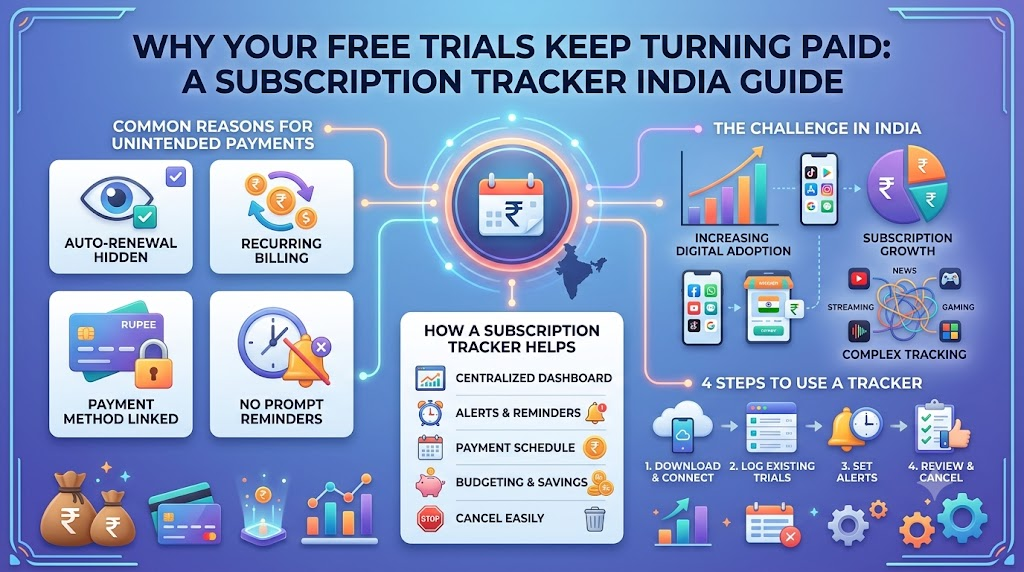
You sign up for a free trial on a quiet evening. You plan to cancel within a week. Then life gets busy, and the date slips by. A month later, a charge appears and you wonder why. Many people face this small shock. A subscription tracker India households use can end it. It keeps every paid plan in one place, with dates and reasons. A recurring payment tracker adds the bank side of the story. This guide gives plain steps to catch trials, renewals, and price rises early. MoneyVoid is a privacy-focused personal and business finance platform that is being developed. It aims to help individuals, families, founders, and finance teams see where money goes.
What Does a Subscription Mean?
A subscription is a plan that charges you again and again for ongoing access. Movies, music, news, games, fitness classes, cloud storage, and learning apps all work this way. Some plans renew by themselves. Others ask for a new payment each cycle. The cycle may be weekly, monthly, or yearly. Think of a milk delivery at your door. It keeps coming until you tell the seller to stop. Digital plans behave the same way. The difference is that nobody rings your bell. The charge simply appears on your statement. So the burden of remembering falls on you.
Why This Matters for Your Money
Most plans look harmless alone. Trouble starts when they multiply. A household may hold several video plans, a few music plans, and some app upgrades. Each family member adds more. Prices also change. A provider may raise a fee at renewal and send only a short notice. If you never read it, you pay more without choosing to. Time is a cost too. Hunting for cancel buttons takes patience. A clear list saves that effort. It also helps you compare value. Ask whether each plan still gives joy or use. If not, let it go.
Subscription Tracker India: Building Your First List
Start with a simple table. Give each plan one row. Add columns for name, price, billing day, cycle, owner, and purpose. Then gather facts from three places. Open your bank statements and mark repeat lines. Open the plan lists inside your phone’s app store. Search your email for words like receipt, renewal, and welcome. Each source finds plans the others miss. Fill the table slowly, and do not worry about perfect order. Add a column called last used. Then sort by it. Plans at the bottom are your first review targets. Keep the list where you can reach it fast.
Expense Tracker India: Hunting Plans in Past Records
An expense tracker India routine turns old bank lines into clues. Plan charges often carry strange names. The line may show a company name, not the app you know. Tag each repeat item as a plan, and write the real service beside it. Then filter by that tag to see the full group. Check at least three months, because yearly plans hide in longer gaps. Also compare month to month. A new line may mean a new plan. A bigger line may mean a price rise. MoneyVoid.com plans a Money Leak Analyzer that sorts expenses, spots unusually high spending, and gives monthly summaries. Early versions are planned around manual entry and CSV imports, with no banking passwords. It is still in development.
Recurring Payment Tracker: Matching Plans to Bank Debits
Your plan list shows what you chose. A recurring payment tracker shows what your bank will actually release. Compare the two. A plan on your list with no bank debit may be paid through an app store balance. A bank debit with no plan on your list is a red flag. Investigate it. Also note how each plan is paid. Card, UPI mandate, and wallet all work differently. Knowing the route tells you where to cancel. Add the next debit date to every row. Then a quick glance shows what leaves your account this week. Keep the two lists in step with each other.
Personal Finance App India: Picking Where the List Lives
Your list can live in a notebook, a sheet, or an app. A personal finance app India users prefer should handle sensitive data with care. Read what it stores and for how long. Choose manual entry or file imports when you can. Avoid sharing banking passwords. Check that you can export your list in one tap. Notifications matter too. A good tool warns you before a renewal, not after. Test it for a short period. If the reminders feel noisy, adjust them. If the screens feel heavy, switch tools. The best home for your list is the one you open without effort.
Budget Planner App India: Setting a Fun Money Cap
Entertainment plans deserve their own limit. A budget planner app India offers can hold this as a named group. Decide how much you are happy to spend on shows, music, games, and reading. Add up your current plans. If the total passes the limit, choose what stays. Some people rotate. They keep one video plan for a month, then switch. This keeps variety without paying for all plans together. Review the cap each quarter. If your free time changes, change the limit. A cap does not remove fun. It simply makes each plan earn its place.
Understanding Your Financial Health Score
A financial health score rates how your money habits fit together. It looks at spending, debt, savings, and emergency funds. Plan costs sit inside spending. When they grow, they can squeeze the money you save. An emergency fund is money set aside for sudden needs, such as a hospital bill. Trimming idle plans may free a little room for it. Still, a score is only a guide. It cannot see your hobbies or family duties. MoneyVoid.com plans a Money Void Score, a financial health score based on spending, debt, savings, emergency funds, and risk. It is still being built.
UPI Fraud Prevention: Fake Renewal Notices
Scammers love plan reminders. A message may say your plan has expired and ask for quick payment. Another may promise a refund for a plan you never bought. Both aim to scare or tempt you. Strong UPI fraud prevention begins with your list. If the plan is not on it, be careful. Phishing is a trick where a fake link or message steals your details. Never tap payment links in unexpected notes. Open the real app yourself. Never share an OTP or PIN. If fraud happens, contact your bank and official helplines. This is general safety information, not legal advice. MoneyVoid.com plans a Scam and Fraud Shield for awareness only.
Startup Burn Rate Calculator: Team Plans Inside Monthly Burn
Companies hold many plans too. Burn rate is the cash a startup spends each month. A startup burn rate calculator adds salaries, rent, cloud fees, tools, and ads, then subtracts income. Plans for team tools sit in that sum. List them separately instead of in one lump. That shows which ones cost the most. A founder may find two chat plans and two storage plans. Merge them and burn eases a little. MoneyVoid.com plans a Startup Burn Optimizer to model payroll, cloud costs, SaaS subscriptions, and marketing costs. It is a planned tool, not a live one.
Startup Runway Calculator: What One Dropped Plan Adds
Runway is the number of months cash can last. A startup runway calculator divides cash by net burn. Use it to test a plan review. Enter your current numbers and note the result. Then remove one idle plan from the burn and run it again. The gain may look small. But a few such choices stack up over a year. Test a cautious case as well, where sales dip. Do not count a saving until the provider confirms the cancellation. Keep results in a dated note, so you can see which choices helped.
SaaS Spend Management: Work Plans on Personal Cards
SaaS means software you rent online. SaaS spend management is the habit of reviewing those plans. A common gap is the personal card. An employee buys a tool for a quick task and pays from home funds. The company never sees it. Later the charge is claimed back, or forgotten. Fix this with a simple rule. Every work tool goes on the shared list, no matter who pays. Add the owner and the renewal date. Review the list monthly. Also remove seats for people who left. A seat is one paid user slot.
Table: Money Tools at a Glance
| Tool Type | What It Does | Who It Helps |
|---|---|---|
| Subscription tracker India | Lists each plan with price and billing day | Households and students |
| Expense tracker India | Finds repeat charges in past records | Salaried people and freelancers |
| Recurring payment tracker | Shows what the bank will release next | Anyone with auto-debits |
| Personal finance app India | Keeps the list and sends reminders | Individuals and families |
| Budget planner app India | Caps spending on entertainment plans | Families and flatmates |
| Financial health score | Shows how plan costs affect habits | Anyone seeking a snapshot |
| UPI fraud prevention | Helps you question fake renewal notices | All phone payers |
| Startup burn rate calculator | Lists team plans inside monthly burn | Founders |
| Startup runway calculator | Tests the months a dropped plan adds | Founders and advisors |
| SaaS spend management | Brings work tools on personal cards into view | Small teams |
Common Mistakes People Make With Money
- Starting a free trial without a reminder. Set an alert on the day you sign up.
- Trusting memory over a list. A subscription tracker India sheet never forgets a date.
- Reading bank names too fast. An expense tracker India review should match each odd name to a real plan.
- Ignoring the payment route. A recurring payment tracker shows whether a plan sits on a card or a mandate.
- Keeping plans nobody uses. Pause or cancel them.
- Letting prices creep. Read every renewal notice, even the short ones.
- Storing the list in an unsafe app. Pick a personal finance app India with clear privacy rules.
- Having no fun cap. A budget planner app India group keeps entertainment in check.
- Paying fake renewal links. UPI fraud prevention means opening the real app yourself.
- Hiding work tools on personal cards. SaaS spend management needs every tool on one list, and a startup burn rate calculator or startup runway calculator needs the same facts.
A Simple Example
This is a fictional example. A college student lives on a small monthly allowance. After a free trial slips by, the student decides to act. First, the student lists every plan seen in bank lines and the phone’s app store. Then each plan gets a short note about how often it is used. Two plans are barely opened, so the student cancels them through the official apps. Next, the student sets a cap for entertainment and a reminder for each billing day. No amounts are shown, because every case differs. A platform like MoneyVoid.com, which is still in development, aims to support this habit with categories, reminders, and summaries.
How MoneyVoid Can Help
MoneyVoid is a privacy-focused personal and business finance platform that is being developed. It aims to help people and teams find needless spending and lower money risk. Its Subscription and Recurring Tracker idea is planned to serve as a subscription tracker India and a recurring payment tracker, with renewal reminders and views of unused services. The Money Leak Analyzer is planned for expense tracker India tasks. A Scam and Fraud Shield is planned for UPI fraud prevention awareness. A Money Void Score is planned as a financial health score. For startups, a Startup Burn Optimizer would act as a startup burn rate calculator and a startup runway calculator, and it would support SaaS spend management. Together, these ideas aim to shape a personal finance app India and budget planner app India experience people can trust. All of it is in progress, and none is released.
Frequently Asked Questions About Plan Tracking
- What is the quickest way to start a subscription tracker India list?
Open one bank statement and mark every line that repeats. Write each on a sheet with its price and date. Then check your phone’s app store and email for more. Within an hour, you will have a useful first version to refine later. - How does an expense tracker India reveal plans I forgot?
Tag repeat lines across three months. Similar amounts on similar dates point to plans. Yearly plans show up once, so look back further. Match each odd bank name to a real service. Anything you cannot match deserves a question to your bank. - Why use a recurring payment tracker if I already keep a plan list?
Your plan list shows what you intended to pay. The tracker shows what leaves your bank. Comparing them exposes gaps. A debit missing from your list may be an error or a scam. A plan missing from the bank view may be paid elsewhere. - Is it safe to keep my list inside a personal finance app India?
It can be, with care. Read the privacy rules and see what data is stored. Prefer manual entry or file imports. Skip apps that ask for banking passwords. Confirm that you can export or delete everything. If doubts remain, a simple private sheet works well. - How big should my entertainment cap be in a budget planner app India?
There is no single right size. Review your past records and decide what feels fair. Count shows, music, games, and reading. If your plans go over, choose which ones stay. Revisit the cap each quarter, since your free time and income can change. - Can plan trimming change a financial health score?
It may help indirectly. Lower plan costs can leave more money for savings or debt repayment. Those parts shape a financial health score. But scores differ by method, and results vary. Use the number as a general guide, and ask a qualified professional about personal decisions. - How do I spot a fake renewal message in UPI fraud prevention?
Check your list first. If the plan is not there, be suspicious. Look for pressure, spelling errors, and odd links. Do not tap anything. Open the official app yourself. Never share an OTP or PIN. Report doubtful messages to your bank and official helplines. - How can a startup burn rate calculator and a startup runway calculator use my plan list?
Enter each team plan as its own cost line. The burn tool then shows how large software costs are. Remove an idle plan and the runway tool shows the extra months. Always wait for the provider to confirm a cancellation before you count the gain. - What does SaaS spend management add that a home plan list lacks?
It adds owners, seats, approvals, and reviews. Work tools affect many people, so rules matter more. Keep one shared list, even for tools paid on personal cards. Check seats for departed staff. Review the list monthly with a finance contact. - Is MoneyVoid ready for use?
MoneyVoid is a privacy-focused personal and business finance platform that is still being developed. Its tools for expenses, plans, scam awareness, a financial health score, and startup costs are planned, not live. It does not promise savings or fraud safety. Please follow official updates for progress.
Final Thoughts
Plans are easy to join and easy to forget. A little order fixes that. Keep a subscription tracker India list with dates and reasons. Use an expense tracker India review to find charges you missed, and a recurring payment tracker to match them with bank debits. Store your list in a personal finance app India that respects privacy, and cap fun spending with a budget planner app India group. Treat your financial health score as a guide, and use UPI fraud prevention on every renewal notice. Founders can add a startup burn rate calculator, a startup runway calculator, and SaaS spend management. This is general education, not financial advice. Please speak to a qualified professional for personal decisions. MoneyVoid is still in development, and it aims to help people see where money goes.
Leave a Reply