Mastering Cloud Economics Through Professional FinOps Training
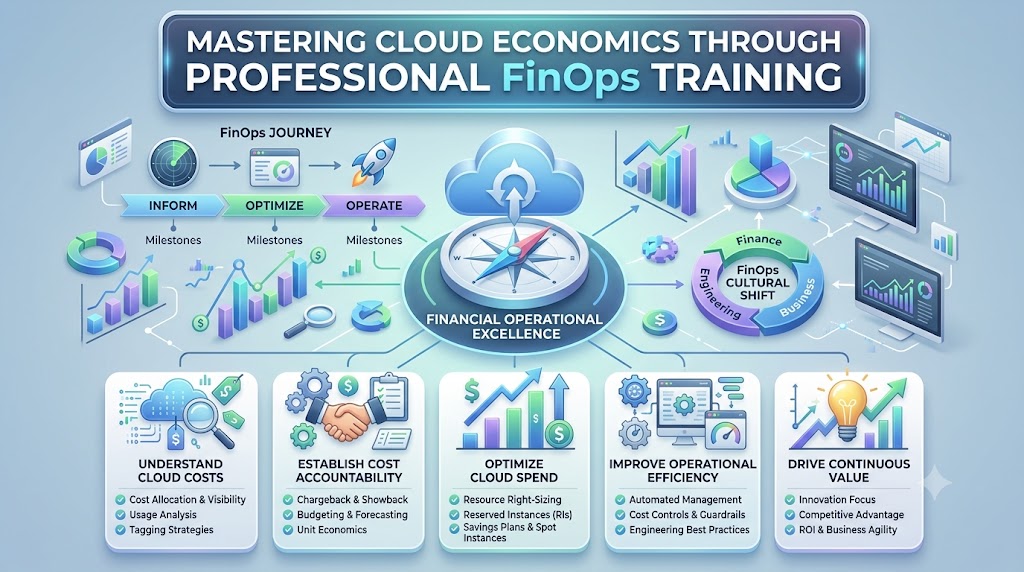
Moving workloads to the public cloud transformed infrastructure from a predictable hardware purchase into a fluid utility expense. While this agility accelerates software delivery, it introduces a complex economic challenge. When developers can provision vast compute clusters instantly via API calls, monthly bills can quickly decouple from actual business value. Uncontrolled cloud spending rarely stems from malicious waste; rather, it happens because engineering teams build systems in isolation from financial feedback loops. Solving this disconnect requires treating cost as a core system metric. This is why professional FinOps Training has become a critical requirement for modern technology organizations. By establishing shared accountability, technical teams and financial leaders can align system performance with commercial realities, ensuring every cloud resource deployed directly serves business objectives.
What Is FinOps?
FinOps represents the cultural and operational intersection of cloud engineering and financial management. Instead of treating cost control as a reactive accounting review at the end of the month, FinOps embeds financial intelligence directly into the engineering lifecycle.
Definition of FinOps
It is an organizational framework that unites technology, finance, and business leaders to drive data-driven spending decisions in real time. Rather than enforcing top-down budget restrictions that slow innovation, FinOps decentralizes accountability, giving engineering teams clear visibility into the financial consequences of their architectural choices.
Why FinOps Matters in Cloud Computing
Traditional IT infrastructure operated on fixed capital depreciation cycles with predictable procurement schedules. Cloud computing, by contrast, operates on elastic, pay-as-you-go pricing models. Without active economic governance, idle assets, unoptimized database queries, and forgotten staging environments accumulate silently, inflating monthly operational expenditures unnecessarily.
FinOps and Cloud Financial Management
Cloud Financial Management (CFM) serves as the overarching strategic discipline for governing cloud investments across an enterprise. FinOps is the practical, cross-functional execution methodology that operationalizes CFM principles within daily engineering and financial workflows.
Relationship Between Engineering, Finance, Procurement, and Business Teams
FinOps tears down traditional enterprise silos by establishing a shared operational language:
- Engineering & Platform Teams: Gain context on how system architecture impacts unit costs, allowing them to balance performance against financial efficiency.
- Finance Teams: Receive predictable billing data, granular expenditure tracking, and accurate variance models for rolling financial forecasts.
- Procurement Divisions: Leverage consolidated operational usage data to negotiate optimal enterprise agreement terms and volume commitments.
- Business Leadership: Directly connect infrastructure investments to top-line revenue growth, profit margins, and customer acquisition costs.
FinOps Lifecycle
The FinOps framework operates as a continuous, iterative three-phase feedback loop:
    +-------------------------------------------------+
    |                                                 |
    |                   1. INFORM                     |
    |        (Visibility, Allocation, Dashboards)     |
    |                         |                       |
    |                         v                       |
    |                   2. OPTIMIZE                   |
    |        (Rightsizing, Commitments, Waste)        |
    |                         |                       |
    |                         v                       |
    |                   3. OPERATE                    |
    |        (Governance, Automation, Culture)        |
    |                         |                       |
    +-------------------------+-----------------------+
- Inform: Establishes granular visibility, maps cloud costs to business units via metadata tags, and delivers real-time dashboards to stakeholders.
- Optimize: Identifies architectural inefficiencies, eliminates idle resources, rightsizes over-provisioned capacity, and secures commitment discounts.
- Operate: Enforces automated governance policies, tracks performance against organizational KPIs, and fosters continuous economic improvement.
What Is FinOps Training?
Purpose of FinOps Training
Structured FinOps Training bridges the gap between cloud architecture and corporate finance. Its primary purpose is to give practitioners the analytical tools needed to interpret complex billing telemetry and translate it into actionable system adjustments.
Skills Developed Through FinOps Training
Participants develop a balanced, multidisciplinary skill set:
- Parsing multi-tenant cloud cost telemetry and billing exports.
- Designing robust resource tagging strategies for complete cost attribution.
- Evaluating risk versus reward across commitment instruments like Savings Plans and Reserved Instances.
- Configuring automated alerting mechanisms for immediate spending anomaly detection.
- Calculating cloud unit economics to measure technical expense against user activity.
Who Should Learn FinOps?
FinOps education delivers substantial value across diverse professional roles:
- Cloud & DevOps Engineers: To build cost-efficient architectures and embed financial checks into deployment pipelines.
- Platform Engineers: To integrate automated cost visibility and governance tools into internal developer portals.
- Financial Analysts & Controllers: To understand variable cloud billing models and improve budget forecasting.
- Procurement Specialists: To optimize cloud vendor contract negotiations and maximize commitment utilization.
- Engineering Leaders: To foster a team culture that treats financial efficiency as a key indicator of system health.
FinOps Certification
Pursuing a formal FinOps Certification validates an individual’s mastery of cloud financial governance frameworks. It demonstrates that a practitioner can navigate the complexities of multi-cloud billing, design accurate cost allocation models, and foster cross-functional collaboration. Certification coursework covers fundamental economic principles, variance analysis, and governance strategies, offering independent verification of professional capability.
FinOps Course
An effective FinOps Course transforms theoretical financial concepts into hands-on operational capability. Learners move beyond whitepapers to examine raw billing files, configure automated budget alerts, and deploy cost-allocation tags. Key curriculum areas include parsing provider billing schemas, building showback models, identifying orphaned block storage, rightsizing compute tiers, and tracking containerized workloads in Kubernetes clusters. Practical lab work ensures participants can analyze real-world billing anomalies immediately.
FinOps Certification Training
Comprehensive FinOps Certification Training combines exam preparation with deep operational context. Learners explore realistic business scenarios, such as untangling multi-cloud cost attribution for legacy microservices or structuring flexible commitment portfolios for fluctuating web traffic. This dual focus ensures candidates gain both the conceptual knowledge required for exams and the practical execution skills needed for enterprise environments.
Corporate FinOps Training
Enterprise cloud growth often stalls when engineering scaling outpaces financial visibility. Corporate FinOps Training delivers customized, team-wide enablement designed to align engineering, finance, and leadership divisions around shared economic goals. Programs focus on an organization’s specific cloud architectures and internal workflows, helping cross-functional teams analyze internal billing data, fix metadata tagging blind spots, and establish collaborative accountability frameworks.
FinOps Online Training
Modern distributed organizations require flexible, accessible educational formats. Digital learning tracks combine self-paced modules with live instructor-led sessions, enabling global technology and finance teams to build operational expertise without interrupting active delivery schedules. High-quality online programs emphasize interactive cloud billing simulators, remote labs, and collaborative case study reviews over passive video consumption.
FinOps Training in India
India’s position as a global epicenter for cloud engineering, software development, and digital transformation drives intense demand for cloud financial management skills. As Indian enterprises and Global Capability Centers scale operations across AWS, Azure, and Google Cloud, mastering multi-cloud cost allocation and automated governance is vital. Developing local expertise enables engineering teams to deliver high-performance, cost-optimized solutions that support rapid business expansion.
FinOps Practitioner Training
Practitioner-focused education targets professionals responsible for daily cloud visibility, cost allocation, and interdepartmental reporting. FinOps Practitioner Training builds core competencies in dashboard creation, tagging enforcement, budget variance tracking, and unit economic calculations. Practitioners learn how to bridge the communication divide between engineering managers and financial controllers.
FinOps Engineer Training
While practitioners manage governance and reporting, engineers drive technical automation. FinOps Engineer Training provides technical teams with the skills needed to embed financial guardrails directly into software delivery pipelines. Focus areas include integrating cost checks into Infrastructure as Code (IaC), deploying container cost-allocation tools, scripting automated non-production shutdowns, and optimizing storage lifecycle tiers.
Cloud Cost Optimization Training
Cost optimization is the systematic removal of infrastructure waste without sacrificing system reliability, performance, or security. Specialized optimization training teaches teams how to evaluate compute utilization, eliminate idle assets, transition cold data to cheaper storage tiers, and leverage commitment discount instruments effectively.
       RAW SPEND DATA                      OPTIMIZED CLOUD
+--------------------------+          +--------------------------+
|  * Idle Compute Nodes    |          |  * Right-sized Compute   |
|  * Orphaned Volumes      | =======> |  * Tiered Storage Rules  |
|  * Over-provisioned DBs  |          |  * Strategic Commitments |
|  * Unused On-Demand RIs  |          |  * Auto-scheduled Non-Prod|
+--------------------------+          +--------------------------+
AWS, Azure, and Google Cloud FinOps
Each major public cloud provider offers proprietary cost management portals, billing APIs, and commitment pricing models. Managing multi-cloud environments effectively requires understanding how these provider-specific features compare.
| Cloud Platform | Primary Cost Analytics Portal | Native Budgeting & Alerting | Key Commitment Discount Mechanisms |
| AWS | AWS Cost Explorer, Cost & Usage Reports (CUR) | AWS Budgets, Cost Anomaly Detection | Compute Savings Plans, Reserved Instances |
| Microsoft Azure | Azure Cost Management + Billing, Cost Analysis | Azure Budgets, Management Group Alerts | Azure Reservations, Azure Compute Savings Plans |
| Google Cloud | GCP Cloud Billing Console, BigQuery Exports | GCP Budgets & Programmatic Alerts | Committed Use Discounts (CUDs) |
Note: Vendor tooling, console layouts, and discount structures change frequently. Always consult official provider documentation for current platform feature availability.
FinOps Core Practices
Establishing a mature cloud financial operating model requires embedding continuous, cross-functional practices into daily enterprise workflows:
Cost Visibility
Creating accessible, real-time dashboards that give technical, operational, and financial teams clear insights into current infrastructure usage and spend trends.
Cost Allocation
Attributing 100% of cloud expenditure to specific business units, application teams, or product lines through consistent, enforced tagging policies.
Showback and Chargeback
Publishing detailed usage reports to show teams the cost impact of their infrastructure decisions (showback), or directly charging cloud costs back to departmental operating budgets (chargeback).
Budgeting
Establishing dynamic, context-aware spend limits for applications and project teams to prevent unexpected budget overruns without slowing engineering progress.
Forecasting
Utilizing historical usage data, application growth trends, and upcoming architectural changes to accurately model future cloud capacity and financial commitments.
Cost Optimization
Continuously identifying technical waste, rightsizing underutilized resources, and managing commitment discount portfolios to lower overall unit costs.
Anomaly Detection
Deploying automated monitoring to detect sudden, unexpected spend spikes instantly, enabling engineering teams to address runaway processes before bills escalate.
Governance
Setting clear organizational policies, automated tagging rules, and compliance guardrails for provisioning new cloud resources.
Continuous Improvement
Regularly evaluating internal FinOps processes, measuring unit economic efficiency, and refining automation capabilities over time.
FinOps Tools and Technologies
While culture and process form the foundation of cloud financial management, modern software platforms provide the automation, scale, and deep analytics required to manage enterprise environments. Provider-native consoles offer foundational reporting, while multi-cloud analytics platforms aggregate telemetry across diverse environments. Container cost allocation tools break down shared Kubernetes cluster expenses, and policy enforcement engines automate metadata compliance and shutdown schedules. Software tools serve as powerful force multipliers, but long-term financial efficiency ultimately depends on organizational ownership.
FinOps Implementation Process
Building a mature cloud financial operations model requires a structured, phase-based rollout plan:
Step 1: Establish Cloud Cost Visibility
Centralize billing export streams, configure automated data pipelines into analytics platforms, and build core operational dashboards for stakeholders.
Step 2: Define Ownership and Allocation
Establish an enterprise-wide metadata tagging standard. Ensure every cloud resource carries mandatory metadata identifying its owner, environment, and cost center.
Step 3: Set Budgets and Forecasts
Establish baseline operational budgets for every engineering squad. Configure programmatic notifications to alert teams when spending approaches pre-set thresholds.
Step 4: Identify Waste
Perform targeted technical audits across all active cloud accounts to locate unattached storage volumes, idle compute nodes, and over-provisioned database engines.
Step 5: Implement Optimization
Execute low-risk infrastructure rightsizing, set up automated storage lifecycle rules, and secure commitment discounts to cover stable baseline usage.
Step 6: Automate Cost Controls
Shift governance left by integrating cost policy checks into CI/CD pipelines, enforcing mandatory tagging on deployment, and automating non-production resource shutdowns.
Step 7: Monitor and Improve Continuously
Establish recurring cadence meetings between finance leads and technical directors to review unit economics, update usage forecasts, and refine governance rules.
Common FinOps Mistakes
Organizations establishing cloud cost management frameworks often encounter predictable pitfalls. The matrix below highlights frequent missteps alongside practical solutions:
| Common Mistake | Root Cause | Practical Solution |
| Treating FinOps as purely a finance responsibility | Technical teams are disconnected from the financial consequences of their infrastructure choices. | Establish shared unit economic KPIs; provide developers with direct spend visibility. |
| Focusing exclusively on aggressive cost reduction | Indiscriminate cost-cutting can degrade application performance, reliability, and delivery velocity. | Frame optimization around value maximization; preserve system performance and availability SLAs. |
| Inconsistent metadata tagging enforcement | Incomplete tagging leads to large pools of unallocated, untraceable cloud spend. | Enforce policy-as-code guardrails in CI/CD deployment pipelines to block untagged resources. |
| Relying on manual spreadsheet audits | Manual cost tracking cannot keep pace with dynamic, elastically auto-scaling cloud environments. | Deploy automated cost anomaly detection platforms and programmatic guardrail policies. |
| Ignoring non-production environments | Development, staging, and testing environments run continuously at full capacity off-hours. | Implement automated scheduling tools to spin down non-production resources outside work hours. |
Benefits of FinOps Training
Investing in structured cloud financial management education yields tangible operational advantages across the business:
- Elimination of Billing Surprises: Provides real-time visibility into infrastructure consumption, preventing end-of-month bill shock.
- Decentralized Spending Ownership: Moves fiscal responsibility directly to the engineering squads responsible for provisioning cloud resources.
- Accurate Financial Forecasting: Gives finance teams reliable telemetry to model future infrastructure expenses accurately.
- Seamless Cross-Team Alignment: Establishes a shared language and aligned objectives across engineering, finance, and procurement units.
- Higher Infrastructure Efficiency: Ensures compute, memory, and storage allocations closely match actual operational requirements.
- Professional Skill Advancement: Equips technical and operational leaders with high-demand cloud management skills.
How to Choose FinOps Training
Selecting the right educational program requires evaluating your organization’s technical ecosystem, team composition, and operational priorities. Key factors to evaluate include comprehensive curriculum coverage across multi-cloud environments, practical hands-on lab exercises with live billing datasets, role-tailored learning tracks for engineering or finance professionals, and alignment with recognized industry certification standards.
FinOpsSchool.com Service Fit
FinOpsSchool.com provides structured, practical education programs designed to build real-world capability across every tier of your tech organization. Engineering squads benefit from specialized technical automation modules; finance leads utilize practitioner allocation courses; enterprise organizations access tailored corporate workshops; and global professionals leverage flexible online delivery options. Discover tailored learning programs at FinOpsSchool.com to build the technical and financial skills needed to control cloud spend effectively.
External Authoritative References
For deeper technical context and official provider guides on cloud cost management, refer to these authoritative resources:
- FinOps Foundation Core Resources: finops.org — Official community standards, frameworks, and operational lifecycle guides.
- AWS Cost Management Documentation: Official guides covering AWS Cost Explorer, billing exports, and Savings Plans management.
- Microsoft Azure Cost Management Documentation: Technical guides detailing Azure billing setups, management groups, and budget management.
- Google Cloud Cost Management Documentation: Documentation on BigQuery billing exports, GCP budget alerts, and commitment tracking.
Frequently Asked Questions
- What is FinOps Training and why do organizations need it?
FinOps Training is an educational program that teaches technical, financial, and management teams how to collaborate on cloud cost management. It covers real-time spend visibility, metadata tagging, optimization techniques, budget controls, and automated governance across major public clouds. - How does a FinOps Certification help advance an IT career?
A FinOps Certification provides independent verification of an individual’s knowledge of cloud financial management frameworks. It validates a practitioner’s ability to optimize cloud usage, align technical teams with business priorities, and establish effective cloud cost governance. - What core subjects are taught in a standard FinOps Course?
A comprehensive FinOps Course covers cloud billing structures, metadata tagging strategies, cost allocation models, showback and chargeback systems, dynamic budgeting, infrastructure rightsizing, commitment discounts, and container spend tracking. - What makes specialized FinOps Certification Training valuable?
FinOps Certification Training equips professionals with specialized skills in cloud cost governance. As organizations focus on controlling variable cloud expenditure, certified engineers, architects, and financial analysts are well-positioned to lead strategic cloud initiatives. - How does Corporate FinOps Training benefit enterprise technology teams?
Corporate FinOps Training aligns engineering, finance, platform, and leadership teams around shared cloud spend goals. It helps establish clear governance frameworks, improves financial forecasting accuracy, and builds a sustainable culture of cost efficiency across engineering units. - What format options are available in FinOps Online Training?
FinOps Online Training programs offer self-paced video modules, live instructor-led sessions, digital labs, and real-world billing exercises. This delivery format allows distributed global teams to build practical cloud financial management skills flexibly. - Why is the demand for FinOps Training in India accelerating?
Demand for FinOps Training in India is growing due to rapid enterprise cloud adoption and the expansion of global capability centers (GCCs). Companies need skilled professionals who can manage multi-cloud infrastructure costs effectively without reducing delivery velocity. - Who is the ideal audience for FinOps Practitioner Training?
FinOps Practitioner Training is designed for technology managers, financial controllers, cloud leads, and systems administrators responsible for managing cloud budgets, tracking spend allocation, building dashboards, and coordinating cross-departmental cost optimization initiatives. - What technical skills are emphasized in FinOps Engineer Training?
FinOps Engineer Training focuses specifically on building financial guardrails into technical operations. It teaches engineers how to automate cost controls, integrate spend checks into Infrastructure as Code, track Kubernetes cluster costs, and optimize resource footprints programmatically. - What techniques are covered during Cloud Cost Optimization Training?
Cloud Cost Optimization Training focuses on technical strategies to reduce cloud waste. Key skills include rightsizing compute resources, setting up automated non-production schedules, automating storage lifecycle transitions, identifying spend anomalies, and optimizing commitment portfolios. - Which tools are typically utilized in cloud financial management?
Training programs typically cover provider-native tools like AWS Cost Explorer, Azure Cost Management, and Google Cloud Billing, alongside multi-cloud analytics platforms, Kubernetes cost tracking tools like Kubecost, and policy automation utilities. - How does FinOps improve collaboration between engineering and finance?
FinOps establishes a common operational framework and shared metrics between departments. Finance gets predictable spend visibility and reliable forecasts, while engineering teams gain real-time visibility into how architectural choices affect product unit economics.
Conclusion
Managing public cloud spend is no longer a periodic administrative task—it is a continuous technical discipline. As enterprise cloud footprints scale, relying on manual billing spreadsheet audits or reactive, emergency cost-cutting undermines organizational agility. Establishing a mature FinOps framework provides the operational visibility, financial accountability, and structural alignment needed to maintain control over dynamic cloud environments. By committing to structured FinOps Training, organizations empower their engineering, platform, and finance squads to work together to eliminate waste, streamline multi-cloud architectures, and establish durable governance guardrails. Whether upskilling individual practitioners or transforming enterprise operations through corporate enablement, mastering cloud financial operational practices ensures every cloud investment directly supports business growth.
Leave a Reply