Architecting Enterprise DataOps: Testing, Observability, and Delivery Automation
Introduction
Data delivery systems regularly suffer from unseen schema modifications, upstream sync failures, unverified data types, and manual deployment chaos. When data systems expand across hybrid cloud storage, streaming frameworks, and analytical warehouses, conventional batch processing and ad-hoc scripts fall apart under operational load.
DataOps resolves these friction points by blending software engineering disciplines, continuous delivery mechanics, and lean operational workflows directly into data engineering. Instead of putting out fire after fire when reports fail, engineering teams gain a repeatable process for releasing, validating, and monitoring data assets.
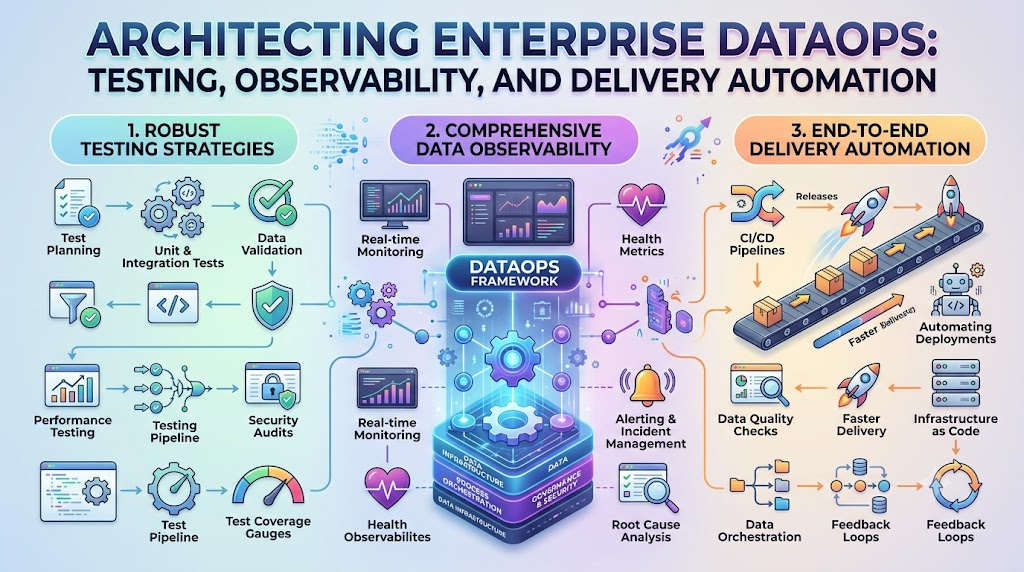
Creating a stable DataOps pipeline requires more than scheduling scripts inside an orchestration tool. It involves establishing infrastructure as code, continuous integration and deployment (CI/CD), deep data observability, inline testing, and structural data governance.
This guide breaks down the core patterns, tooling considerations, and system designs necessary to build high-throughput, low-friction DataOps workflows. Dedicated educational guides and practical reference material at TheDataOps.org offer additional paths for mastering modern data operations.
Deconstructing the DataOps Pipeline Concept
A DataOps pipeline acts as a fully managed, automated software system designed to extract, model, evaluate, and deliver data while continuously auditing operational safety and data validity.
Rather than treating data engineering strictly as a sequence of SQL queries and ETL steps, a DataOps strategy handles data models, pipeline code, and infrastructure configurations as unified software products subject to strict software lifecycles.
+-----------------------------------------------------------------------------------+
|                        Continuous DataOps Operations                              |
|                                                                                   |
|  +--------------+     +--------------+     +--------------+     +--------------+  |
|  | Event/Batch  | --> | Transform &  | --> | Inline Quality| --> | Consumption  |  |
|  | Ingestion    |     | Modeling     |     | Assertion    |     | Target       |  |
|  +--------------+     +--------------+     +--------------+     +--------------+  |
|         ^                                                                 |       |
|         |                      Continuous Lineage & Telemetry             |       |
|         +-----------------------------------------------------------------+       |
+-----------------------------------------------------------------------------------+
Modern data operations solve three primary structural failure modes:
- Environmental Instability: Upstream database changes, API format shifts, and network timeouts break analytical models without warning engineering leads.
- Organizational Friction: Hand-offs between software developers, data engineers, analytics leads, and infrastructure teams create long deployment delays and misaligned objectives.
- Silent Pipeline Degradation: Inaccurate or corrupted records pass through transformations undetected, damaging executive confidence in analytics dashboards.
Integrating code versioning, ephemeral test environments, runtime assertions, and continuous logging shifts team operations from emergency firefighting to systematic, high-velocity engineering.
Layered Architecture of a DataOps System
A mature DataOps system isolates data processing tasks from control-plane automation. Data moves horizontally across functional stages, while security, orchestration, testing, and telemetry interact vertically across every system tier.
====================================================================================
                       GOVERNANCE, SECURITY & ACCESS CONTROL
              (RBAC, KMS Secrets, Lineage, Column Masking, Audit Logs)
====================================================================================
 +------------+   +------------+   +------------+   +------------+   +------------+
 |   DATA     |   | INGESTION  |   | STORAGE &  |   | ASSERTION  |   | ANALYTICS  |
 |  SOURCES   |-->|   FRAME    |-->| COMPUTE    |-->| & TESTING  |-->|  TARGETS   |
 | (OLTP,     |   | (Kafka,    |   | (Databricks|   | (dbt,      |   | (Dashboards|
 |  APIs)     |   |  Airbyte)  |   |  Snowflake)|   |  Soda)     |   |  ML Models)|
 +------------+   +------------+   +------------+   +------------+   +------------+
====================================================================================
                       ORCHESTRATION & EXECUTION CONTROL
                  (Apache Airflow, Dagster, Prefect, CI/CD Engine)
====================================================================================
                       OBSERVABILITY & SYSTEM TELEMETRY
              (Freshness Metrics, Volume Alerts, Schema Drift, Logs)
====================================================================================
Functional System Tiers
- Data Ingestion Tier: Captures real-time event logs, CDC database feeds, and third-party API payloads via batch extractors or event stream brokers (e.g., Apache Kafka, Airbyte).
- Compute & Storage Engine: High-performance analytical platforms (e.g., Databricks, Snowflake, Apache Spark) executing complex analytical modeling and raw-to-refined data transitions.
- Control & Orchestration Layer: Manages task graphs, tracks task dependencies, enforces retry schedules, and routes alerts on failure (e.g., Apache Airflow, Dagster).
- Validation & Assertions Framework: Runs programmatic checks, schema verifications, and value constraint evaluations at ingestion and post-transformation boundaries.
- Telemetry & Observability Layer: Tracks system logs, metadata evolution, table freshness, row-count deviations, and directional lineage graphs across all pipeline nodes.
- Governance & Security Perimeter: Enforces identity permissions, secret store integrations, dynamic data masking, and compliance tracking across production and staging tiers.
- Target Delivery Layer: Serves cleaned datasets directly to business intelligence, operational APIs, reverse-ETL platforms, and predictive ML models.
Engineering Pipeline Automation: Git, CI/CD, and Environments
Automation in DataOps extends beyond simple cron schedules. It applies established software delivery mechanics—specifically version management, programmatic testing, and automated release gates—to data transformation code and cloud infrastructure.
1. Versioning Everything as Code
Pipeline transformation logic, database schemas, orchestration DAGs, and cloud environments (via Infrastructure as Code frameworks like Terraform) must be managed inside Git repositories. This establishes clear commit history, enables peer code reviews, and provides immediate rollback paths during outages.
2. CI/CD Pipeline Mechanics
Whenever an engineer updates transformation logic or pipeline scripts, continuous integration tools execute an automated validation pipeline:
[ Developer Branch Feature ]
            |
            v
[ Open Pull Request ]
            |
            v
[ Continuous Integration Pipeline Triggers ]
   |--> Linter & Static Code Analysis (SQLFluff, Ruff)
   |--> Unit Testing Code Logic (pytest)
   |--> Dynamic Test Sandbox Provisioning
   |--> Execute Data Transformation on Sample Data
   |--> Run Data Assertion & Schema Check Rules
            |
            v
[ Pull Request Reviewed & Merged ]
            |
            v
[ Continuous Deployment Pipeline Triggers ]
   |--> Automated Zero-Downtime Deployment to Production
   |--> Blue/Green Schema Swap or Migration Run
3. Isolated Development Environments
Testing modifications directly in production data warehouses leads to data corruption and inaccurate analytics. Teams should use ephemeral sandbox schemas, zero-copy clone features, or dynamic development environments to validate transformation updates against actual metadata structures without impacting live production systems.
Comparing Data Quality Management and Data Observability
While both discipline areas focus on data system reliability, data quality and data observability handle operational risks differently.
+-----------------------------------------------------------------------------------+
|                        RELIABILITY FRAMEWORK MATRIX                               |
+------------------------------------+----------------------------------------------+
|       DATA QUALITY MANAGEMENT      |              DATA OBSERVABILITY              |
|        (Rule-Based & Explicit)     |           (Systemic & Inferential)          |
+------------------------------------+----------------------------------------------+
| • Asserts explicit conditions      | • Identifies unexpected, unscripted          |
|   (e.g., NOT NULL, FK constraints).|   system anomalies and statistical shifts.   |
| • Evaluates data payloads at rest. | • Audits metadata across system components.  |
| • Identifies rule violations:      | • Maps end-to-end data dependency lineage.   |
|   "Is this ID field non-null?"     | • Answers: "Why is the pipeline delayed, and |
|                                    |   which reporting endpoints are affected?"   |
+------------------------------------+----------------------------------------------+
Data Quality Management
Data quality focuses on verifying that datasets follow defined domain rules and structural constraints. Key evaluation dimensions include:
- Accuracy: Ensuring data values accurately represent external business events.
- Completeness: Verifying that expected rows and essential attribute values are present.
- Uniqueness: Preventing duplicate records from breaking primary key constraints.
- Conformity: Validating that data formats match required patterns (e.g., date formats, status values).
Tools like dbt tests, Great Expectations, and Soda evaluate these constraints at specific steps in the processing workflow.
Data Observability
Data observability analyzes global system health by tracking operational metadata across five central vectors:
- Freshness: Verifying that datasets update within expected operational SLAs.
- Volume: Spotting unexpected record surges or drops caused by broken ingestion steps.
- Schema Integrity: Monitoring unexpected structural alterations, such as deleted columns or altered data types.
- Data Lineage: Mapping upstream and downstream dependencies to evaluate error propagation paths.
- Distribution Drift: Tracking statistical shifts in numeric distributions (e.g., standard deviations, null ratios) over time.
Observability platforms continuously scan these system metadata logs to alert engineering teams to anomalies before business users spot incorrect metrics.
DataOps Compared Across Engineering Specializations
Positioning DataOps relative to adjacent software and infrastructure disciplines highlights its unique operational scope:
| Field | Core Objective | Primary Deliverables | Standard Tooling |
| DataOps | Maximizing data reliability, pipeline delivery speed, data observability, and deployment velocity. | Automated CI/CD, assertion suites, lineage graphs, freshness monitoring, data SLAs. | Airflow, Dagster, Great Expectations, Monte Carlo, Git, Terraform. |
| Data Engineering | Building scalable storage layers, ingestion routines, and data transformation frameworks. | Warehouse schemas, ETL/ELT pipelines, streaming processors, raw storage lakes. | Apache Spark, Snowflake, Databricks, Python, SQL, Kafka. |
| DevOps | Automating software application build cycles, server configurations, and system stability. | Application deployment pipelines, container engines, server infrastructure. | Kubernetes, Docker, GitHub Actions, Jenkins, Terraform. |
| MLOps | Managing machine learning model lifecycles, operational tracking, and automated retraining loops. | Model registries, feature repositories, drift monitoring, serving endpoints. | MLflow, Kubeflow, Feast, AWS SageMaker, Weights & Biases. |
| Platform Engineering | Engineering self-service developer platforms and managing core infrastructure services. | Internal Developer Platforms (IDPs), cloud networking, access management layers. | Kubernetes, Crossplane, ArgoCD, Cloud Providers (AWS/GCP/Azure). |
Evaluating the DataOps Technology Stack
Building an effective DataOps architecture relies on integrating specialized modular tools rather than relying on a single closed ecosystem.
+-----------------------------------------------------------------------------------+
|                        DataOps Tooling Categorization                             |
+----------------------+------------------------------------------------------------+
| Structural Category  | Representative Software Technologies                       |
+----------------------+------------------------------------------------------------+
| Workflow Scheduling  | Apache Airflow, Dagster, Prefect, Mage                     |
| Ingestion & CDC      | Airbyte, Fivetran, Apache Kafka, Redpanda                  |
| Transformation       | dbt (data build tool), Apache Spark, SQL, Ray              |
| Assertions & Testing | Great Expectations, dbt tests, Soda, Deequ                 |
| System Observability | Monte Carlo, Acceldata, Datadog, OpenLineage               |
| Infrastructure / CI  | Terraform, Docker, Kubernetes, GitHub Actions, GitLab CI   |
| Warehouse & Storage  | Snowflake, Databricks, BigQuery, Amazon Redshift           |
+----------------------+------------------------------------------------------------+
Architectural Selection Criteria
When evaluating additions to your data engineering stack:
- API First Design: Ensure the product can be managed via code, configuration scripts, and REST/gRPC interfaces rather than requiring manual UI operations.
- Git Versioning Support: Verify that pipeline definitions, infrastructure requirements, and test suites live natively inside standard Git repositories.
- Open Metadata Standards: Prioritize platforms that export execution logs and data lineage using open specifications (such as OpenLineage).
- Dynamic Resource Scaling: Choose engines capable of scaling compute resources on demand to manage volume fluctuations efficiently.
Practical Engineering Examples
Example 1: Ingestion Script with Inline Data Validation
This script demonstrates an ingestion step that checks raw transaction records for structural validity before running downstream analytical models.
Python
# snippet: Operational Quality Gate Execution
import sys
import pandas as pd
from sqlalchemy import create_engine

def validate_and_ingest_records(db_connection_str, target_table_name):
    db_engine = create_engine(db_connection_str)
    query = f"SELECT transaction_id, user_id, amount, created_at FROM {target_table_name} WHERE created_at >= CURRENT_DATE"
    data_frame = pd.read_sql(query, db_engine)

    # Validation Gate 1: Check Minimum Expected Record Volume
    if data_frame.empty:
        raise ValueError(f"PIPELINE HALTED: Zero transactions ingested for {target_table_name} today.")

    # Validation Gate 2: Primary Key Integrity Check
    if data_frame['transaction_id'].isnull().any():
        raise ValueError(f"DATA ERROR: Found NULL transaction_id records in {target_table_name}.")

    # Validation Gate 3: Domain Value Bounds Assertions
    if (data_frame['amount'] <= 0).any():
        raise ValueError(f"RULE ERROR: Found transaction records with non-positive amounts in {target_table_name}.")

    print(f"SUCCESS: Quality checks cleared for {target_table_name}. Processed {len(data_frame)} rows.")

if __name__ == "__main__":
    # Called by orchestrator task prior to triggering downstream models
    try:
        validate_and_ingest_records("postgresql://admin:password@localhost:5432/analytics", "raw_transactions")
    except Exception as error_msg:
        print(f"Execution Aborted: {error_msg}")
        sys.exit(1)
In this pipeline pattern, an upstream failure or invalid record halts processing immediately, preventing corrupt data from contaminating downstream reporting models.
Example 2: Declarative Testing in dbt
Data teams can enforce assertions directly alongside transformation code using configuration files:
YAML
# schema.yml - Transformation Model Quality Schema
version: 2

models:
  - name: stg_customer_orders
    description: "Transformation model for customer order activity."
    columns:
      - name: order_id
        tests:
          - unique
          - not_null

      - name: order_status
        tests:
          - accepted_values:
              values: ['pending', 'processing', 'completed', 'refunded']

      - name: customer_id
        tests:
          - relationships:
              to: ref('dim_customers')
              field: customer_id
10-Step DataOps Implementation Roadmap
Adopting DataOps requires a structured strategy to avoid overwhelming engineering teams. Follow this sequential operational roadmap:
+-----------------------------------------------------------------------------------+
|                     10-Step DataOps Implementation Roadmap                        |
|                                                                                   |
|  [01] Inventory System ----> [02] Find Friction Points -> [03] Define System SLAs |
|                                                                        |          |
|  [06] Modern Orchestration <- [05] Build CI/CD Loops <--- [04] Git Standardization|
|         |                                                                         |
|         v                                                                         |
|  [07] Deploy Telemetry ----> [08] Lock Down Governance -> [09] Monitor SLAs       |
|                                                                  |                |
|  [10] Continuous System Optimization <---------------------------+                |
+-----------------------------------------------------------------------------------+
- Audit Infrastructure and Pipelines: Document all upstream data sources, ingestion steps, database dependencies, and downstream analytics consumers.
- Locate Operational Bottlenecks: Identify processes requiring manual intervention, frequent failure points, and deployment delays.
- Establish System SLAs: Define explicit Service Level Agreements (SLAs) covering dataset freshness limits, acceptable failure rates, and job runtimes.
- Standardize on Version Control: Move all SQL queries, infrastructure configurations, and pipeline code into Git repositories with branch protection rules.
- Build Automated CI/CD Pipelines: Implement automated testing triggers (using GitHub Actions, GitLab CI, or Jenkins) to validate syntax, run unit tests, and perform dry runs on pull requests.
- Implement Modern Orchestration: Shift off basic task schedulers to orchestration engines (Airflow, Dagster, Prefect) that support complex dependency DAGs and retry logic.
- Embed Telemetry and Observability: Implement continuous metadata monitoring across critical warehouse assets to capture freshness, schema changes, and volume shifts.
- Enforce Security and Governance: Set up least-privilege role-based access control (RBAC), secrets management, and automated column masking across environments.
- Track Operational Success Metrics: Monitor organizational performance using key operational metrics like Mean Time to Detect (MTTD) and Mean Time to Recovery (MTTR).
- Refine Operations Continuously: Conduct formal post-mortems on pipeline failures to continuously expand test suites and improve system recovery procedures.
Operational Challenges and Anti-Patterns to Avoid
Deploying a DataOps framework involves updating software habits and engineering workflows. Mind these common execution risks:
Common Anti-Patterns
- Treating DataOps as a Software Purchase: Buying observability licenses or orchestration services without updating team workflows, testing habits, and deployment strategies produces minimal returns.
- Automating Flawed Operations: Automating poorly designed SQL models or fragile APIs only generates failures faster. Refactor unstable queries before automating them.
- Alert Overload: Generating notifications for minor statistical deviations causes alert fatigue, leading engineers to ignore critical system outages.
- Direct Production Editing: Updating SQL logic, pipeline DAGs, or database schemas directly in production warehouses eliminates change history and leads to service disruptions.
- Vague Component Ownership: Leaving pipelines without explicit owners delays incident recovery times when upstream schemas break.
Decision-Making Framework: Evaluating DataOps Initiatives
Use this structured decision framework when evaluating tooling choices, architectural modifications, or platform upgrades:
                  +----------------------------------------------+
                  |  Step 1: Identify Operational Pain Points    |
                  +----------------------------------------------+
                                         |
                                         v
                  +----------------------------------------------+
                  |  Step 2: Map Affected Teams & Stakeholders   |
                  +----------------------------------------------+
                                         |
                                         v
                  +----------------------------------------------+
                  |  Step 3: Review Stack Compatibility          |
                  +----------------------------------------------+
                                         |
                                         v
                  +----------------------------------------------+
                  |  Step 4: Verify Security & Governance Rules  |
                  +----------------------------------------------+
                                         |
                                         v
                  +----------------------------------------------+
                  |  Step 5: Execute a Narrow Proof-of-Concept   |
                  +----------------------------------------------+
                                         |
                                         v
                  +----------------------------------------------+
                  |  Step 6: Measure Outcomes Against Metrics    |
                  +----------------------------------------------+
- Identify Operational Pain Points: Clearly articulate the engineering challenge (e.g., “Deployment cycles take two weeks,” or “Unannounced schema changes break executive dashboards”).
- Map Stakeholders: Gather requirements from data engineers, analytics leads, security specialists, and infrastructure managers.
- Review Stack Compatibility: Ensure proposed systems integrate natively with your current data warehouses, Git services, and orchestrators.
- Verify Security and Governance: Validate that the proposed architecture complies with corporate encryption, secrets management, and access control policies.
- Execute a Narrow Proof of Concept (PoC): Deploy candidate tools or methodologies on a non-critical secondary data asset to test operational impact safely.
- Evaluate Against Concrete Success Metrics: Measure the PoC using clear operational targets, such as reduced outage times, faster deployment velocity, and lower system maintenance costs.
Security, Compliance, and Data Governance
Automated pipelines must maintain strict data governance and security controls as datasets flow through transformation steps.
- Role-Based Access Management (RBAC): Restrict system access across production schemas, staging environments, and lakehouse files using automated permissions defined in code.
- Centralized Secrets Vaults: Keep credentials, API keys, and connection strings out of Git code repositories by integrating secrets managers like HashiCorp Vault or AWS Secrets Manager.
- Lineage & Audit Tracking: Capture dataset dependency trees and system interaction logs to simplify regulatory compliance audits (e.g., GDPR, CCPA, HIPAA).
- Automated Data Obfuscation: Apply column masking, hashing, or anonymization transformations to sensitive customer identifiers before populating development and testing sandboxes.
Emerging Trends Shaping Data Operations
As cloud storage, real-time analytics, and artificial intelligence expand, modern data operations continue to evolve:
- Data Contracts: Enforceable schemas agreed upon by upstream application developers and downstream data teams, preventing breaking application changes from reaching analytical pipelines.
- AI-Driven Anomaly Detection: Machine learning algorithms that analyze historical metadata logs to automatically refine alerting thresholds, minimizing manual alert configuration.
- Metadata-Driven Pipeline Execution: Dynamic orchestrators that reconfigure DAG dependencies and scale cloud compute resources in real time based on incoming data characteristics.
- Platform Engineering Integration: Internal Developer Platforms (IDPs) that offer self-service data infrastructure, enabling data engineers to provision storage and compute resources independently.
Deepening Your DataOps Mastery with TheDataOps.org
Building reliable, high-throughput data platforms requires a blend of solid architectural strategies, hands-on tool experience, and modern operational concepts. Data teams need practical guidance to keep pace with evolving tools, automation frameworks, and pipeline methodologies.
TheDataOps.org acts as an educational resource and platform dedicated to advancing modern data operations:
- DataOps Training & Structured Learning: Comprehensive educational resources covering continuous integration, pipeline orchestration, automated data testing, and cloud infrastructure operations.
- DataOps Certification Guidance: Detailed materials designed to help data professionals validate their skills across automation, quality management, and pipeline design.
- DataOps Consulting Frameworks: Strategy guides to assist enterprise engineering teams in evaluating current technical maturity, modernizing legacy ETL setups, and selecting appropriate platform tooling.
By combining version-controlled automation, inline quality gates, and system observability, engineering organizations can move away from fragile, reactive operations and build scalable data platforms.
Key Takeaways
- DataOps Treats Pipelines as Software: It applies version management, continuous integration, automated assertions, and continuous telemetry directly to data systems.
- Automation Encompasses Full Delivery: Comprehensive automation manages pipeline scheduling, environment creation, configuration deployment, and inline data assertions.
- Observability Extends Quality Assurance: Data quality asserts explicit data rules at fixed boundaries, while observability monitors overall system metrics across freshness, schema, volume, and lineage vectors.
- Decoupled System Architecture Scales Better: Isolating storage, processing engine, orchestration, and metadata observability tiers prevents single-vendor lock-in and simplifies upgrades.
- Incremental Adoption Works Best: Focus first on resolving key operational bottlenecks, establishing Git version control, and building continuous integration for core transformation code before re-architecting your entire data stack.
Frequently Asked Questions
What is DataOps?
DataOps (Data Operations) is an operational methodology combining Agile workflows, DevOps techniques, and lean manufacturing concepts. It automates and optimizes data pipeline creation, deployment, testing, and lifecycle monitoring to deliver consistent, high-quality data products.
How does DataOps differ from DevOps?
While DevOps focuses on automating application code deployments, infrastructure provisioning, and service uptime, DataOps focuses specifically on managing dynamic data platforms. DataOps must account for changing data states, unexpected schema drifts, and data quality degradation across pipeline nodes.
What are the essential components of a DataOps stack?
A standard DataOps setup relies on Git for version control, CI/CD runners for automated testing, pipeline orchestration engines, validation assertion libraries, metadata-driven observability suites, and scalable cloud storage infrastructure.
Why is automation critical in data engineering?
Automation eliminates manual deployment mistakes, accelerates feature release cycles, enforces quality assertions before target loading, simplifies cloud infrastructure management, and lets engineering teams scale operations cleanly.
What is data observability?
Data observability evaluates system operational health by continuously tracking key metadata metrics—including data freshness, row volume trends, schema modifications, dynamic lineage, and execution logs—to detect runtime anomalies automatically.
Which tools are commonly used in DataOps systems?
Popular solutions include Apache Airflow, Dagster, and Prefect for scheduling; dbt for SQL transformations; Great Expectations and Soda for inline quality testing; Monte Carlo for metadata observability; and Terraform with GitHub Actions for infrastructure automation and CI/CD runs.
How do quality assertions run within automated pipelines?
Quality checks run as automated validation tasks during pipeline execution. They verify records against business rules and data constraints (such as uniqueness or range bounds), halting downstream processing if assertions fail.
What responsibilities belong to a DataOps Engineer?
A DataOps Engineer builds, manages, and optimizes the automation frameworks supporting data teams. They create CI/CD pipelines, configure test execution environments, integrate telemetry platforms, and manage cloud infrastructure as code.
How do organizations measure DataOps maturity?
Engineering organizations evaluate progress using operational KPIs, such as release velocity, pipeline execution reliability, Mean Time to Detect (MTTD) data anomalies, Mean Time to Recovery (MTTR), and SLA compliance rates.
How does TheDataOps.org assist data professionals?
TheDataOps.org provides educational guides, training pathways, technical insights, and career development resources to help engineers and organizations master pipeline automation, data observability, and enterprise data operations.
Conclusion
Adopting DataOps transforms data engineering from a series of fragile, manual tasks into a predictable, software-driven operational discipline. Unifying code version control, automated testing, continuous integration, and metadata telemetry allows data teams to release pipeline updates faster while protecting downstream systems from corrupt data.Constructing a failure-resistant data platform requires solid system design, automated testing, and ongoing cross-team collaboration. For teams building their first automated pipelines or modernizing complex cloud platforms, resources at TheDataOps.org provide the technical depth, reference patterns, and structural insights needed to build scalable data operations. Continuous operational refinement remains the foundation of a modern, data-driven system.
Leave a Reply