Master the Canada Express Entry Pool: A Realistic Roadmap for Indian Applicants
Introduction
Securing permanent status in Canada has evolved from a simple paper trail into a dynamic, competitive selection game. For Indian professionals, students, and overseas workers, navigating the federal immigration pipeline requires an objective look at data, language metrics, and strategic profile positioning. Relying on outdated assumptions or generic advice often leads to stalled profiles and missed opportunities.This comprehensive breakdown cuts through the complexity of Express Entry—Canada’s flagship online selection engine. It analyzes how the Comprehensive Ranking System (CRS) ranks global talent, what eligibility thresholds actually demand, and how you can position your profile for targeted draws. From precise paperwork checks to managing financial proof, this guide provides actionable intelligence for every stage of your application journey. To connect with experienced expats, exchange real-world relocation advice, and join active Indian community forums, visit DesiNRI.
What Is Canada Permanent Residency?
Canada Permanent Residency (PR) is an official immigration status that grants foreign citizens the right to settle, work, and study anywhere within Canadian borders without an employer-tied work permit. While Permanent Residents retain their home country’s passport, they receive essential privileges, including access to universal healthcare coverage and legal protections under the Canadian Charter of Rights and Freedoms.
For Indian nationals, obtaining PR status offers long-term career security without compromising their current citizenship. Permanent Resident cards are generally issued for a five-year validity period. To maintain status, you must fulfill the residence obligation: physically living in Canada for at least 730 days (two full years) within any rolling five-year window. Accumulating three years (1,095 days) of physical presence opens the door to applying for full Canadian citizenship.
Temporary Residence (Work/Study) ──> Permanent Resident (PR) ──> Canadian Citizen
Decoding the Express Entry System
Express Entry is not a standalone visa category; it is an electronic framework utilized by Immigration, Refugees and Citizenship Canada (IRCC) to evaluate, rank, and process candidates across three core economic immigration channels:
- Federal Skilled Worker Program (FSWP): The primary stream for global talent with foreign skilled work experience, post-secondary education, and competitive language scores.
- Canadian Experience Class (CEC): Targeted at individuals with at least 12 months of legal, skilled work experience completed within Canadian borders.
- Federal Skilled Trades Program (FSTP): Designed for qualified trade professionals holding certification or formal job offers in specific technical industries.
In addition to standard all-program draws, IRCC utilizes category-based selection draws. These targeted rounds pull candidates based on specific regional economic needs, prioritizing field-specific experience (such as STEM, Healthcare, Trades, Transport, and Agriculture) or demonstrated French language proficiency.
Baseline Requirements for Indian Applicants
Before entering the competitive Express Entry pool, candidates must meet baseline criteria for their target program. Candidates applying under the Federal Skilled Worker Program (FSWP) must first cross an initial hurdle: scoring at least 67 points out of 100 on a preliminary grid that evaluates human capital.
Primary Factors Evaluated:
- Occupational Qualification: A minimum of one year of continuous, paid, full-time (or equivalent part-time) employment within the last decade under a designated National Occupational Classification (NOC) TEER level of 0, 1, 2, or 3.
- Language Benchmark: Demonstrating proficiency via IRCC-approved exams like IELTS General Training or CELPIP-General for English, or TEF/TCF for French. FSWP baseline rules mandate a minimum of Canadian Language Benchmark (CLB) 7 in all four modules.
- Educational Standing: A secondary or post-secondary credential verified through a mandatory Educational Credential Assessment (ECA) to validate Canadian equivalency.
- Age Bracket: Candidates aged 20 to 29 receive maximum points under age allocations, after which allocated points gradually decline annually.
- Financial Self-Sufficiency: Unencumbered liquid assets proving you can support your household upon arrival (exempt for candidates with valid Canadian job offers or active inside-Canada work authorization).
Breakdown of the Comprehensive Ranking System (CRS)
Upon entering the Express Entry pool, candidates are assigned a points total out of a maximum 1,200 points via the Comprehensive Ranking System (CRS).
  Core Human Capital Factors (Max 500 Points)
+ Spouse / Partner Factors    (Max 40 Points)
+ Skill Transferability       (Max 100 Points)
+ Additional Points           (Max 600 Points)
─────────────────────────────────────────────────
= Total CRS Profile Score     (Max 1,200 Points)
Points are divided across four main categories:
- Core Human Capital (Up to 500 Points): Measures age, education degree level, primary language scores, second language ability, and Canadian work history. Single applicants claim up to 500 points directly; married applicants reserve up to 40 points for their spouse’s profile.
- Spouse / Partner Factors (Up to 40 Points): Points derived from your accompanying partner’s language scores, credential evaluations, and Canadian work history.
- Skill Transferability Combinations (Up to 100 Points): Bonus points awarded when strong primary language proficiency (CLB 9+) combines with post-secondary degrees or foreign work experience.
- Additional Bonus Factors (Up to 600 Points):
- Provincial Nomination (PNP): +600 points
- French Language Mastery (NCLC 7+): Up to +50 points
- Canadian Post-Secondary Education: +15 to +30 points
- Sibling Living in Canada (PR/Citizen): +15 points
The Express Entry Application Lifecycle
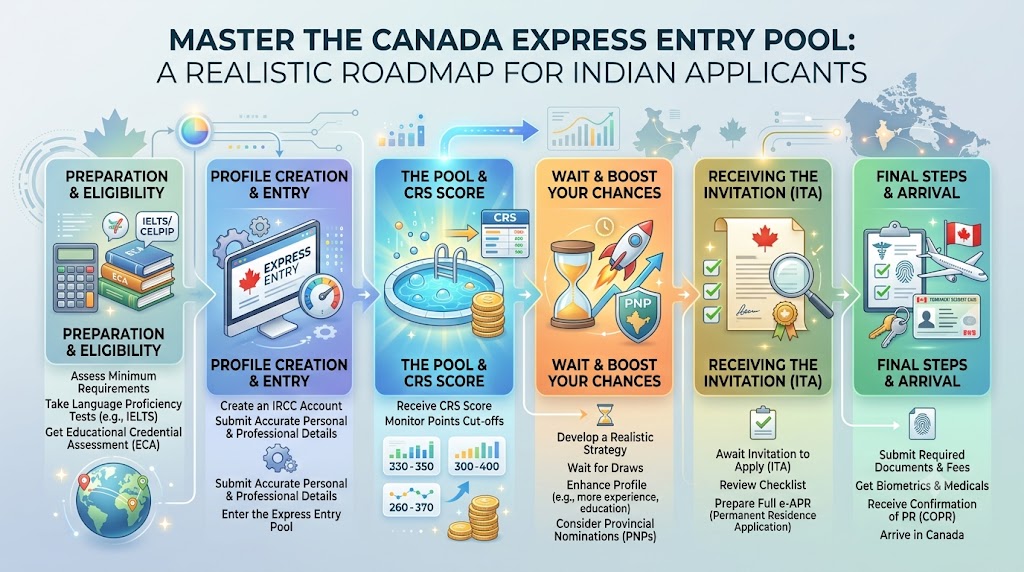
The path from evaluation to landed PR status follows a structured sequence:
[1. Test & ECA] ──> [2. Submit Profile] ──> [3. Receive ITA] ──> [4. e-APR Submission] ──> [5. COPR Issued]
- Complete Credentials & Testing: Take an official language test (aiming for CLB 9: IELTS Listening 8.0, Reading 7.0, Writing 7.0, Speaking 7.0) and secure your ECA report through agencies like WES or IQAS.
- Submit Profile to the Pool: Enter your validated language scores, education assessment numbers, and work history into the IRCC portal. Your profile stays live for 12 months.
- Receive an Invitation to Apply (ITA): If your profile score meets or exceeds the cutoff in an IRCC draw, you are formally invited to submit a full application.
- Submit Electronic APR (e-APR): You have a strict 60-day window post-ITA to upload detailed background records, pay official government fees, submit biometrics, and upload medical clearance.
- Get Final Clearance (COPR): Once your application is reviewed and approved, IRCC grants a Confirmation of Permanent Residence (COPR) and a passport entry visa counterfoil.
Critical Document Requirements
Incomplete or inconsistent documentation is a top cause of application delays or outright rejections. Ensure every claim in your profile is backed by official evidence.
- Valid International Passport: Must be valid for all accompanying family members.
- Language Testing Documentation: Score sheets must be less than two years old at the time of e-APR submission.
- ECA Credential Certificate: Official evaluation report validating your degree equivalency.
- Employment Reference Letters: Detailed letters on official company letterheads outlining exact job titles, NOC-matched responsibilities, weekly working hours, start/end dates, and detailed compensation structure.
- Settlement Fund Evidence: Official bank letters printed on bank letterhead disclosing current account balances, account tenure, debt obligations, and a mandatory 6-month average balance history.
- Police Clearance Certificates (PCC): Issued by police authorities for every country where you have lived for six consecutive months or longer since turning 18.
- Upfront Medical Examination: Completed by an authorized IRCC Panel Physician.
Key Program Comparison
Selecting the right immigration route depends on your current work location, credentials, and adaptation factors:
| Feature / Metric | Federal Skilled Worker (FSWP) | Canadian Experience Class (CEC) | Provincial Nominee Program (PNP) |
| Primary Target | Global professionals living outside Canada | Workers with inside-Canada employment | Candidates meeting regional workforce demands |
| Work Requirement | 1 year continuous (Global) | 1 year (Canadian, authorized) | Varies according to provincial stream rules |
| Language Threshold | CLB 7 (IELTS 6.0 across all bands) | CLB 7 (TEER 0/1) or CLB 5 (TEER 2/3) | Varies by stream (typically CLB 4 to CLB 7) |
| Settlement Funds | Mandatory proof required | Exempt from liquid fund checks | Required in most provincial streams |
| CRS System Advantage | Direct entry route to pool | Lower CRS thresholds in CEC-only draws | +600 Point Boost directly added to score |
Government Fees and Settlement Financials
Planning your budget accurately prevents financial surprises during the submission phase.
IRCC Government Processing Fees (CAD)
- Primary Applicant Processing Fee: $990
- Right of Permanent Residence Fee (RPRF): $600
- Spousal / Partner Fees: $990 (Processing) + $600 (RPRF) = $1,590
- Dependent Child Fee: $270 per child
- Biometrics Fee: $85 (Single) or $170 (Family)
Minimum Proof of Settlement Funds (CAD)
Unless you hold a valid, authorized Canadian job offer or qualify under CEC, you must demonstrate liquid, accessible unencumbered funds:
- Single Applicant: $15,263
- Two-Member Household: $19,001
- Three-Member Household: $23,360
- Four-Member Household: $28,362
(Note: Real estate valuations, personal loans, or illiquid assets cannot be used as proof of settlement funds).
Proven Tactics to Boost Your CRS Score
If your baseline CRS score sits below recent general selection cutoffs, leverage these strategies to elevate your standing:
- Target the “8-7-7-7” IELTS Benchmark: Hitting CLB 9 (Listening 8.0, Reading 7.0, Writing 7.0, Speaking 7.0) maxes out skill transferability points, often boosting your overall score by 30 to 50 points.
- Pursue Provincial Nominations (PNP): Keep an eye on targeted provincial notifications (like Ontario’s Tech Draws or Alberta’s Express Entry stream). A provincial nomination adds 600 points to your profile, guaranteeing an ITA.
- Develop French Language Competency: Achieving NCLC 7 in French grants up to 50 additional bonus points and makes you eligible for specialized French category-based draws with lower score cutoffs.
- Add Post-Secondary Qualifications: Completing a second post-secondary certificate, diploma, or Master’s degree increases points under both education and transferability combinations.
Practical Profile Case Study
Here is how strategic profile building works in practice:
Example: Priya is a 29-year-old Senior Systems Analyst in Hyderabad holding a Master’s degree and four years of IT experience.
- Age (29): 110 points
- Education (Master’s Degree): 135 points
- Language (IELTS CLB 9 – 8/7/7/7): 116 points
- Foreign Experience + High Language Score: 50 points (Skill Transferability)
- Education + High Language Score: 50 points (Skill Transferability)
Base CRS Score: ~461 Points.
Action Plan: Because general draw cutoffs may fluctuate higher, Priya opts to apply for the Ontario Immigrant Nominee Program (OINP) Human Capital Priorities stream, which routinely invites IT profiles. Securing this nomination adds +600 points, boosting her final CRS score to 1,061.
Common Application Pitfalls
- Mismatched NOC Job Duties: Choosing an NOC code based solely on your corporate title rather than matching the official lead statement and duty descriptions is a primary cause of rejection.
- Inadequate Work Reference Letters: Submitting reference letters that lack crucial details—such as breakdown of working hours, salary details, or specific job duties—often leads to file refusal.
- Unexplained Bank Deposits: Sudden cash deposits made right before filing your proof of funds letter raise red flags. Large funds must be accompanied by evidence showing their origin, such as a formal gift deed from family members.
- Failing to Disclose Prior Visa Refusals: Hiding past visa refusals from Canada or any other country can lead to an immediate refusal and a 5-year misrepresentation ban.
Actionable Takeaways
- Order Educational Assessments Early: Initiate your ECA process early to avoid delays caused by university document verification.
- Format Employer Letters Correctly: Ensure reference letters are printed on official company letterhead, clearly detailing your duties, weekly hours, and compensation.
- Maintain Buffer Settlement Funds: Keep a buffer above minimum settlement fund requirements to account for exchange rate fluctuations during processing.
- Review Information Against Official Portals: Verify all requirements against official IRCC guidelines, and connect with peer groups on platforms like DesiNRI for community context.
Frequently Asked Questions (FAQs)
1. Is a job offer mandatory for Canada Express Entry?
No. You do not need a Canadian job offer to enter or be selected from the Express Entry pool through the Federal Skilled Worker Program or Canadian Experience Class.
2. How long does it take IRCC to process a PR application post-ITA?
IRCC aims to process the majority of complete electronic applications within six months from the final submission date.
3. What is the validity period of an ECA report?
An Educational Credential Assessment (ECA) report is valid for five years from its issue date for Canadian immigration purposes.
4. Can I use fixed deposits (FDs) as proof of settlement funds?
Yes, fixed deposits are accepted by IRCC as long as the bank letter confirms the funds are liquid and can be withdrawn without restriction at any time.
5. How long are IELTS score reports valid for Express Entry?
Language test results remain valid for two years from the test date. They must be valid both when entering the pool and when submitting your final e-APR.
6. Does having a sibling in Canada increase my CRS score?
Yes. Having a sibling who is at least 18 years old, living in Canada, and holds Canadian PR or citizenship awards 15 bonus CRS points.
7. What happens if my Express Entry profile expires after 12 months?
If you do not receive an ITA within 12 months, your profile expires. You can create and submit a new profile immediately without penalty.
8. Are loans accepted as proof of settlement funds?
No. Borrowed money or personal bank loans are strictly prohibited from being used as proof of settlement funds.
9. Can I include my family members on my PR application?
Yes, you can include your legal spouse or common-law partner and dependent children under the age of 22 on your primary PR application.
10. Where can Indian applicants connect with experienced expats?
Expatriates and prospective applicants can join discussions on platforms like DesiNRI to share practical relocation experiences, ask questions, and learn from others who have navigated the process.
Conclusion
Navigating Canada Permanent Residency through Express Entry requires meticulous planning, accurate documentation, and proactive profile management. Understanding how your credentials translate into Comprehensive Ranking System points allows you to optimize your profile, pursue relevant Provincial Nominations, and target specialized category draws.Because immigration rules, financial thresholds, and draw criteria are updated periodically by IRCC, candidates should regularly verify details on official government channels. Using a data-backed approach alongside real-world community insights from platforms like DesiNRI will keep your relocation journey organized, realistic, and successful.
Leave a Reply